Fund for Scientific Research Flanders (FWO), Brussels, Belgium.
Int J Behav Nutr Phys Act. 2010 Dec 8;7:87. doi: 10.1186/1479-5868-7-87.
Since physical activity levels in older adolescents have the potential to be increased by stimulating active transportation to school (ATS), the most important correlates of ATS should be determined before developing interventions, especially in those adolescents for whom the distance to school is feasible for active commuting. The main aims of this study were to determine criterion distances for ATS in Belgian older adolescents, to examine multidimensional correlates of ATS in adolescents living within a feasible distance from school and to investigate the associations of ATS with total physical activity and with other physical activities besides ATS.
In total, 1281 older adolescents (17-18 years) from 20 general secondary schools in East- and West-Flanders completed a questionnaire on physical activity behaviors, demographic factors and psychosocial and physical environmental correlates of physical activity. Distance to school was objectively measured using Routenet online route planner.
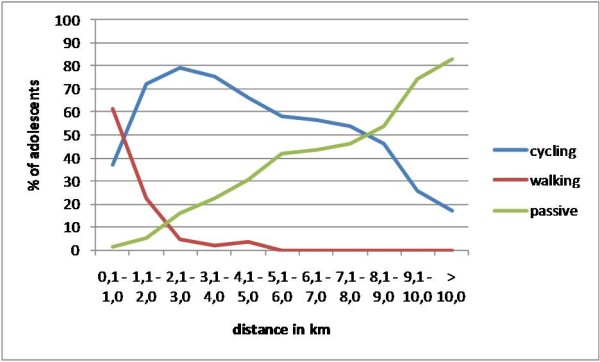
In total, 58.4% of the participants commuted actively to school. The criterion distance for ATS could be set at eight kilometers for cycling and two kilometers for walking. For those adolescents living within a feasible distance for ATS, gender, smoking status, walkability of the neighborhood and social modeling were associated with transportation mode choice. ATS was positively associated with total physical activity, but not significantly related to min/week of other physical activities.
For older adolescents living within eight kilometers of their school, interventions taking into account the correlates found to be related to ATS could possibly be effective to enhance ATS and to increase total physical activity levels. In the context of the overall physical activity decline in adolescence, also interventions targeting physical activity behaviors of adolescents living further away from school might be needed, but these interventions should probably emphasize alternative strategies.
由于通过刺激主动式交通上学(ATS)可以提高大龄青少年的身体活动水平,因此在制定干预措施之前,应确定与 ATS 最相关的因素,尤其是对于那些距离学校可行的青少年来说。本研究的主要目的是确定比利时大龄青少年 ATS 的标准距离,研究居住在学校可行距离内的青少年的 ATS 的多维相关因素,并探讨 ATS 与总身体活动以及除 ATS 以外的其他身体活动之间的关联。
在东佛兰德和西佛兰德的 20 所普通中学中,共有 1281 名 17-18 岁的大龄青少年完成了一份关于身体活动行为、人口统计学因素以及身体活动的心理社会和物理环境相关因素的问卷。使用 Routenet 在线路线规划器客观测量到学校的距离。
共有 58.4%的参与者选择主动上学。ATS 的标准距离可以设定为骑自行车 8 公里和步行 2 公里。对于居住在 ATS 可行距离内的青少年,性别、吸烟状况、邻里可步行性和社会榜样作用与交通方式选择有关。ATS 与总身体活动呈正相关,但与每周 min/分钟的其他身体活动没有显著关系。
对于居住在学校 8 公里以内的大龄青少年来说,考虑到与 ATS 相关的因素的干预措施可能会有效提高 ATS 和增加总身体活动水平。在青少年整体身体活动下降的背景下,可能还需要针对居住在离学校更远的青少年的身体活动行为的干预措施,但这些干预措施可能需要强调替代策略。