Department of Pathology and Medical Biology, University Medical Center Groningen, University of Groningen, Groningen, the Netherlands.
BMC Pulm Med. 2010 Dec 13;10:64. doi: 10.1186/1471-2466-10-64.
Smoking is the major etiologic factor in COPD, yet the exact underlying pathogenetic mechanisms have not been elucidated. Since a few years, there is mounting evidence that a specific immune response, partly present as an autoimmune response, contributes to the pathogenesis of COPD. Increased levels of anti-Hep-2 epithelial cell and anti-elastin autoantibodies as well as antibodies against airway epithelial and endothelial cells have been observed in COPD patients. Whether the presence of these autoantibodies contributes to the pathogenesis of COPD is unclear.
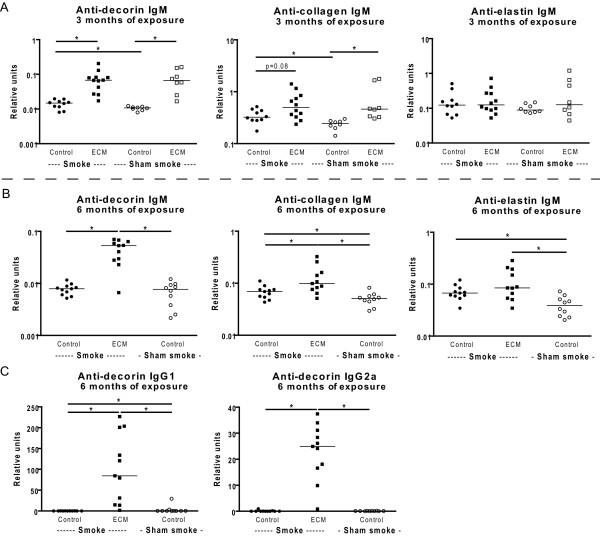
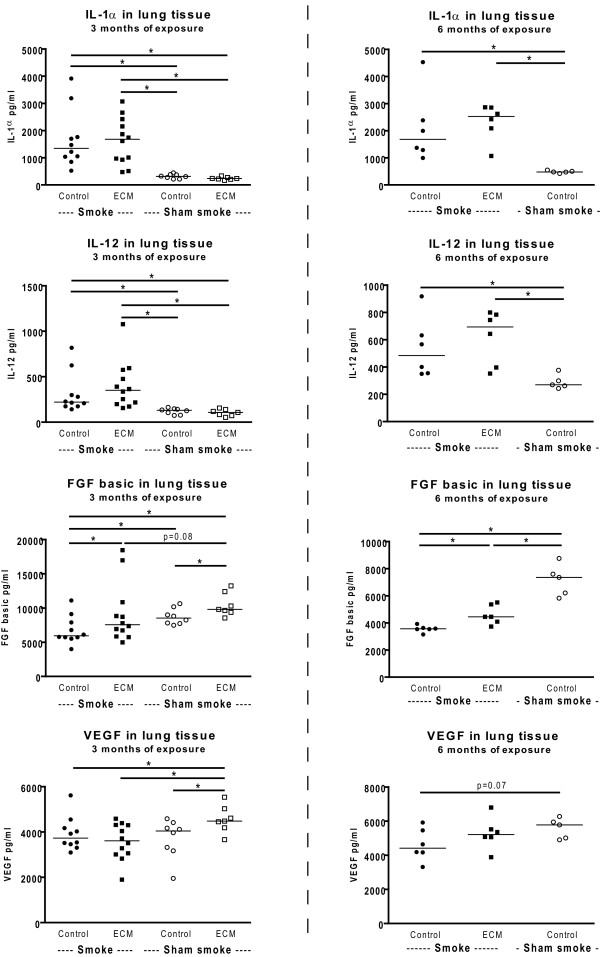
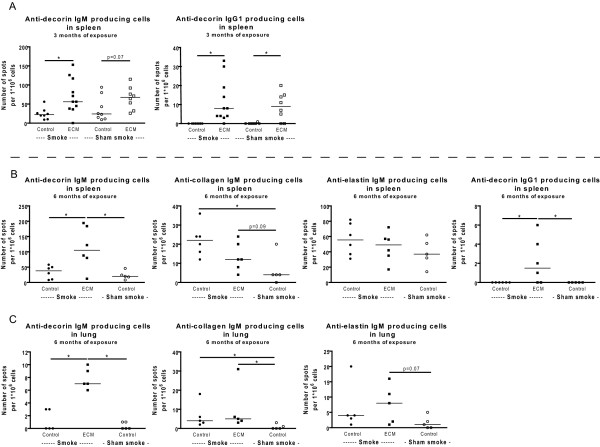
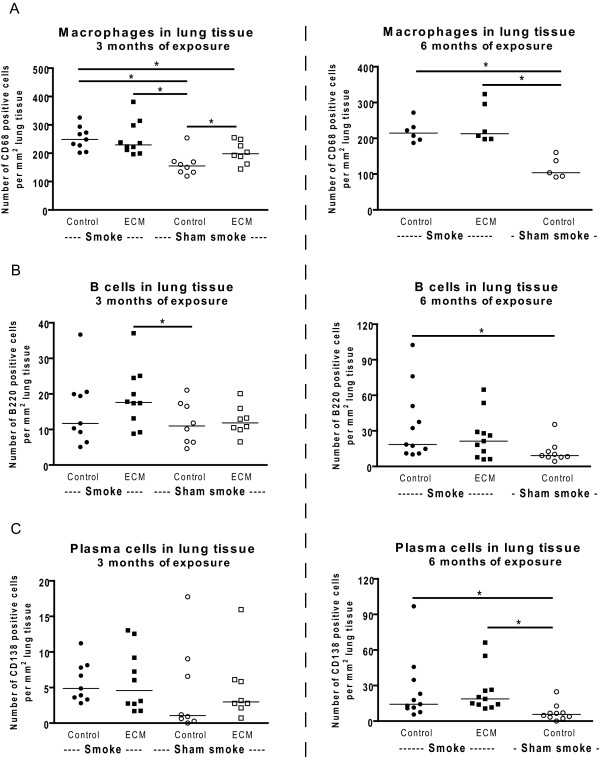
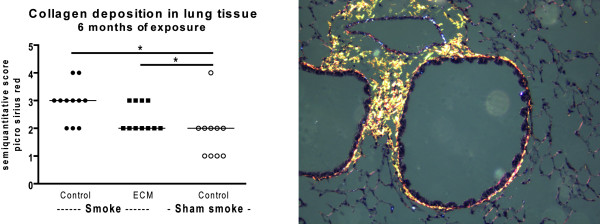
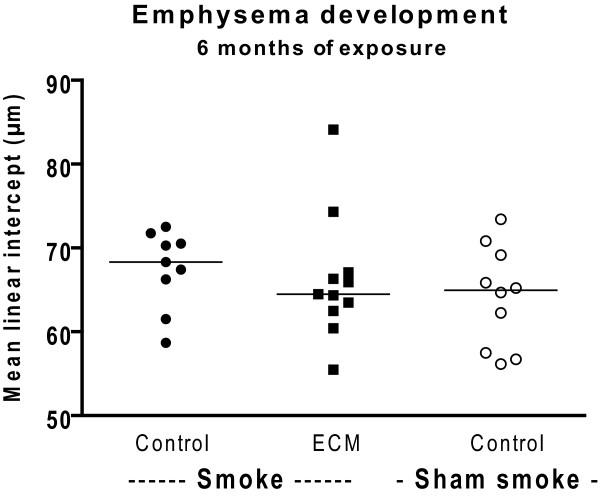
To test whether induction of autoantibodies against lung matrix proteins can augment the smoke-induced inflammatory response, we immunized mice with a mixture of the lung extracellular matrix (ECM) proteins elastin, collagen, and decorin and exposed them to cigarette smoke for 3 or 6 months. To evaluate whether the immunization was successful, the presence of specific antibodies was assessed in serum, and presence of specific antibody producing cells in spleen and lung homogenates. In addition, the presence of inflammatory cells and cytokines was assessed in lung tissue and emphysema development was evaluated by measuring the mean linear intercept.
We demonstrated that both ECM immunization and smoke exposure induced a humoral immune response against ECM proteins and that ECM immunization itself resulted in increased macrophage numbers in the lung. The specific immune response against ECM proteins did not augment the smoke-induced inflammatory response in our model.
By demonstrating that smoke exposure itself can result in a specific immune response and that presence of this specific immune response is accompanied by an influx of macrophages, we provide support for the involvement of a specific immune response in the smoke-induced inflammatory response as can be seen in patients with COPD.
吸烟是 COPD 的主要病因,但确切的发病机制尚未阐明。近年来,越来越多的证据表明,特定的免疫反应(部分表现为自身免疫反应)有助于 COPD 的发病机制。COPD 患者的血清中观察到抗 Hep-2 上皮细胞和抗弹性蛋白自身抗体以及针对气道上皮和内皮细胞的抗体水平升高。这些自身抗体的存在是否有助于 COPD 的发病机制尚不清楚。
为了测试针对肺基质蛋白的自身抗体的诱导是否可以增强吸烟引起的炎症反应,我们用弹性蛋白、胶原蛋白和饰胶蛋白等肺细胞外基质 (ECM) 蛋白混合物免疫小鼠,并将其暴露于香烟烟雾中 3 或 6 个月。为了评估免疫是否成功,我们在血清中评估了特定抗体的存在,在脾和肺匀浆中评估了特定抗体产生细胞的存在。此外,还评估了肺组织中的炎症细胞和细胞因子的存在,并通过测量平均线性截距评估肺气肿的发展。
我们证明 ECM 免疫和吸烟暴露均可诱导针对 ECM 蛋白的体液免疫反应,并且 ECM 免疫本身可导致肺中巨噬细胞数量增加。针对 ECM 蛋白的特异性免疫反应并未增强我们模型中的吸烟引起的炎症反应。
通过证明吸烟暴露本身可以引起特异性免疫反应,并且这种特异性免疫反应伴随着巨噬细胞的涌入,我们为特异性免疫反应参与 COPD 患者中所见的吸烟引起的炎症反应提供了支持。