Medical Research Council, Cognition and Brain Sciences Unit, Cambridge, UK.
Brain Res. 2011 Feb 10;1373(2):110-23. doi: 10.1016/j.brainres.2010.11.086. Epub 2010 Dec 8.
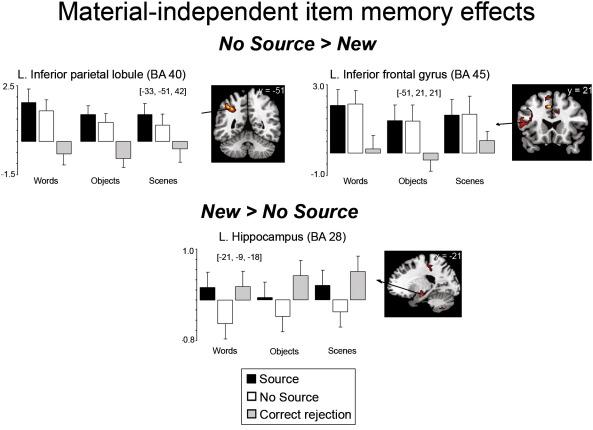
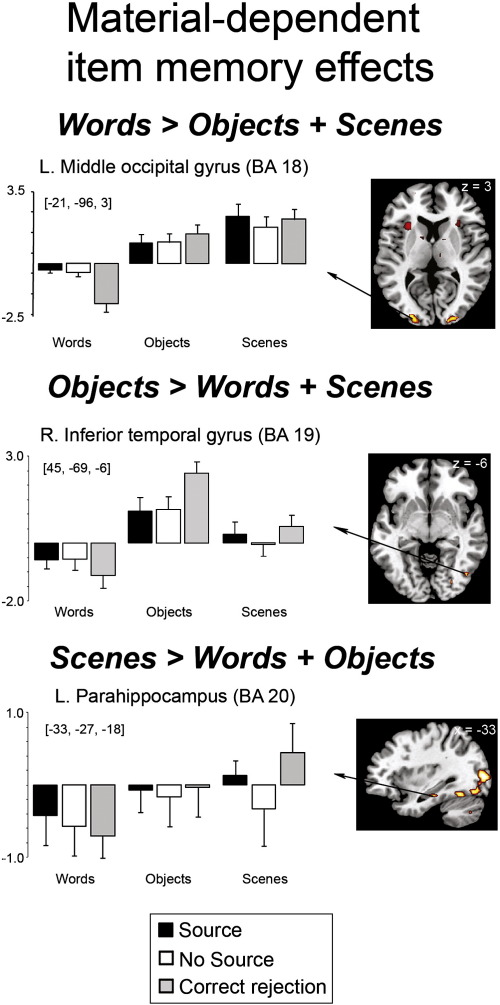
It has been suggested that several regions of the brain, including subregions of the medial temporal lobe (MTL) and the posterior parietal cortex, contribute to source memory success in a material-general manner, with most models highlighting the importance of memory process rather than material type. For the MTL in particular, however, increasing evidence suggests that MTL subregions may be specialized for processing different materials, raising the possibility that source memory-related activity may be material-sensitive. Previous fMRI studies have not directly compared source memory activity for different categories of stimuli, and it remains unclear whether source memory effects, in the MTL or elsewhere, are influenced by material. To investigate this issue, young participants were scanned during study while they made semantic judgments about words, pictures of objects and scenes, and during test when they retrieved the context (source) in which these items were studied. Several regions, including the hippocampi, medial and lateral parietal cortex, exhibited source memory effects common to words, objects and scenes, at both study and test. Material-dependent source memory effects were also identified in the left posterior inferior frontal and left perirhinal cortex for words and objects, respectively, at study but not test. These results offer direct support for the hypothesis that the MTL and posterior parietal cortex make material-general contributions to recollection. These results also point to a dissociation between encoding and retrieval with regard to the influence of material on the neural correlates of source memory accuracy, supporting the idea that a relatively small proportion of the activity elicited by a stimulus during encoding is incorporated into an episodic memory representation of the stimulus.
有人认为,大脑的几个区域,包括内侧颞叶(MTL)的亚区和后顶叶皮层,以材料普遍的方式有助于源记忆的成功,大多数模型都强调记忆过程而不是材料类型的重要性。然而,对于 MTL 来说,越来越多的证据表明,MTL 的亚区可能专门用于处理不同的材料,这增加了源记忆相关活动可能对材料敏感的可能性。以前的 fMRI 研究没有直接比较不同类别的刺激的源记忆活动,并且仍然不清楚源记忆效应,无论是在 MTL 还是其他地方,是否受到材料的影响。为了研究这个问题,年轻的参与者在学习时接受扫描,同时对单词、物体和场景的图片进行语义判断,在测试时回忆这些项目的上下文(来源)。几个区域,包括海马体、内侧和外侧顶叶皮层,在学习和测试时都表现出对单词、物体和场景的源记忆效应。在学习时,但不在测试时,还在左侧后下额叶和左侧边缘回皮层中发现了与单词和物体相关的材料依赖性源记忆效应。这些结果直接支持了 MTL 和后顶叶皮层对回忆做出材料普遍贡献的假设。这些结果还表明,在材料对源记忆准确性的神经相关物的影响方面,存在编码和检索之间的分离,支持这样一种观点,即刺激在编码过程中引起的活动的相对较小比例被纳入刺激的情节记忆表示中。