Yong Phaik Har, Zong Hongliang, Medina Reinhold J, Limb G Astrid, Uchida Koji, Stitt Alan W, Curtis Tim M
Centre for Vision and Vascular Science, The Queen's University of Belfast, Institute of Clinical Sciences, The Royal Victoria Hospital, Grosvenor Road, Belfast, Northern Ireland.
Mol Vis. 2010 Dec 2;16:2524-38.
Recent evidence suggests that neuroglial dysfunction and degeneration contributes to the etiology and progression of diabetic retinopathy. Advanced lipoxidation end products (ALEs) have been implicated in the pathology of various diseases, including diabetes and several neurodegenerative disorders. The purpose of the present study was to investigate the possible link between the accumulation of ALEs and neuroretinal changes in diabetic retinopathy.
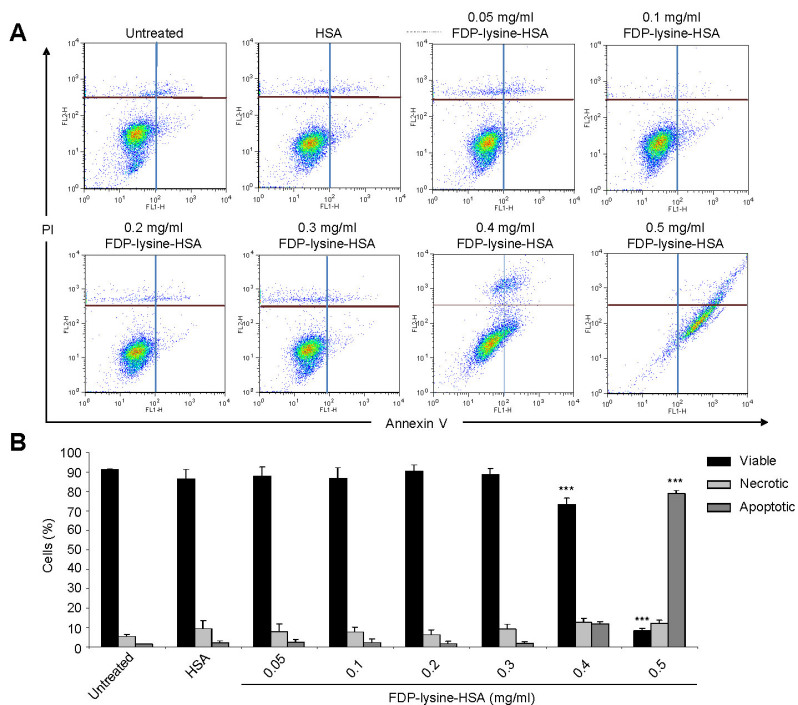
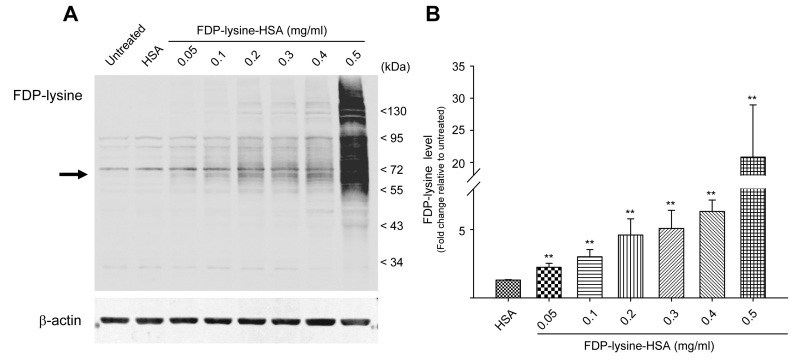
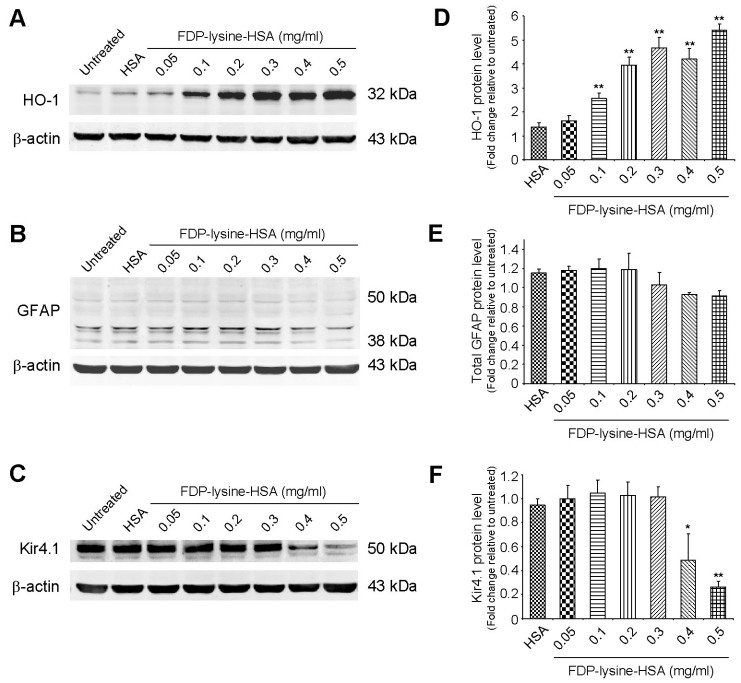
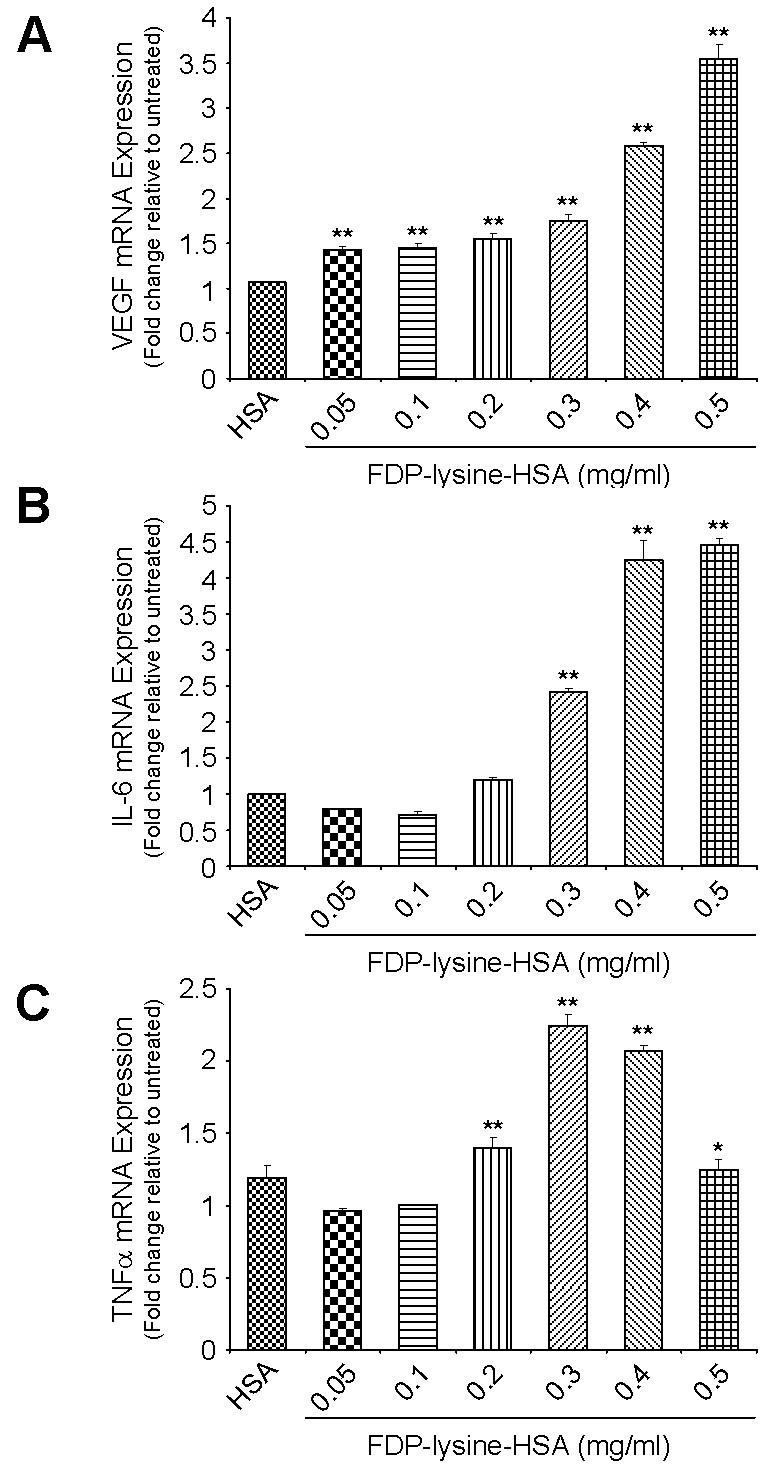
Retinal sections obtained from diabetic rats and age-matched controls were processed for immunohistochemistry using antibodies against several well defined ALEs. In vitro experiments were also performed using a human Müller (Moorfields/Institute of Ophthalmology-Müller 1 [MIO-M1]) glia cell line. Western blot analysis was used to measure the accumulation of the acrolein-derived ALE adduct Nε-(3-formyl-3,4-dehydropiperidino)lysine (FDP-lysine) in Müller cells preincubated with FDP-lysine-modified human serum albumin (FDP-lysine-HSA). Responses of Müller cells to FDP-lysine accumulation were investigated by analyzing changes in the protein expression of heme oxygenase-1 (HO-1), glial fibrillary acidic protein (GFAP), and the inwardly rectifying potassium channel Kir4.1. In addition, mRNA expression levels of vascular endothelial growth factor (VEGF), interleukin-6 (IL-6), and tumor necrosis factor-α (TNFα) were determined by reverse transcriptase PCR (RT-PCR). Apoptotic cell death was evaluated by fluorescence-activated cell sorting (FACS) analysis after staining with fluorescein isothiocyanate (FITC)-labeled annexin V and propidium iodide.
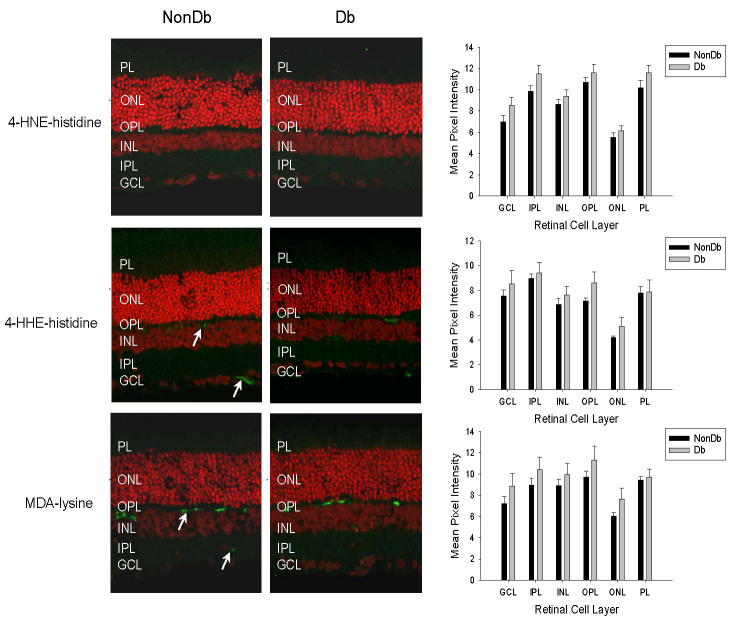
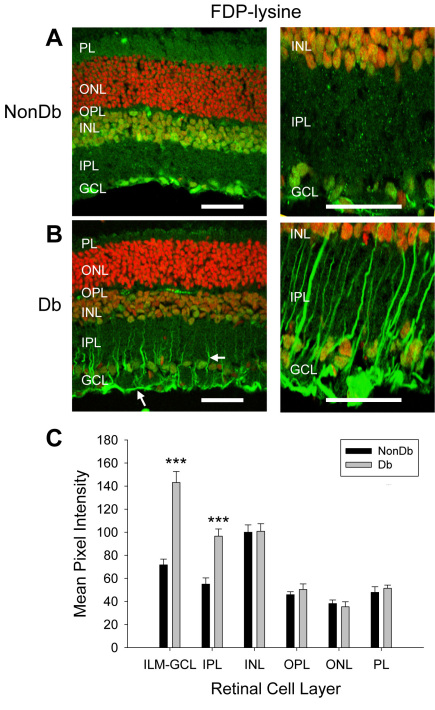
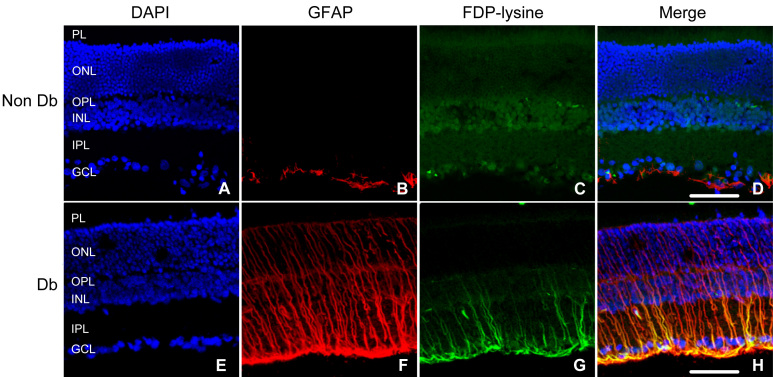
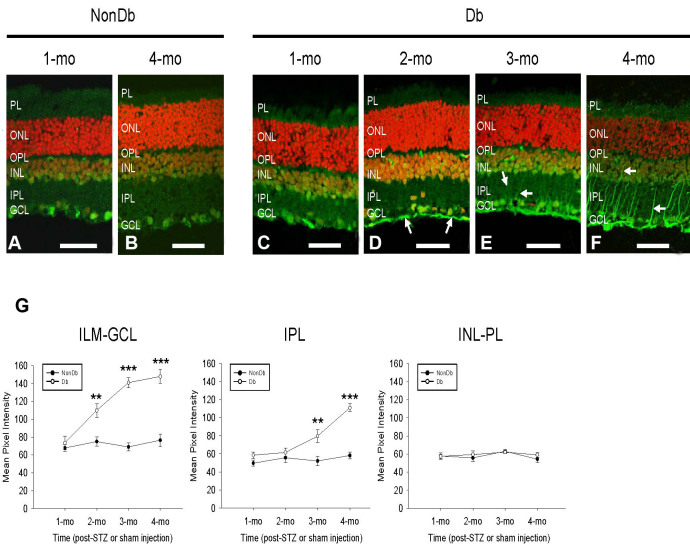
No significant differences in the levels of malondialdehyde-, 4-hydroxy-2-nonenal-, and 4-hydroxyhexenal-derived ALEs were evident between control and diabetic retinas after 4 months of diabetes. By contrast, FDP-lysine immunoreactivity was markedly increased in the Müller glia of diabetic rats. Time-course studies revealed that FDP-lysine initially accumulated within Müller glial end feet after only a few months of diabetes and thereafter spread distally throughout their inner radial processes. Exposure of human Müller glia to FDP-lysine-HSA led to a concentration-dependent accumulation of FDP-lysine-modified proteins across a broad molecular mass range. FDP-lysine accumulation was associated with the induction of HO-1, no change in GFAP, a decrease in protein levels of the potassium channel subunit Kir4.1, and upregulation of transcripts for VEGF, IL-6, and TNF-α. Incubation of Müller glia with FDP-lysine-HSA also caused apoptosis at high concentrations.
Collectively, these data strongly suggest that FDP-lysine accumulation could be a major factor contributing to the Müller glial abnormalities occurring in the early stages of diabetic retinopathy.
近期证据表明,神经胶质功能障碍和变性在糖尿病性视网膜病变的病因学和进展过程中发挥作用。晚期糖基化终末产物(ALEs)与包括糖尿病和几种神经退行性疾病在内的多种疾病的病理过程相关。本研究的目的是探讨糖尿病性视网膜病变中ALEs积累与神经视网膜变化之间的可能联系。
使用针对几种明确的ALEs的抗体,对从糖尿病大鼠和年龄匹配的对照大鼠获得的视网膜切片进行免疫组织化学处理。还使用人Müller(摩尔菲尔德眼科医院/眼科研究所-Müller 1 [MIO-M1])胶质细胞系进行体外实验。蛋白质印迹分析用于测量用FDP-赖氨酸修饰的人血清白蛋白(FDP-赖氨酸-HSA)预孵育的Müller细胞中丙烯醛衍生的ALE加合物Nε-(3-甲酰基-3,4-脱氢哌啶基)赖氨酸(FDP-赖氨酸)的积累。通过分析血红素加氧酶-1(HO-1)、胶质纤维酸性蛋白(GFAP)和内向整流钾通道Kir4.1的蛋白质表达变化,研究Müller细胞对FDP-赖氨酸积累的反应。此外,通过逆转录聚合酶链反应(RT-PCR)测定血管内皮生长因子(VEGF)、白细胞介素-6(IL-6)和肿瘤坏死因子-α(TNFα)的mRNA表达水平。在用异硫氰酸荧光素(FITC)标记的膜联蛋白V和碘化丙啶染色后,通过荧光激活细胞分选(FACS)分析评估凋亡细胞死亡。
糖尿病4个月后,对照视网膜和糖尿病视网膜之间丙二醛、4-羟基-2-壬烯醛和4-羟基己烯醛衍生的ALEs水平无显著差异。相比之下,糖尿病大鼠的Müller胶质细胞中FDP-赖氨酸免疫反应性明显增加。时间进程研究表明,糖尿病仅几个月后,FDP-赖氨酸最初在Müller胶质终足内积累,此后向远端扩散至其整个内侧放射状突起。人Müller胶质细胞暴露于FDP-赖氨酸-HSA导致FDP-赖氨酸修饰蛋白在广泛的分子量范围内呈浓度依赖性积累。FDP-赖氨酸积累与HO-1的诱导、GFAP无变化、钾通道亚基Kir4.1蛋白水平降低以及VEGF、IL-6和TNF-α转录本上调相关。用FDP-赖氨酸-HSA孵育Müller胶质细胞在高浓度下也会导致细胞凋亡。
总体而言,这些数据强烈表明,FDP-赖氨酸积累可能是导致糖尿病性视网膜病变早期出现Müller胶质细胞异常的主要因素。