Psychology Department, University of Toronto, Toronto, Ontario, Canada.
PLoS One. 2010 Dec 7;5(12):e14241. doi: 10.1371/journal.pone.0014241.
The study of social categorization has largely been confined to examining groups distinguished by perceptually obvious cues. Yet many ecologically important group distinctions are less clear, permitting insights into the general processes involved in person perception. Although religious group membership is thought to be perceptually ambiguous, folk beliefs suggest that Mormons and non-Mormons can be categorized from their appearance. We tested whether Mormons could be distinguished from non-Mormons and investigated the basis for this effect to gain insight to how subtle perceptual cues can support complex social categorizations.
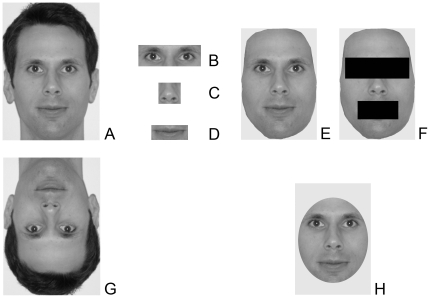
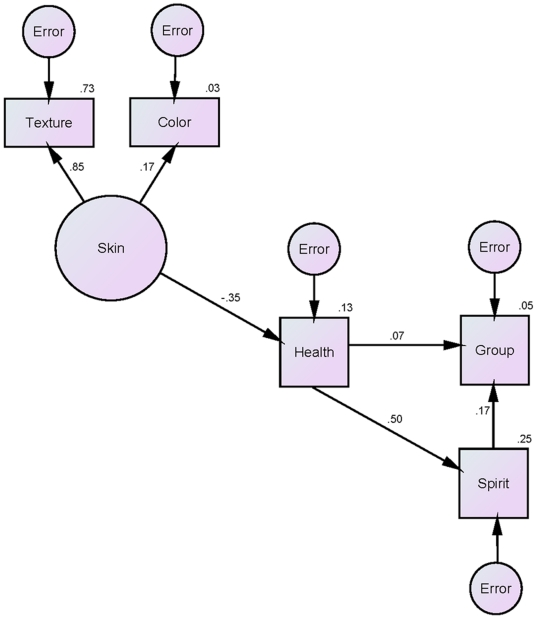
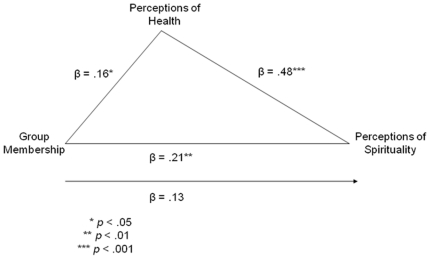
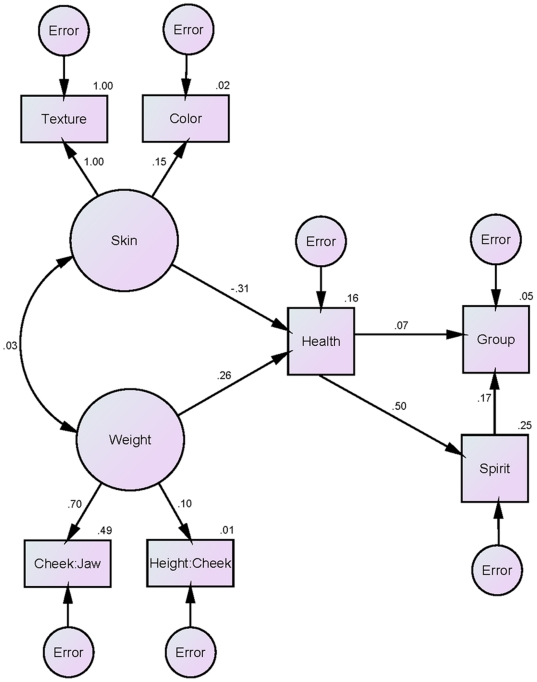
METHODOLOGY/PRINCIPAL FINDINGS: Participants categorized Mormons' and non-Mormons' faces or facial features according to their group membership. Individuals could distinguish between the two groups significantly better than chance guessing from their full faces and faces without hair, with eyes and mouth covered, without outer face shape, and inverted 180°; but not from isolated features (i.e., eyes, nose, or mouth). Perceivers' estimations of their accuracy did not match their actual accuracy. Exploration of the remaining features showed that Mormons and non-Mormons significantly differed in perceived health and that these perceptions were related to perceptions of skin quality, as demonstrated in a structural equation model representing the contributions of skin color and skin texture. Other judgments related to health (facial attractiveness, facial symmetry, and structural aspects related to body weight) did not differ between the two groups. Perceptions of health were also responsible for differences in perceived spirituality, explaining folk hypotheses that Mormons are distinct because they appear more spiritual than non-Mormons.
CONCLUSIONS/SIGNIFICANCE: Subtle markers of group membership can influence how others are perceived and categorized. Perceptions of health from non-obvious and minimal cues distinguished individuals according to their religious group membership. These data illustrate how the non-conscious detection of very subtle differences in others' appearances supports cognitively complex judgments such as social categorization.
社会分类的研究主要局限于考察通过明显的感知线索区分的群体。然而,许多生态上重要的群体差异并不明显,这使得我们能够深入了解人知觉中涉及的一般过程。尽管宗教群体成员身份被认为是模糊的,但民间信仰表明,摩门教徒和非摩门教徒可以从他们的外表进行分类。我们测试了摩门教徒是否可以与非摩门教徒区分开来,并研究了这种效果的基础,以深入了解微妙的感知线索如何支持复杂的社会分类。
方法/主要发现:参与者根据他们的群体成员身份对摩门教徒和非摩门教徒的面部或面部特征进行分类。与单纯猜测相比,个体能够显著更好地区分这两个群体,从他们的全脸和没有头发的脸、眼睛和嘴巴被遮住的脸、没有外部脸型的脸和 180°翻转的脸;但不能从孤立的特征(即眼睛、鼻子或嘴巴)中区分。感知者对自己准确性的估计与实际准确性不匹配。对剩余特征的探索表明,摩门教徒和非摩门教徒在感知健康方面存在显著差异,这些感知与皮肤质量的感知有关,这在一个代表肤色和皮肤纹理贡献的结构方程模型中得到了证明。两组之间其他与健康相关的判断(面部吸引力、面部对称性和与体重相关的结构方面)没有差异。健康感知也导致了对精神性感知的差异,这解释了民间假设,即摩门教徒与众不同,因为他们看起来比非摩门教徒更有精神性。
结论/意义:群体成员身份的细微标志可以影响他人的感知和分类。从不明显和最小的线索中感知健康可以区分个体的宗教群体成员身份。这些数据说明了如何通过对他人外表非常细微差异的非意识检测来支持复杂的认知判断,如社会分类。