School of Psychology, Open University, Milton Keynes, UK.
School of Psychology, University of Sussex, Brighton, UK.
Perception. 2020 Jun;49(6):672-687. doi: 10.1177/0301006620918100. Epub 2020 Apr 11.
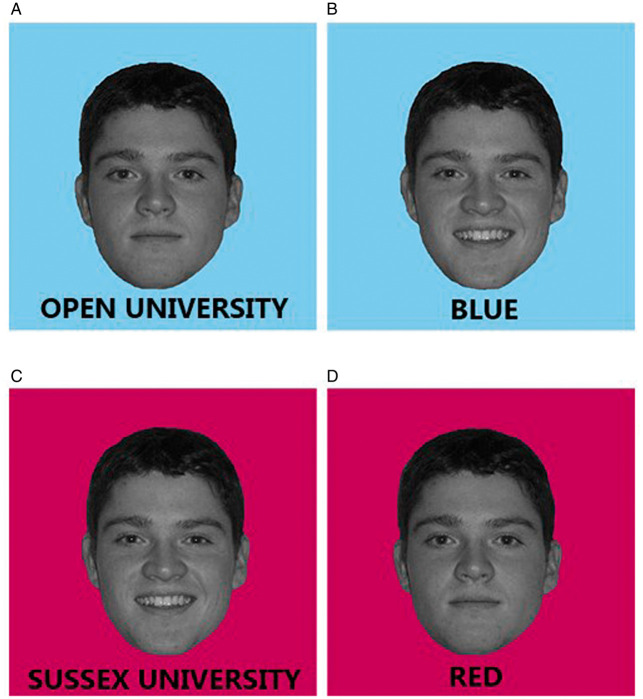
Previous research has demonstrated several own-group biases (OGBs) in face recognition, but why they occur is unclear. Social-cognitive accounts suggest they stem from differential attention and facial processing, following the categorisation of a face as belonging to an "in" or "out" group. Three studies explored whether OGBs can be produced by mere categorisation at encoding and investigated the role of in-group membership saliency on face recognition. Participants saw 40 facial images fictionally grouped according to in-/out-group status. Studies 1 and 2 used university membership as the grouping variable and found no evidence of an OGB, and no relationship between OGB magnitude and salience of group membership. Study 3 used the same design as Study 2, but with a highly salient group characteristic: participants' stance on the U.K. Referendum (i.e., whether they were "Leave" or "Remain" supporters). In this case, an asymmetrical OGB was found, with only Remain voters demonstrating an OGB. Furthermore, a relationship between OGB magnitude and attitude toward the Referendum result was found. Overall, our results suggest that social categorisation and membership saliency alone may not be enough to moderate in- and out-group face recognition. However, when sufficiently groups are used as in-/out-group categories, OGBs may occur.
先前的研究表明,人脸识别中存在多种内群体偏见(OGB),但这些偏见为何产生尚不清楚。社会认知理论认为,这些偏见源于对属于“内群体”或“外群体”的面孔的不同注意和面部处理。本研究有三项,旨在探讨仅仅在编码阶段进行分类是否会产生 OGB,并研究内群体成员显著性对人脸识别的作用。参与者观看了 40 张虚构分组的面孔图像,根据内/外群体身份进行分组。研究 1 和 2 使用大学成员资格作为分组变量,未发现 OGB 的证据,也未发现 OGB 幅度与群体成员显著性之间存在关系。研究 3 采用与研究 2 相同的设计,但使用了一个高度显著的群体特征:参与者对英国脱欧公投的立场(即他们是“脱欧”还是“留欧”支持者)。在这种情况下,发现了一个不对称的 OGB,只有留欧选民表现出 OGB。此外,还发现 OGB 幅度与对脱欧结果的态度之间存在关系。总体而言,我们的研究结果表明,仅仅进行社会分类和成员显著性可能不足以调节内群体和外群体的人脸识别。然而,当充分利用群体作为内/外群体类别时,可能会出现 OGB。