The Department of Psychological and Brain Sciences, Indiana University Bloomington, IN 47405, USA; E-Mails:
Int J Mol Sci. 2010 Oct 15;11(10):3965-76. doi: 10.3390/ijms11103965.
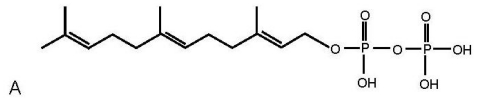
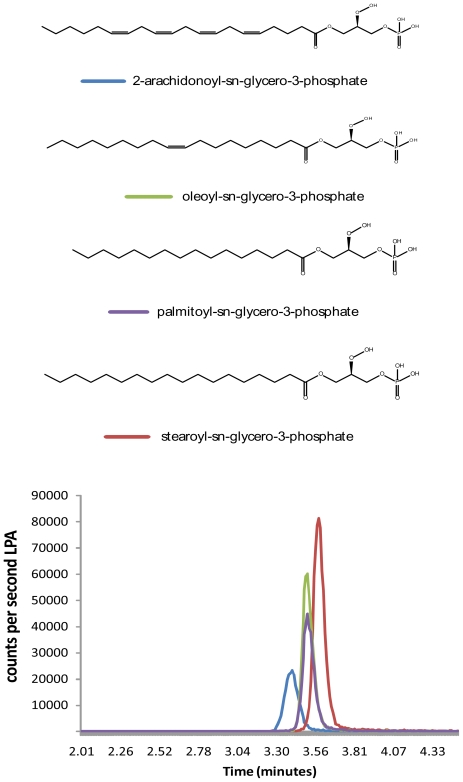
Lysophosphatidic acid (LPA) is the umbrella term for lipid signaling molecules that share structural homology and activate the family of LPA receptors. Farnesyl Pyrophosphate (FPP) is commonly known as an intermediate in the synthesis of steroid hormones; however, its function as a signaling lipid is beginning to be explored. FPP was recently shown to an activator of the G-protein coupled receptor 92 (also known as LPA5) of the calcium channel TRPV(3). The LPA receptors (including GPR92) are associated with the signal transduction of noxious stimuli, however, very little is known about the distribution of their signaling ligands (LPAs and FPP) in the brain. Here, using HPLC/MS/MS, we developed extraction and analytical methods for measuring levels of FPP and 4 species of LPA (palmitoyl, stearoyl, oleoyl and arachidonoyl-sn-glycerol-3 phosphate) in rodent brain. Relative distributions of each of the five compounds was significantly different across the brain suggesting divergent functionality for each as signaling molecules based on where and how much of each is being produced. Brainstem, midbrain, and thalamus contained the highest levels measured for each compound, though none in the same ratios while relatively small amounts were produced in cortex and cerebellum. These data provide a framework for investigations into functional relationships of these lipid ligands in specific brain areas, many of which are associated with the perception of pain.
溶血磷脂酸(LPA)是具有结构同源性并激活 LPA 受体家族的脂质信号分子的总称。法呢基焦磷酸(FPP)通常被认为是合成甾体激素的中间产物;然而,其作为信号脂质的功能开始被探索。最近的研究表明,FPP 是 G 蛋白偶联受体 92(也称为 LPA5)的激动剂,该受体属于钙通道 TRPV(3)。LPA 受体(包括 GPR92)与有害刺激的信号转导有关,然而,关于它们的信号配体(LPA 和 FPP)在大脑中的分布知之甚少。在这里,我们使用 HPLC/MS/MS 开发了提取和分析方法,用于测量啮齿动物大脑中 FPP 和 4 种 LPA(棕榈酰、硬脂酰、油酰和花生四烯酰-sn-甘油-3 磷酸)的水平。五种化合物中的每一种的相对分布在整个大脑中差异显著,表明它们作为信号分子具有不同的功能,这取决于它们在何处以及产生了多少。脑桥、中脑和丘脑含有每种化合物测量的最高水平,尽管没有一种化合物的比例相同,而皮质和小脑产生的相对较少。这些数据为研究这些脂质配体在特定脑区的功能关系提供了框架,其中许多脑区与疼痛感知有关。