Vogeltrekstation-Dutch Centre for Avian Migration and Demography, NIOO-KNAW, Heteren, The Netherlands.
Oecologia. 2011 Jun;166(2):369-79. doi: 10.1007/s00442-010-1868-x. Epub 2010 Dec 12.
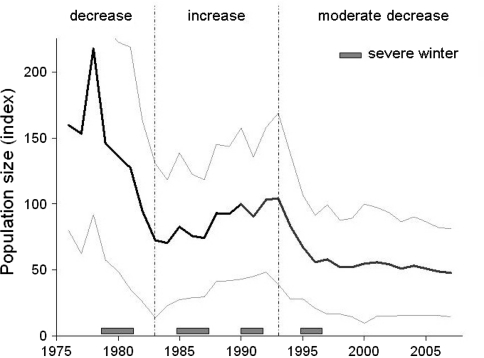
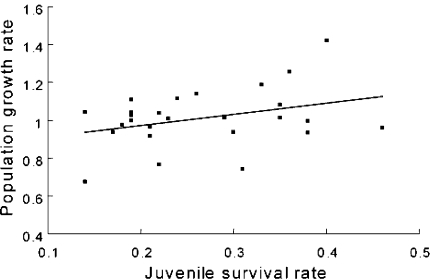
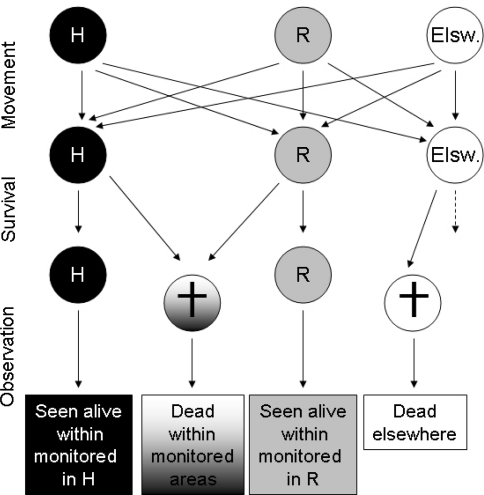
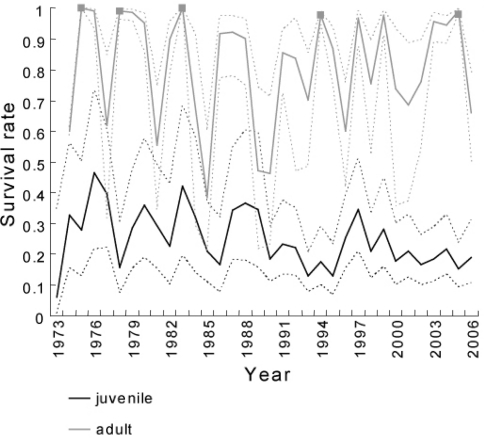
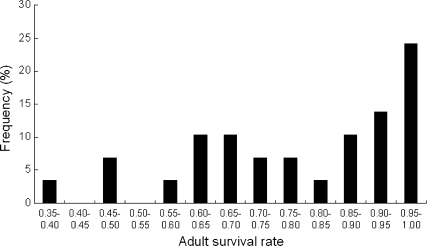
The little owl (Athene noctua) has declined significantly in many parts of Europe, including the Netherlands. To understand the demographic mechanisms underlying their decline, we analysed all available Dutch little owl ringing data. The data set spanned 35 years, and included more than 24,000 ringed owls, allowing detailed estimation of survival rates through multi-state capture-recapture modelling taking dispersal into account. We investigated geographical and temporal variation in age-specific survival rates and linked annual survival estimates to population growth rate in corresponding years, as well as to environmental covariates. The best model for estimating survival assumed time effects on both juvenile and adult survival rates, with average annual survival estimated at 0.258 (SE = 0.047) and 0.753 (SE = 0.019), respectively. Juvenile survival rates decreased with time whereas adult survival rates fluctuated regularly among years, low survival occurring about every 4 years. Years when the population declined were associated with low juvenile survival. More than 60% of the variation in juvenile survival was explained by the increase in road traffic intensity or in average temperature in spring, but these correlations rather reflect a gradual decrease in juvenile survival coinciding with long-term global change than direct causal effects. Surprisingly, vole dynamics did not explain the cyclic dynamics of adult survival rate. Instead, dry and cold years led to low adult survival rates. Low juvenile survival rates, that limit recruitment of first-year breeders, and the regular occurrence of years with poor adult survival, were the most important determinants of the population decline of the little owl.
欧洲许多地区,包括荷兰,角鸮的数量都明显减少。为了了解导致其减少的人口机制,我们分析了所有可用的荷兰角鸮环志数据。该数据集跨越 35 年,包括 24000 多只环志猫头鹰,允许通过多状态捕获-再捕获模型进行详细的生存率估计,该模型考虑了扩散。我们研究了年龄特定生存率的地理和时间变化,并将年度生存率估计值与相应年份的种群增长率以及环境协变量联系起来。估计生存率的最佳模型假设时间对幼鸟和成年鸟的生存率都有影响,平均年生存率估计为 0.258(SE=0.047)和 0.753(SE=0.019)。幼鸟的生存率随时间下降,而成年鸟的生存率在年间有规律地波动,大约每 4 年出现一次低生存率。种群下降的年份与低幼鸟生存率有关。幼鸟生存率的 60%以上的变化可以用道路交通强度或春季平均温度的增加来解释,但这些相关性更多地反映了与长期全球变化相吻合的幼鸟生存率的逐渐下降,而不是直接的因果效应。令人惊讶的是,田鼠动态并不能解释成年生存率的周期性变化。相反,干旱和寒冷的年份会导致成年鸟的生存率降低。低幼鸟生存率,限制了第一年繁殖者的招募,以及成年鸟生存率差的年份的定期出现,是角鸮种群减少的最重要决定因素。