Harri Merisaari, Mika Teras, Jussi Hirvonen, Nevalainen Olli S, Jarmo Hietala
Turku PET Centre, University of Turku / Turku University Central Hospital, Turku, Finland.
J Med Phys. 2007 Jul;32(3):108-17. doi: 10.4103/0971-6203.35723.
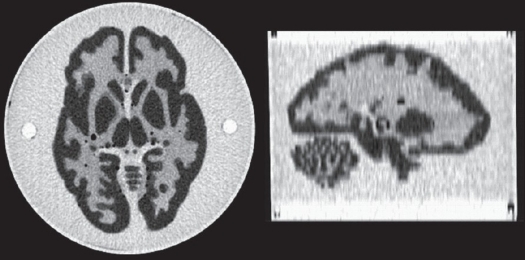
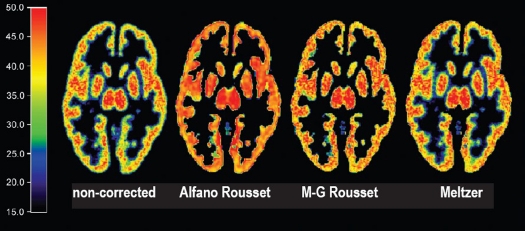
Quantitative accuracy of positron emission tomography (PET) is decreased by the partial volume effect (PVE). The PVE correction (PVC) methods proposed by Alfano et al., Rousset et al., Müller-Gärtner et al. and Meltzer et al. were evaluated in the present study to obtain guidelines for selecting among them. For accuracy evaluation, the Hoffman brain phantom was scanned with three PETs of differing spatial resolution in order to measure the effect of PVC on radioactivity distribution. Test-retest data consisting of duplicate dynamic emission recordings of the dopamine D2-receptor ligand [(11)C] raclopride obtained in eight healthy control subjects were used to test the correction effect in different regions of interest. The PVC method proposed by Alfano et al. gave the best quantification accuracy in the brain gray matter region. When the effect of PVC on reliability was tested with human data, the method of Meltzer et al. proved to be the most reliable. The method by Alfano et al. may be better for group comparison studies and the method by Meltzer et al. for intra-subject drug-effect studies.
正电子发射断层扫描(PET)的定量准确性会因部分容积效应(PVE)而降低。本研究对Alfano等人、Rousset等人、Müller-Gärtner等人以及Meltzer等人提出的PVE校正(PVC)方法进行了评估,以便为在这些方法中进行选择提供指导。为了评估准确性,使用具有不同空间分辨率的三台PET对霍夫曼脑模体进行扫描,以测量PVC对放射性分布的影响。由八名健康对照受试者获得的多巴胺D2受体配体[(11)C]雷氯必利的重复动态发射记录组成的重测数据,用于测试不同感兴趣区域的校正效果。Alfano等人提出的PVC方法在脑灰质区域给出了最佳的定量准确性。当用人的数据测试PVC对可靠性的影响时,Meltzer等人的方法被证明是最可靠的。Alfano等人的方法可能更适合用于组间比较研究,而Meltzer等人的方法则更适合用于个体内药物效应研究。