Institute of Pathology, REPAIR-Lab, Johannes Gutenberg University, Langenbeckstr. 1, 55101 Mainz, Germany.
Eur J Med Res. 2010 Nov 25;15(11):483-92. doi: 10.1186/2047-783x-15-11-483.
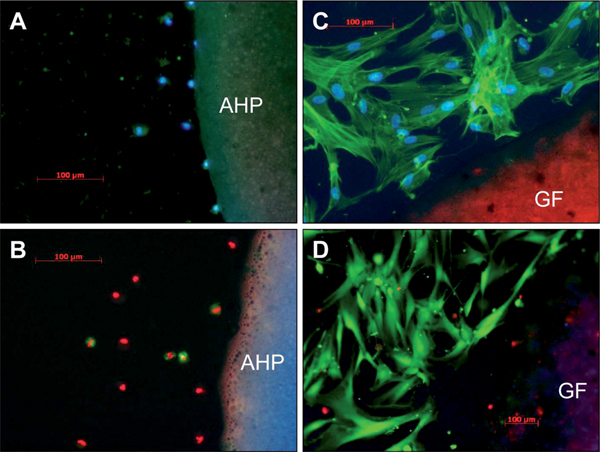
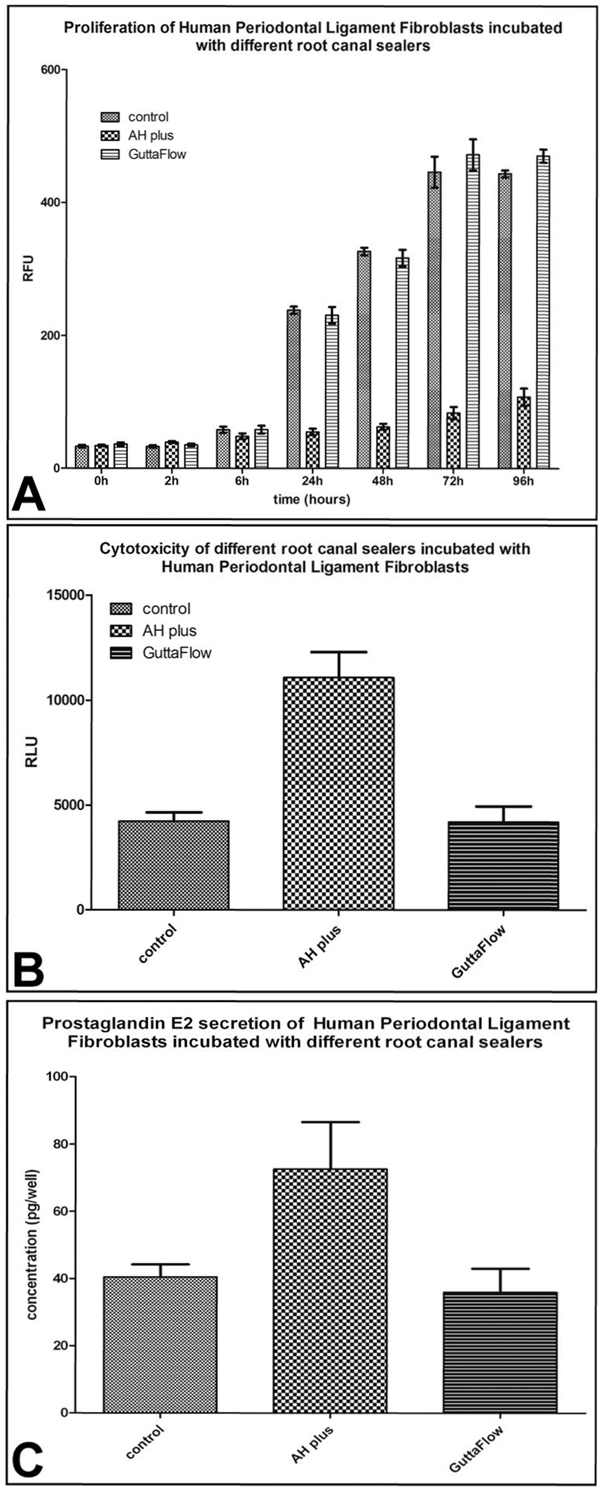
The biodegradability of root canal sealers in areas other than the root canal system is crucial to the overall success rate of endodontic treatment. The aim of the present study was to investigate, the cell and tissue reaction to GuttaFlow and AHPlus, both in vitro and in vivo. For the in vitro experiments the materials were incubated with Human Periodontal Ligament Fibroblasts and cell proliferation and cytotoxicity analyses were performed. Additional fluorescence-microscope stainings were carried out in order to visualize cell growth and morphology. For assessment of the tissue reaction to the materials a subcutaneous implantation model in Wistar rats was employed and the inflammatory response to the materials was visualized by means of general and specific histology after 6 weeks. Human gingival fibroblasts proliferation seemed to be dependent upon dental material and cultivation time. After an incubation period of 96 hrs AHPlus proved to be significantly (p<0.002) more cytotoxic than GuttaFlow, as only a small number of fibroblasts survived on AHPlus. In vivo, GuttaFlow was surrounded by a fibrous capsule and no degradation took place, while AHPlus induced a well-vascularized granulation tissue in which the material was phagocyted by macrophages. The results of this study demonstrate that a potential cytotoxic effect of a sealing material may beneficial in order to have antibacterial properties and induce self degradation when accidentally extruded over the apical foramen.
根管封闭剂在根管系统以外的区域的生物降解性对根管治疗的整体成功率至关重要。本研究的目的是研究 GuttaFlow 和 AHPlus 在体外和体内的细胞和组织反应。对于体外实验,将材料与人牙周膜成纤维细胞孵育,并进行细胞增殖和细胞毒性分析。此外,还进行了荧光显微镜染色,以观察细胞生长和形态。为了评估材料对组织的反应,采用了 Wistar 大鼠皮下植入模型,在 6 周后通过一般和特殊组织学观察材料的炎症反应。人牙龈成纤维细胞的增殖似乎取决于牙科材料和培养时间。在孵育 96 小时后,AHPlus 的细胞毒性明显(p<0.002)强于 GuttaFlow,因为只有少数成纤维细胞在 AHPlus 上存活。在体内,GuttaFlow 被纤维囊包围,没有发生降解,而 AHPlus 则诱导了富含血管的肉芽组织,其中巨噬细胞吞噬了材料。本研究的结果表明,密封材料的潜在细胞毒性作用可能有益于具有抗菌性能,并在意外挤出根尖孔上方时诱导自身降解。