Graduate student, Department of Prosthodontics, School of Dentistry, Seoul National University & Dental Research Institute, Seoul, Korea.
J Adv Prosthodont. 2009 Jul;1(2):107-12. doi: 10.4047/jap.2009.1.2.107. Epub 2009 Jul 31.
Macroscopic and especially microscopic properties of implant surfaces play a major role in the osseous healing of dental implants. Dental implants with modified surfaces have shown stronger osseointegration than implants which are only turned (machined). Advanced surface modification techniques such as anodic oxidation and Ca-P application have been developed to achieve faster and stronger bonding between the host bone and the implant.
The purpose of this study was to investigate the effect of surface treatment of titanium dental implant on implant stability after insertion using the rabbit tibia model.
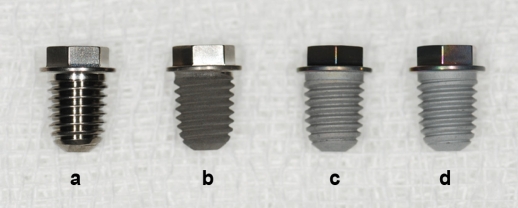
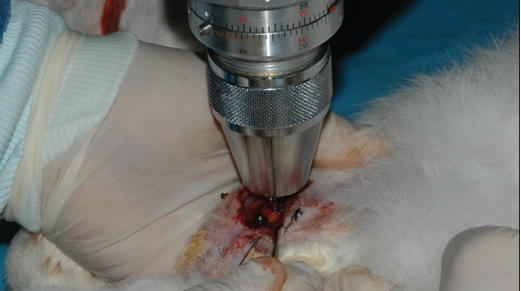
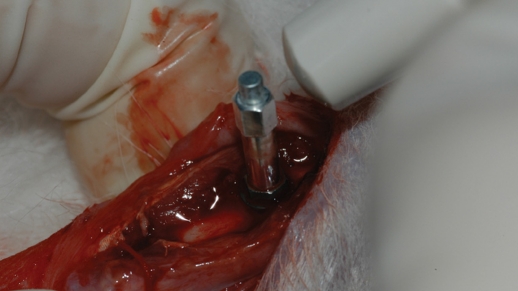
THREE TEST GROUPS WERE PREPARED: sandblasted, large-grit and acid-etched (SLA) implants, anodic oxidized implants, and anodized implants with Ca-P immersion. The turned implants served as control. Twenty rabbits received 80 implants in the tibia. Resonance frequencies were measured at the time of implant insertion, 2 weeks and 4 weeks of healing. Removal torque values (RTV) were measured 2 and 4 weeks after insertion.
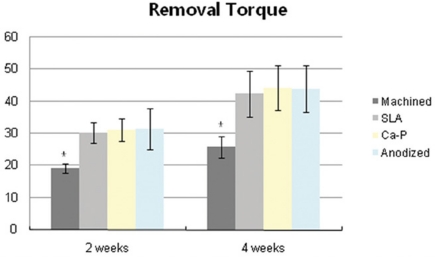
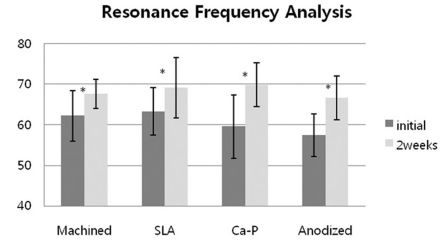
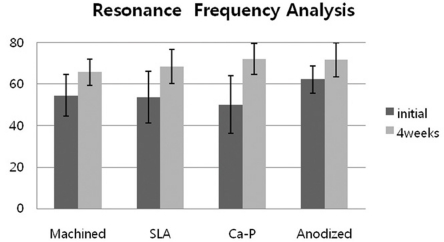
The implant stability quotient (ISQ) values of implants for resonance frequency analysis (RFA) increased significantly (P < .05) during 2 weeks of healing period although there were no significant differences among the test and control groups (P > .05). The test and control implants also showed significantly higher ISQ values during 4 weeks of healing period (P < .05). No significant differences, however, were found among all the groups. All the groups showed no significant differences in ISQ values between 2 and 4 weeks after implant insertion (P > .05). The SLA, anodized and Ca-P immersed implants showed higher RTVs at 2 and 4 weeks of healing than the machined one (P < .05). However, there was no significant difference among the experimental groups.
The surface-modified implants appear to provide superior implant stability to the turned one. Under the limitation of this study, however, we suggest that neither anodic oxidation nor Ca-P immersion techniques have any advantage over the conventional SLA technique with respect to implant stability.
种植体表面的宏观和微观特性在种植体的骨愈合中起着重要作用。经过表面改性的种植体比未经表面改性的种植体(机械加工)具有更强的骨整合能力。已经开发出先进的表面改性技术,如阳极氧化和 Ca-P 应用,以实现宿主骨与种植体之间更快、更强的结合。
本研究旨在通过兔胫骨模型探讨钛种植体表面处理对种植体植入后稳定性的影响。
制备了三组试验:喷砂酸蚀(SLA)种植体、阳极氧化种植体和 Ca-P 浸涂阳极氧化种植体,机械加工种植体作为对照组。20 只兔子在胫骨中植入 80 个种植体。在植入时、愈合 2 周和 4 周时测量共振频率,植入后 2 周和 4 周测量拔出扭矩值(RTV)。
尽管各组之间无统计学差异(P >.05),但在愈合 2 周时,用于共振频率分析(RFA)的种植体的种植体稳定性指数(ISQ)值显著增加(P <.05)。在愈合 4 周时,试验组和对照组种植体的 ISQ 值也显著升高(P <.05)。然而,各组之间无显著差异。所有组在植入后 2 周和 4 周之间的 ISQ 值无显著差异(P >.05)。SLA、阳极氧化和 Ca-P 浸涂种植体在愈合 2 周和 4 周时的 RTV 高于机械加工种植体(P <.05)。然而,各组之间无显著差异。
与机械加工种植体相比,表面改性种植体似乎具有更高的种植体稳定性。然而,在本研究的限制内,我们认为,与传统的 SLA 技术相比,阳极氧化或 Ca-P 浸涂技术在种植体稳定性方面没有任何优势。