Intercollegiate Faculty of Biotechnology University of Gdansk and Medical University of Gdansk, Kladki 24, 80-822 Gdansk, Poland.
BMC Microbiol. 2010 Dec 17;10:323. doi: 10.1186/1471-2180-10-323.
Staphylococcus aureus, a major human pathogen causes a wide range of disease syndromes. The most dangerous are methicillin-resistant S. aureus (MRSA) strains, resistant not only to all β-lactam antibiotics but also to other antimicrobials. An alarming increase in antibiotic resistance spreading among pathogenic bacteria inclines to search for alternative therapeutic options, for which resistance can not be developed easily. Among others, photodynamic inactivation (PDI) of S. aureus is a promising option. Photodynamic inactivation is based on a concept that a non toxic chemical, called a photosensitizer upon excitation with light of an appropriate wavelength is activated. As a consequence singlet oxygen and other reactive oxygen species (e.g. superoxide anion) are produced, which are responsible for the cytotoxic effect towards bacterial cells. As strain-dependence in photodynamic inactivation of S. aureus was observed, determination of the molecular marker(s) underlying the mechanism of the bacterial response to PDI treatment would be of great clinical importance. We examined the role of superoxide dismutases (Sod) in photodynamic inactivation of S. aureus as enzymes responsible for oxidative stress resistance.
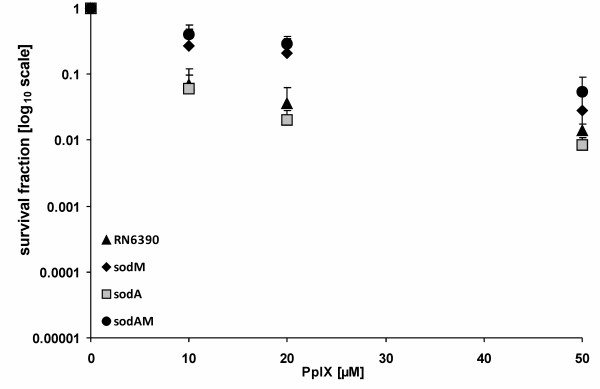
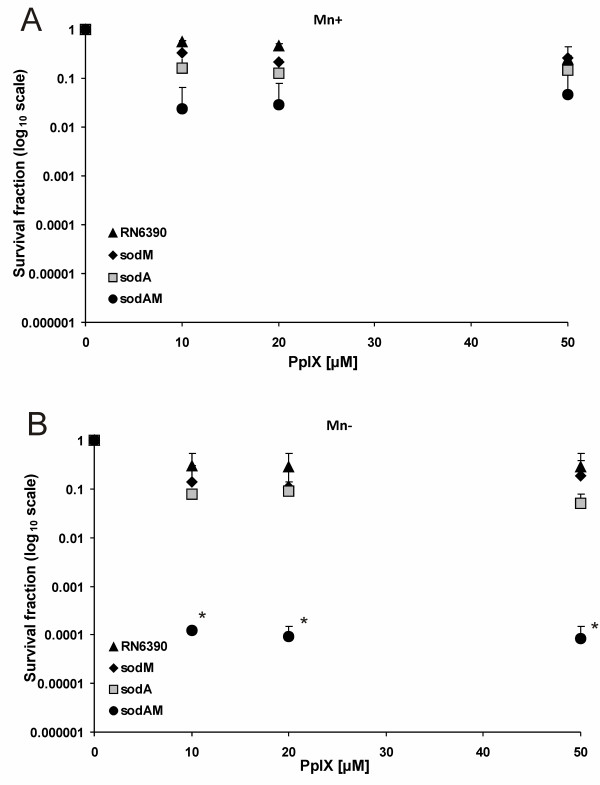
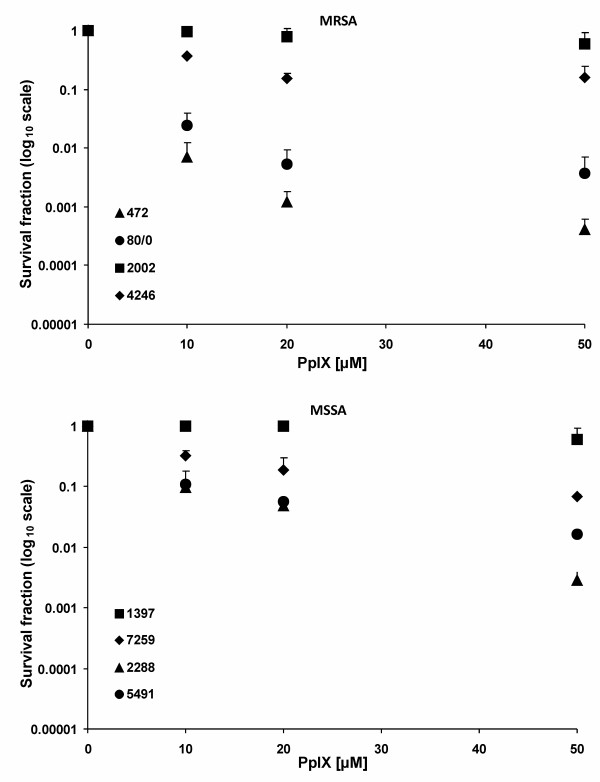
The effectiveness of photodynamic inactivation towards S. aureus and its Sod isogenic mutants deprived of either of the two superoxide dismutase activities, namely SodA or SodM or both of them showed similar results, regardless of the Sod status in TSB medium. On the contrary, in the CL medium (without Mn++ ions) the double SodAM mutant was highly susceptible to photodynamic inactivation. Among 8 clinical isolates of S. aureus analyzed (4 MRSA and 4 MSSA), strains highly resistant and strains highly vulnerable to photodynamic inactivation were noticed. We observed that Sod activity as well as sodA and sodM transcript level increases after protoporphyrin IX-based photodynamic treatment but only in PDI-sensitive strains.
We confirmed that porphyrin-based photokilling efficacy is a strain-dependent phenomenon. We showed that oxidative stress sensitivity caused by the lack of both Sod enzymes can be relieved in the presence of Mn ions and partially in the presence of Fe ions. The fact that Sod activity increase is observed only in PDI-susceptible cells emphasizes that this is probably not a direct factor affecting S. aureus vulnerability to porphyrin-based PDI.
金黄色葡萄球菌是一种主要的人类病原体,可引起多种疾病综合征。最危险的是耐甲氧西林金黄色葡萄球菌(MRSA)株,不仅对所有β-内酰胺类抗生素耐药,而且对其他抗菌药物也耐药。致病性细菌中抗生素耐药性的惊人增加促使人们寻找替代治疗方案,而这些方案不易产生耐药性。在其他方法中,金黄色葡萄球菌的光动力灭活(PDI)是一种很有前途的选择。光动力灭活基于这样一种概念,即一种非毒性化学物质,称为光敏剂,在适当波长的光激发下被激活。结果,产生了单线态氧和其他活性氧物质(例如超氧阴离子),这些物质对细菌细胞具有细胞毒性作用。由于观察到金黄色葡萄球菌的光动力灭活存在菌株依赖性,因此确定细菌对 PDI 治疗反应的分子标记(s)将具有重要的临床意义。我们研究了超氧化物歧化酶(Sod)在金黄色葡萄球菌光动力灭活中的作用,因为 Sod 酶负责氧化应激抗性。
无论 TSB 培养基中的 Sod 状态如何,金黄色葡萄球菌及其缺乏两种超氧化物歧化酶活性(即 SodA 或 SodM 或两者都缺乏)的同基因突变体的 PDI 效果均相似。相反,在 CL 培养基(无 Mn++离子)中,双 SodAM 突变体对光动力灭活高度敏感。在分析的 8 株临床分离的金黄色葡萄球菌(4 株 MRSA 和 4 株 MSSA)中,发现了对光动力灭活高度耐药和高度敏感的菌株。我们观察到,在用原卟啉 IX 为基础的光动力处理后,Sod 活性以及 sodA 和 sodM 转录水平增加,但仅在 PDI 敏感的菌株中增加。
我们证实了基于卟啉的光杀伤功效是一种菌株依赖性现象。我们表明,缺乏两种 Sod 酶引起的氧化应激敏感性可以在 Mn 离子存在下得到缓解,并且在 Fe 离子存在下部分缓解。仅在 PDI 敏感细胞中观察到 Sod 活性增加这一事实强调,这可能不是直接影响金黄色葡萄球菌对基于卟啉的 PDI 易感性的因素。