Department of Physiology and Pharmacology, Federal University of Ceará, Brazil.
J Inflamm (Lond). 2010 Dec 17;7:60. doi: 10.1186/1476-9255-7-60.
The species Himatanthus drasticus is popularly known in Northeast Brazil as "janaguba" and belongs to the family Apocynaceae. The latex collected from its stem bark is used for several purposes including anti-inflammatory properties and presents among its bioactive constituents the pentacyclic triterpene lupeol. The objective of the present work was to study in vivo and in vitro the lupeol acetate (LA) isolated from the plant latex, in several models of inflammation.
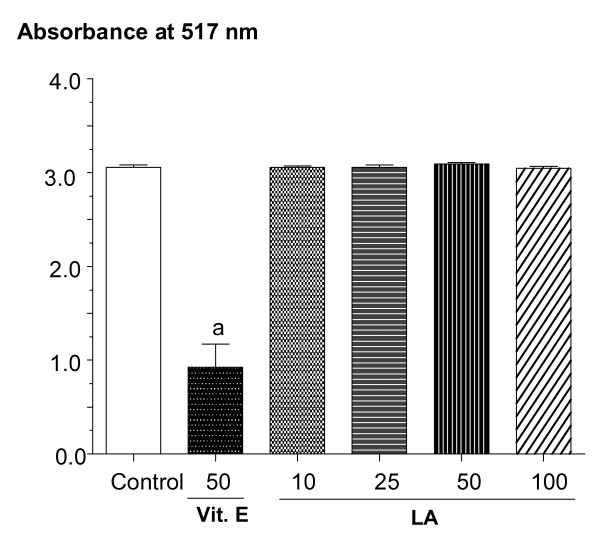
Male Swiss mice (25-30 g, 6-24 animals per group) were administered with LA, 30 min before the test initiation. In the evaluation of analgesic activity the formalin test was used. The anti-inflammatory activity was evaluated by the following tests: paw edema induced by carrageenan and dextran, and the carrageenan-induced neutrophil migration into peritoneal cavities. Furthermore, the effect of LA on the myeloperoxidase release (MPO, an inflammation biomarker) from human neutrophils was also determined, as well as its antioxidant potential by the DPPH assay.
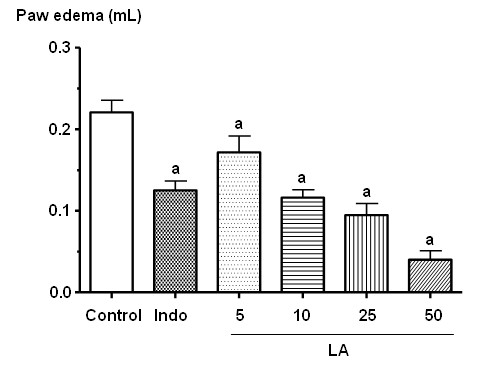
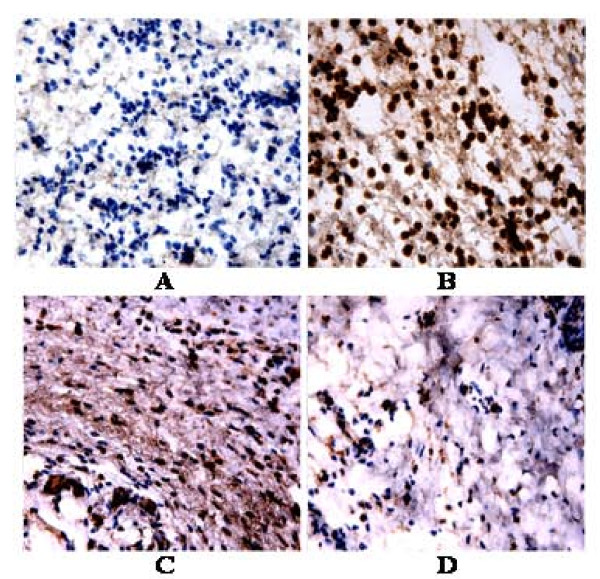
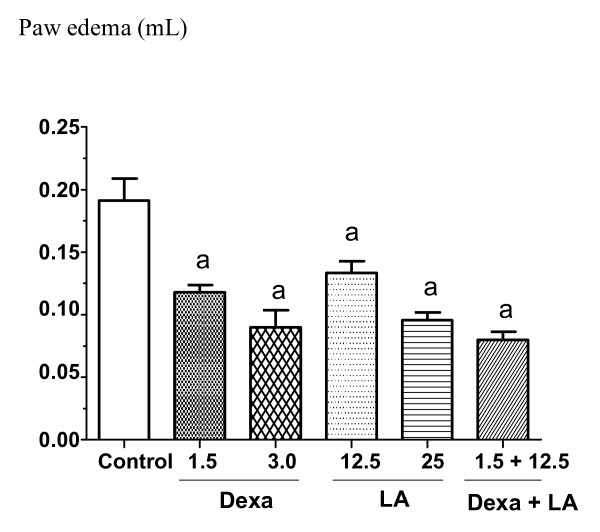
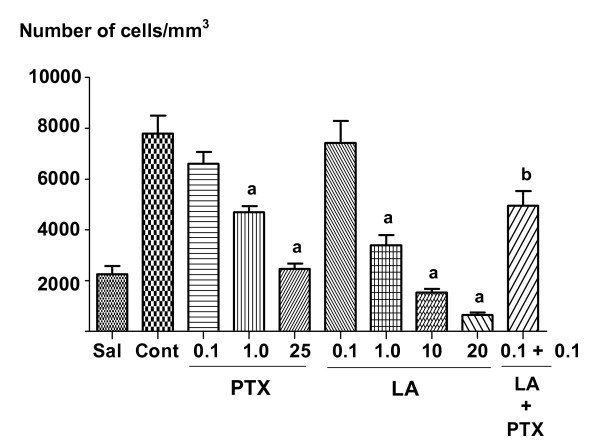
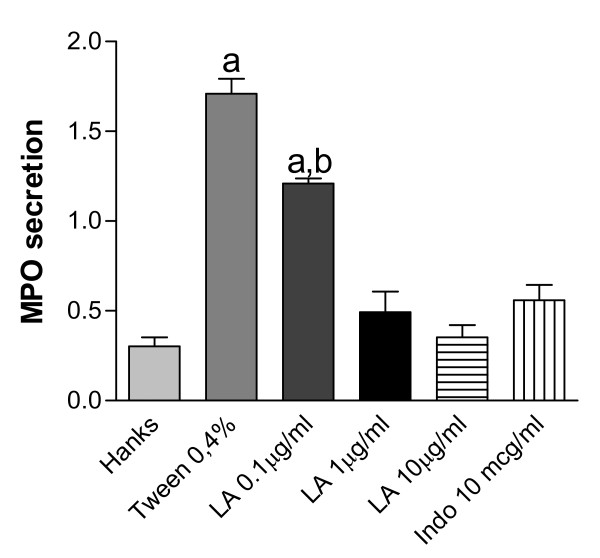
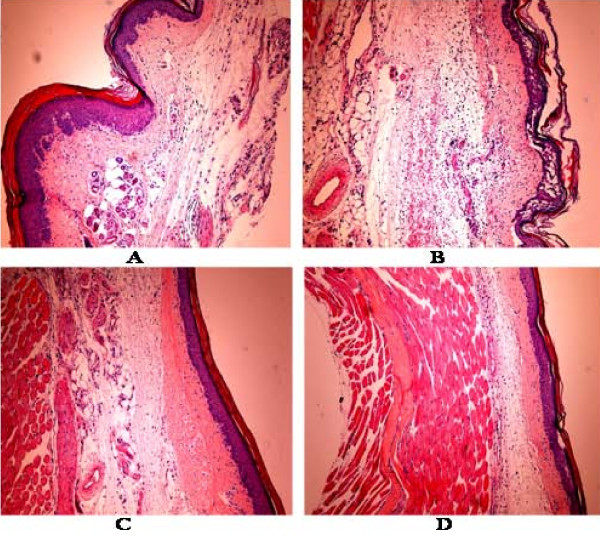
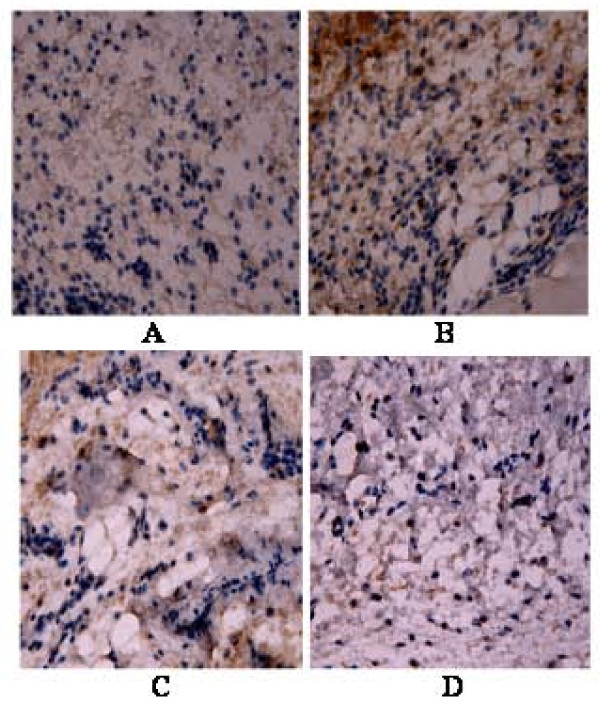
In the formalin test, LA (10, 25 and 50 mg/kg, i.p.) inhibited both the 1st (neurogenic, 0-5 min) and mainly the 2nd (inflammatory, 20-25 min) phase. Naloxone completely reversed the LA effect, indicating the participation of the opioid system. LA also significantly inhibited carrageenan- and dextran-induced paw edemas, as well as the neutrophil migration to the peritoneal cavity evaluated by the carrageenan-induced pleurisia. In this model, the effect of a very low dose of LA (0.1 mg/kg) was potentiated by the same dose of pentoxifylline (PTX), a known TNF-alpha inhibitor. LA (25 and 50 μg/ml) was also very effective in inhibiting MPO released from stimulated human neutrophils, and significantly decreased the number of cells expressing iNOS activity in the paw of mice submitted to carrageenan-induced edema, suggesting a drug involvement with the NO system.
The anti-inflammatory effect of LA probably involves the opioid system, as indicated by the complete blockade of the opioid antagonist naloxone. Furthermore, the LA effect was potentiated by PTX (a TNF-alpha inhibitor). LA also decreased the number of iNOS cells, suggesting the participation of pro-inflammatory cytokines and the NO system in the drug action.
在巴西东北部,物种 Himatanthus drasticus 俗称“janaguba”,属于夹竹桃科。从其茎皮中采集的乳胶用于多种用途,包括抗炎特性,并具有五环三萜 lupeol 等生物活性成分。本工作的目的是研究从植物乳胶中分离出的 lupeol 乙酸酯 (LA) 在几种炎症模型中的体内和体外活性。
雄性瑞士小鼠(25-30 g,每组 6-24 只动物)在试验开始前 30 分钟给予 LA。在评价镇痛活性时使用福尔马林试验。通过以下试验评估抗炎活性:角叉菜胶和右旋糖酐诱导的爪肿胀,以及角叉菜胶诱导的中性粒细胞向腹腔内迁移。此外,还测定了 LA 对人中性粒细胞髓过氧化物酶释放(炎症标志物 MPO)的影响,以及 DPPH 试验测定的其抗氧化潜力。
在福尔马林试验中,LA(10、25 和 50 mg/kg,ip)抑制了第一相(神经源性,0-5 分钟)和主要是第二相(炎症性,20-25 分钟)。纳洛酮完全逆转了 LA 的作用,表明阿片系统的参与。LA 还显著抑制角叉菜胶和右旋糖酐诱导的爪肿胀,以及通过角叉菜胶诱导的胸膜炎评估的中性粒细胞向腹腔内迁移。在该模型中,LA(0.1 mg/kg)的非常低剂量的作用被相同剂量的己酮可可碱(PTX)增强,PTX 是一种已知的 TNF-α抑制剂。LA(25 和 50 μg/ml)也非常有效地抑制了刺激的人中性粒细胞释放的 MPO,并显著减少了在角叉菜胶诱导的水肿的小鼠爪中表达 iNOS 活性的细胞数量,表明该药物与 NO 系统有关。
LA 的抗炎作用可能涉及阿片系统,如阿片受体拮抗剂纳洛酮的完全阻断所表明的那样。此外,LA 的作用被 PTX(TNF-α抑制剂)增强。LA 还减少了 iNOS 细胞的数量,表明促炎细胞因子和 NO 系统参与了药物作用。