Gene Expression Laboratory, The Salk Institute for Biological Studies, La Jolla, California, United States of America.
PLoS One. 2010 Dec 9;5(12):e15526. doi: 10.1371/journal.pone.0015526.
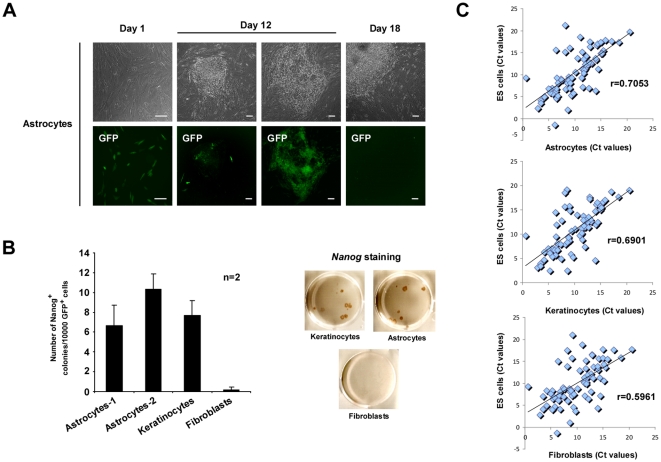
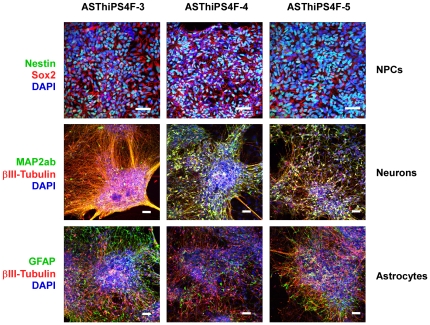
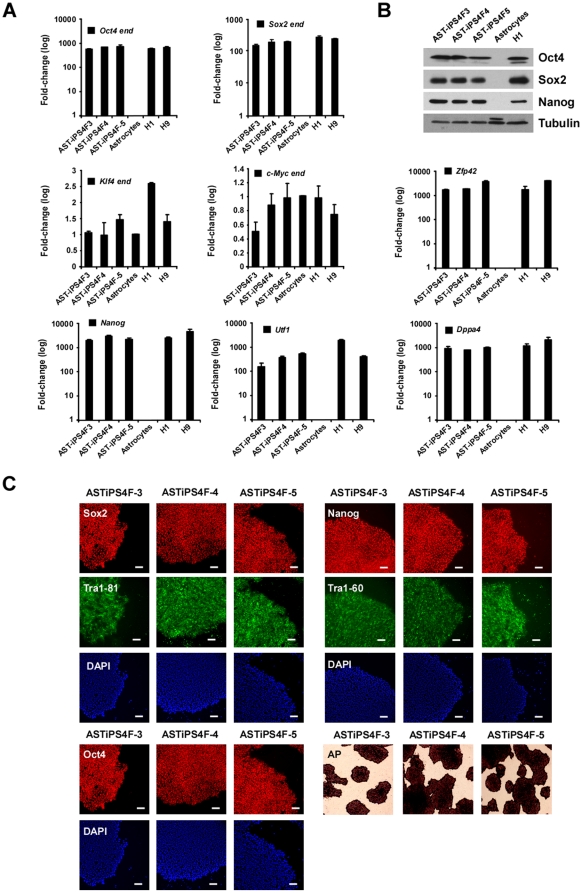
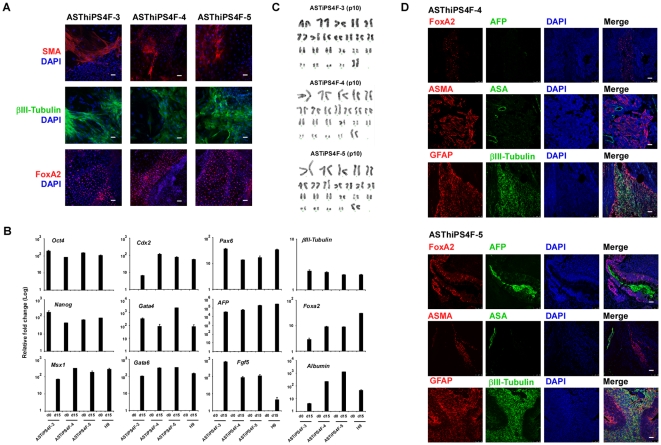
The reprogramming of human somatic cells to induced pluripotent stem (hiPS) cells enables the possibility of generating patient-specific autologous cells for regenerative medicine. A number of human somatic cell types have been reported to generate hiPS cells, including fibroblasts, keratinocytes and peripheral blood cells, with variable reprogramming efficiencies and kinetics. Here, we show that human astrocytes can also be reprogrammed into hiPS (ASThiPS) cells, with similar efficiencies to keratinocytes, which are currently reported to have one of the highest somatic reprogramming efficiencies. ASThiPS lines were indistinguishable from human embryonic stem (ES) cells based on the expression of pluripotent markers and the ability to differentiate into the three embryonic germ layers in vitro by embryoid body generation and in vivo by teratoma formation after injection into immunodeficient mice. Our data demonstrates that a human differentiated neural cell type can be reprogrammed to pluripotency and is consistent with the universality of the somatic reprogramming procedure.
人类体细胞重编程为诱导多能干细胞(hiPS)细胞,使得为再生医学生成患者特异性自体细胞成为可能。已经报道了许多人类体细胞类型可以生成 hiPS 细胞,包括成纤维细胞、角质细胞和外周血细胞,其重编程效率和动力学各不相同。在这里,我们表明人类星形胶质细胞也可以被重编程为 hiPS(ASThiPS)细胞,其效率与角质细胞相似,角质细胞目前被报道具有最高的体细胞重编程效率之一。ASThiPS 系在多能标记物的表达和通过胚状体生成体外分化为三个胚胎胚层以及通过注射入免疫缺陷小鼠后形成畸胎瘤体内分化为三个胚胎胚层的能力方面与人类胚胎干细胞(ES)细胞无法区分。我们的数据表明,人类分化的神经细胞类型可以被重编程为多能性,并且与体细胞重编程程序的普遍性一致。