Fundación Instituto de Investigación en Servicios de Salud, Valencia, Spain.
Popul Health Metr. 2010 Dec 20;8:34. doi: 10.1186/1478-7954-8-34.
Since 1995, approval for many new medicinal products has been obtained through a centralized procedure in the European Union. In recent years, the use of summary measures of population health has become widespread. We investigated whether efforts to develop innovative medicines are focusing on the most relevant conditions from a global public health perspective.
We reviewed the information on new medicinal products approved by centralized procedure from 1995 to 2009, information that is available to the public in the European Commission Register of medicinal products and the European Public Assessment Reports from the European Medicines Agency. Morbidity and mortality data were included for each disease group, according to the Global Burden of Disease project. We evaluated the association between authorized medicinal products and burden of disease measures based on disability-adjusted life years (DALYs) in the European Union and worldwide.
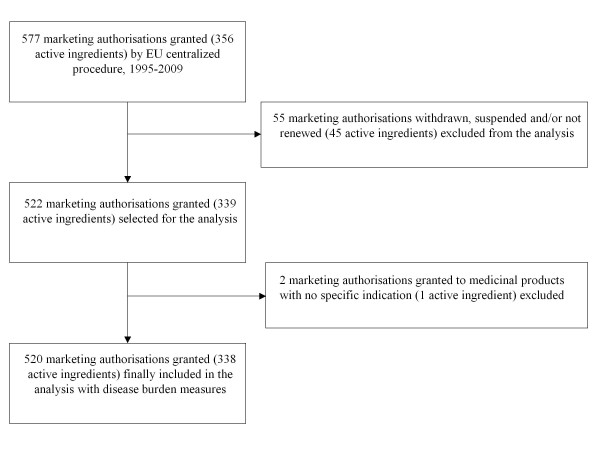
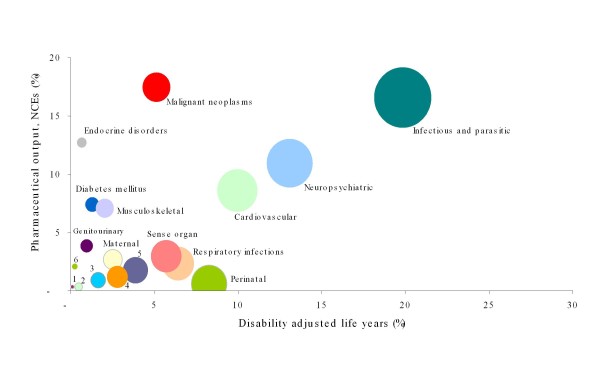
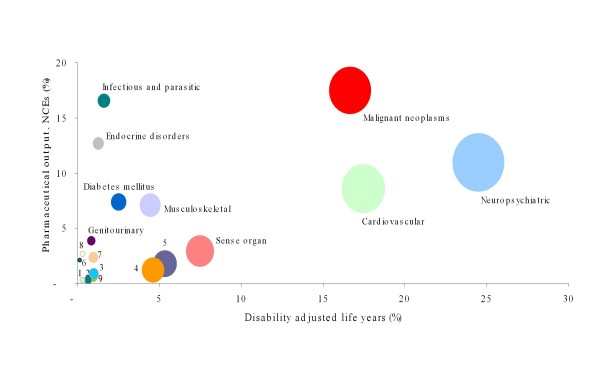
We considered 520 marketing authorizations for medicinal products and 338 active ingredients. New authorizations were seen to increase over the period analyzed. There was a positive, high correlation between DALYs and new medicinal product development (ρ = 0.619, p = 0.005) in the European Union, and a moderate correlation for middle-low-income countries (ρ = 0.497, p = 0.030) and worldwide (ρ = 0.490, p = 0.033). The most neglected conditions at the European level (based on their attributable health losses) were neuropsychiatric diseases, cardiovascular diseases, respiratory diseases, sense organ conditions, and digestive diseases, while globally, they were perinatal conditions, respiratory infections, sense organ conditions, respiratory diseases, and digestive diseases.
We find that the development of new medicinal products is higher for some diseases than others. Pharmaceutical industry leaders and policymakers are invited to consider the implications of this imbalance by establishing work plans that allow for the setting of future priorities from a public health perspective.
自 1995 年以来,欧盟通过集中程序批准了许多新药。近年来,人们广泛使用人群健康综合指标。我们研究了开发创新药物的努力是否集中于从全球公共卫生角度来看最相关的疾病。
我们审查了 1995 年至 2009 年通过集中程序批准的新药信息,这些信息在欧盟药品注册处和欧洲药品管理局的欧洲公共评估报告中均可公开获得。根据全球疾病负担项目,我们为每个疾病组纳入了发病率和死亡率数据。我们根据欧盟和全球范围内的伤残调整生命年(DALY)评估了授权药物与疾病负担指标之间的关系。
我们考虑了 520 种药品的上市许可和 338 种活性成分。在分析期间,新的授权数量有所增加。在欧盟,DALY 与新药开发之间存在正相关(ρ=0.619,p=0.005),且与中低收入国家(ρ=0.497,p=0.030)和全球(ρ=0.490,p=0.033)之间存在中度相关。在欧洲层面,被忽视最严重的疾病(基于其归因健康损失)是神经精神疾病、心血管疾病、呼吸系统疾病、感觉器官疾病和消化系统疾病,而在全球层面,被忽视最严重的疾病是围产期疾病、呼吸道感染、感觉器官疾病、呼吸系统疾病和消化系统疾病。
我们发现,某些疾病的新药开发水平高于其他疾病。我们邀请制药行业领导者和决策者考虑这种不平衡的影响,制定工作计划,以便从公共卫生角度设定未来的优先事项。