Department of Infectious and Tropical Diseases, London School of Hygiene and Tropical Medicine, London, UK.
Trop Med Int Health. 2011 Mar;16(3):349-55. doi: 10.1111/j.1365-3156.2010.02708.x. Epub 2010 Dec 22.
To present an algorithm for primary-care health workers for identifying HIV-infected adolescents in populations at high risk through mother-to-child transmission.
Five hundred and six adolescent (10-18 years) attendees to two primary care clinics in Harare, Zimbabwe, were recruited. A randomly extracted 'training' data set (n = 251) was used to generate an algorithm using variables identified as associated with HIV through multivariable logistic regression. Performance characteristics of the algorithm were evaluated in the remaining ('test') records (n = 255) at different HIV prevalence rates.
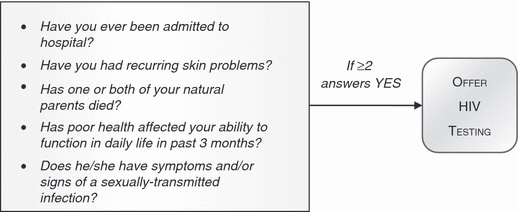
HIV prevalence was 17%, and infection was independently associated with client-reported orphanhood, past hospitalization, skin problems, presenting with sexually transmitted infection and poor functional ability. Classifying adolescents as requiring HIV testing if they reported >1 of these five criteria had 74% sensitivity and 80% specificity for HIV, with the algorithm correctly predicting the HIV status of 79% of participants. In low-HIV-prevalence settings (<2%), the algorithm would have a high negative predictive value (≥ 99.5%) and result in an estimated 60% decrease in the number of people needing to test to identify one HIV-infected individual, compared with universal testing.
Our simple algorithm can identify which individuals are likely to be HIV infected with sufficient accuracy to provide a screening tool for use in settings not already implementing universal testing policies among this age-group, for example immigrants to low-HIV-prevalence countries.
为初级保健卫生工作者提供一种算法,以通过母婴传播识别高危人群中的 HIV 感染青少年。
招募了来自津巴布韦哈拉雷的两家初级保健诊所的 506 名青少年(10-18 岁)参与者。使用多变量逻辑回归确定与 HIV 相关的变量,从随机提取的“训练”数据集(n = 251)中生成算法。在不同 HIV 流行率的剩余“测试”记录(n = 255)中评估算法的性能特征。
HIV 流行率为 17%,感染与客户报告的孤儿身份、过去住院、皮肤问题、性传播感染和功能能力差独立相关。如果青少年报告了这五个标准中的>1 个,则将其归类为需要 HIV 检测,其 HIV 的敏感性为 74%,特异性为 80%,该算法正确预测了 79%的参与者的 HIV 状态。在 HIV 低流行率(<2%)的环境中,该算法的阴性预测值(≥99.5%)会很高,与普遍检测相比,估计可以将需要检测以识别一名 HIV 感染者的人数减少 60%。
我们的简单算法可以准确识别出哪些人可能感染 HIV,足以提供一种筛选工具,用于尚未在该年龄段实施普遍检测政策的环境,例如移民到 HIV 低流行率国家。