Centre for Clinical Epidemiology and Biostatistics, School of Medicine and Public Health, University of Newcastle, Callaghan, NSW, Australia.
BMC Public Health. 2010 Dec 22;10:781. doi: 10.1186/1471-2458-10-781.
Hazardous alcohol consumption is a leading modifiable cause of mortality and morbidity among young people. Screening and brief intervention (SBI) is a key strategy to reduce alcohol-related harm in the community, and web-based approaches (e-SBI) have advantages over practitioner-delivered approaches, being cheaper, more acceptable, administrable remotely and infinitely scalable. An efficacy trial in a university population showed a 10-minute intervention could reduce drinking by 11% for 6 months or more among 17-24 year-old undergraduate hazardous drinkers. The e-SBINZ study is designed to examine the effectiveness of e-SBI across a range of universities and among Māori and non-Māori students in New Zealand.
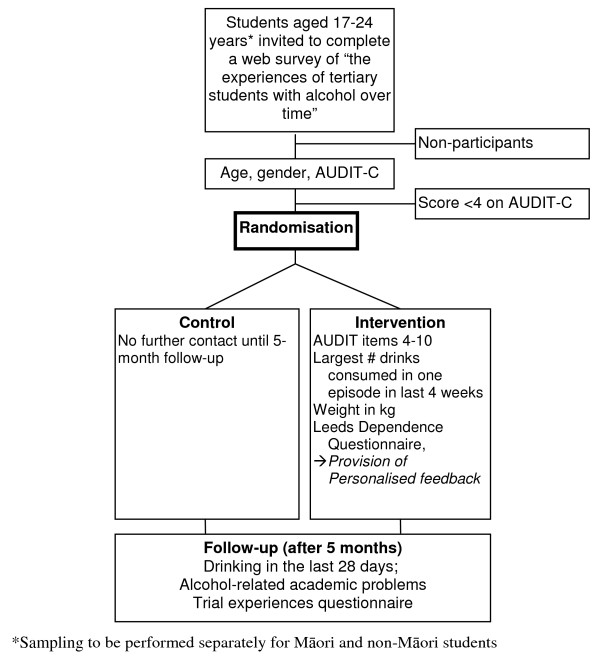
METHODS/DESIGN: The e-SBINZ study comprises two parallel, double blind, multi-site, individually randomised controlled trials. This paper outlines the background and design of the trial, which is recruiting 17-24 year-old students from seven of New Zealand's eight universities. Māori and non-Māori students are being sampled separately and are invited by e-mail to complete a web questionnaire including the AUDIT-C. Those who score >4 will be randomly allocated to no further contact until follow-up (control) or to assessment and personalised feedback (intervention) via computer. Follow-up assessment will occur 5 months later in second semester. Recruitment, consent, randomisation, intervention and follow-up are all online. Primary outcomes are (i) total alcohol consumption, (ii) frequency of drinking, (iii) amount consumed per typical drinking occasion, (iv) the proportions exceeding medical guidelines for acute and chronic harm, and (v) scores on an academic problems scale.
The trial will provide information on the effectiveness of e-SBI in reducing hazardous alcohol consumption across diverse university student populations with separate effect estimates for Māori and non-Māori students.
Australian New Zealand Clinical Trials Registry (ANZCTR) ACTRN12610000279022.
危险饮酒是年轻人死亡和发病的主要可改变原因之一。筛查和简短干预(SBI)是减少社区内与酒精相关危害的关键策略,而基于网络的方法(e-SBI)比从业者提供的方法具有优势,因为它们更便宜、更可接受、可以远程管理并且具有无限可扩展性。一项针对大学生群体的功效试验表明,对于 17-24 岁的有危险饮酒行为的大学生,10 分钟的干预可以使他们的饮酒量减少 11%,并且持续 6 个月或更长时间。e-SBINZ 研究旨在检验 e-SBI 在一系列大学中以及在新西兰的毛利人和非毛利学生中的有效性。
方法/设计:e-SBINZ 研究包括两项平行、双盲、多地点、个体随机对照试验。本文概述了该试验的背景和设计,该试验正在从新西兰的八所大学中的七所招募 17-24 岁的学生。毛利人和非毛利学生分别进行抽样,并通过电子邮件邀请他们完成一个包括 AUDIT-C 的网络问卷。那些得分>4 的人将被随机分配到没有进一步联系,直到随访(对照组)或通过计算机进行评估和个性化反馈(干预组)。5 个月后在第二学期进行随访评估。招募、同意、随机分组、干预和随访都是在线进行的。主要结局指标是(i)总饮酒量,(ii)饮酒频率,(iii)每次典型饮酒量,(iv)超过急性和慢性伤害医学指南的比例,以及(v)学术问题量表的分数。
该试验将提供有关 e-SBI 在减少不同大学生群体中危险饮酒行为的有效性信息,并且针对毛利人和非毛利学生有单独的效果估计。
澳大利亚新西兰临床试验注册(ANZCTR)ACTRN12610000279022。