Murray Elizabeth, Khadjesari Zarnie, Linke Stuart, Hunter Rachael, Freemantle Nick
Research Department of Primary Care and Population Health, University College London, Upper Floor 3, Royal Free Hospital, Rowland Hill Street, London, NW3 2PF, England.
BMC Public Health. 2013 May 24;13:505. doi: 10.1186/1471-2458-13-505.
Alcohol misuse is a significant international public health problem. Screening and brief intervention (SBI) in primary care reduces alcohol consumption by about 15 - 30%, sustained over 12 months in hazardous or harmful drinkers but implementation has proved difficult leading to growing interest in exploring the effectiveness of SBI in other settings, including the workplace. Computerised interventions for alcohol misuse can be as effective as traditional face-to-face interventions and may have advantages, including anonymity, convenience and availability.
METHODS/DESIGN: Individually randomised controlled trial to determine the effectiveness and cost-effectiveness of offering online screening and brief intervention for alcohol misuse in a workplace.
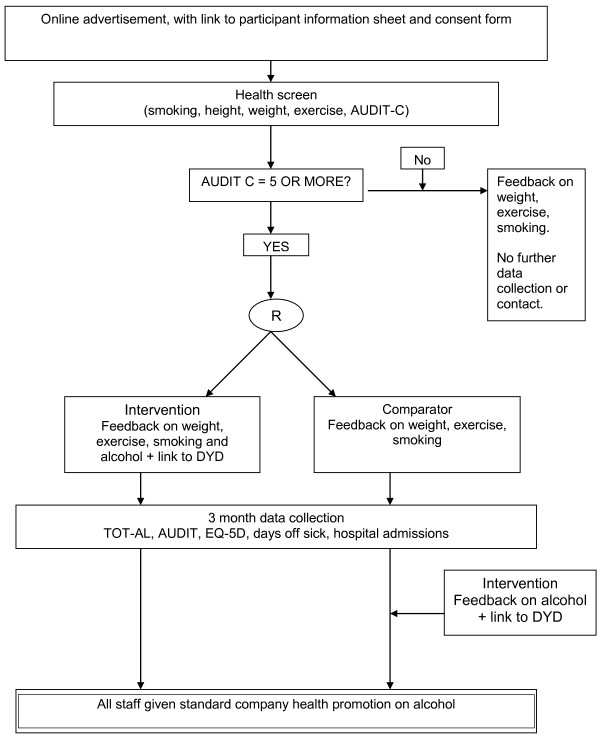
adults (aged 18 or over) employed by participating employers scoring 5 or more on a three item screen for alcohol misuse (the AUDIT-C) indicating possible hazardous or harmful alcohol consumption, recruited through the offer of an online health check providing screening for a range of health behaviours with personalised feedback. PARTICIPANTS who accept the health check and score 5 or more on the alcohol screen will be randomised to receiving immediate feedback on their alcohol consumption and access to an online intervention offering support in reducing alcohol consumption (Down Your Drink) or delayed feedback and access to Down Your Drink after completion of follow-up data at three months. All employees who take the online health check will receive personalised feedback on other screened health behaviours including diet, physical activity, smoking, and body mass index. The primary outcome is alcohol consumption in the past week at three months; secondary outcomes are the AUDIT, EQ-5D, days off work, number and duration of hospital admissions, costs and use of the intervention. A sample size of 1,472 participants (736 in each arm) provides 90% power with 5% significance to determine a 20% reduction in alcohol consumption. Outcomes between groups at three months will be compared following the intention to treat principle and economic analyses will follow NICE guidance.
This innovative design avoids recruitment bias by not mentioning alcohol in the invitation and avoids reactivity of assessment by not collecting baseline data on alcohol consumption.
酒精滥用是一个重大的国际公共卫生问题。初级保健中的筛查与简短干预(SBI)可使酒精消费量减少约15% - 30%,在危险或有害饮酒者中持续12个月,但事实证明实施起来困难重重,这使得人们越来越有兴趣探索SBI在包括工作场所在内的其他环境中的有效性。针对酒精滥用的计算机化干预措施可能与传统的面对面干预措施一样有效,并且可能具有一些优势,包括匿名性、便利性和可及性。
方法/设计:一项个体随机对照试验,以确定在工作场所提供酒精滥用在线筛查与简短干预的有效性和成本效益。
参与研究的雇主所雇佣的成年人(18岁及以上),在三项酒精滥用筛查(AUDIT - C)中得分5分或更高,表明可能存在危险或有害的酒精消费,通过提供在线健康检查招募,该检查可对一系列健康行为进行筛查并提供个性化反馈。接受健康检查且在酒精筛查中得分5分或更高的参与者将被随机分为两组,一组立即获得关于其酒精消费的反馈,并可访问一个提供减少酒精消费支持的在线干预措施(“放下你的酒杯”),另一组在三个月随访数据完成后获得延迟反馈并可访问“放下你的酒杯”。所有进行在线健康检查的员工都将收到关于其他筛查健康行为的个性化反馈,包括饮食、体育活动、吸烟和体重指数。主要结局是三个月时过去一周的酒精消费量;次要结局包括酒精使用障碍识别测试(AUDIT)、EQ - 5D量表、缺勤天数、住院次数和时长、成本以及干预措施的使用情况。1472名参与者(每组736名)的样本量具有90%的检验效能和5%的显著性水平,以确定酒精消费量减少20%。三个月时两组之间的结局将按照意向性分析原则进行比较,经济分析将遵循英国国家卫生与临床优化研究所(NICE)的指导方针。
这种创新设计通过在邀请中不提及酒精来避免招募偏差,并通过不收集酒精消费的基线数据来避免评估的反应性。