Department of Anesthesiology, Leiden University Medical Center, Leiden, The Netherlands;
J Pain Res. 2010 Sep 21;3:183-90. doi: 10.2147/JPR.S13616.
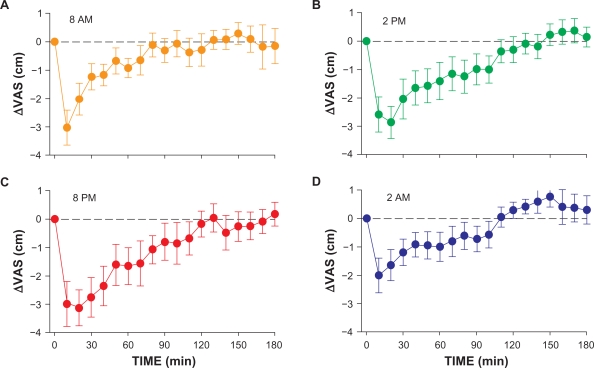
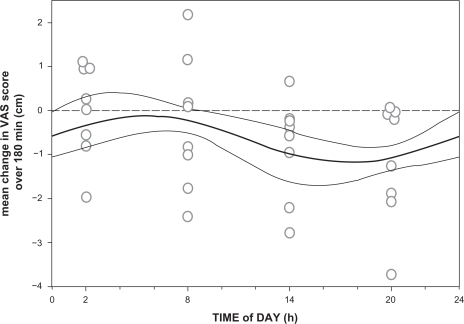
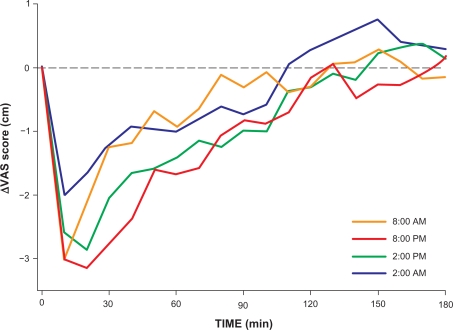
Chronopharmacology studies the effect of the timing of drug administration on drug effect. Here, we measured the influence of 4 timing moments on fentanyl-induced antinociception in healthy volunteers. Eight subjects received 2.1 μg/kg intravenous fentanyl at 2 pm and 2 am, with at least 2 weeks between occasions, and 8 others at 8 am and 8 pm. Heat pain measurements using a thermode placed on the skin were taken at regular intervals for 3 hours, and verbal analog scores (VAS) were then obtained. The data were modeled with a sinusoid function using the statistical package NONMEM. The study was registered at trialregister.nl under number NTR1254. A significant circadian sinusoidal rhythm in the antinociceptive effect of fentanyl was observed. Variations were observed for peak analgesic effect, duration of effect, and the occurrence of hyperalgesia. A peak in pain relief occurred late in the afternoon (5:30 pm) and a trough in the early morning hours (5:30 am). The difference between the peak and trough in pain relief corresponds to a difference in VAS of 1.3-2 cm. Only when given at 2 am, did fentanyl cause a small but significant period of hyperalgesia following analgesia. No significant changes were observed for baseline pain, sedation, or the increase in end-tidal CO(2). The variations in fentanyl's antinociceptive behavior are well explained by a chronopharmacodynamic effect originating at the circadian clock in the hypothalamus. This may be a direct effect through shared pathways of the circadian and opioid systems or an indirect effect via diurnal variations in hormones or endogenous opioid peptides that rhythmically change the pain response and/or analgesic response to fentanyl.
时间药理学研究给药时间对药物作用的影响。在这里,我们测量了 4 个时间点对健康志愿者芬太尼诱导镇痛的影响。8 名受试者在下午 2 点和凌晨 2 点接受 2.1μg/kg 静脉芬太尼,两次之间至少间隔 2 周,另外 8 名受试者在上午 8 点和晚上 8 点接受。使用放置在皮肤上的热痛测量仪每隔一定时间测量 3 小时,并获得口头模拟评分(VAS)。使用统计软件 NONMEM 对数据进行正弦函数建模。该研究在 trialregister.nl 上以 NTR1254 号注册。观察到芬太尼镇痛作用存在明显的昼夜正弦节律。在镇痛效果峰值、作用持续时间和痛觉过敏发生方面存在变化。下午(下午 5:30)出现疼痛缓解高峰,清晨(凌晨 5:30)出现低谷。疼痛缓解的峰值和低谷之间的差异对应于 VAS 的差异为 1.3-2cm。只有在凌晨 2 点给予芬太尼时,才会在镇痛后引起短暂但显著的痛觉过敏期。基线疼痛、镇静或呼气末 CO2 增加均无明显变化。芬太尼镇痛行为的变化很好地解释了起源于下丘脑昼夜节律钟的时间药效学效应。这可能是通过昼夜节律和阿片系统的共享途径的直接效应,或者是通过激素或内源性阿片肽的昼夜变化的间接效应,这些激素或内源性阿片肽周期性地改变疼痛反应和/或对芬太尼的镇痛反应。