Chair and Division of Metabolic Diseases, Second University of Naples, Piazza L. Miraglia, 80138 Napoli, Italy.
Cardiol Res Pract. 2010 Dec 20;2011:293916. doi: 10.4061/2011/293916.
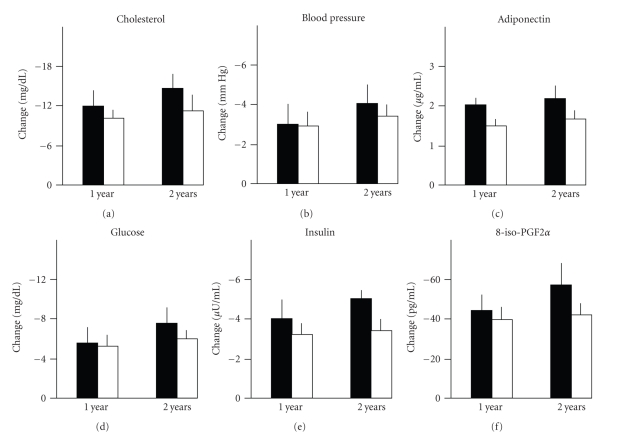
We report the effects of a Mediterranean-style diet, with or without calorie restriction, on biomarkers of aging and oxidative stress in overweight men. 192 men were randomly assigned to either a Mediterranean-style diet or a conventional diet. The intervention program was based on implementation of a Mediterranean dietary pattern in the overweight group (MED diet group), associated with calorie restriction and increased physical activity in the obese group (lifestyle group). Both groups were compared with participants in two matched control groups (advice groups). After 2 years, there was a significant difference in weight loss between groups, which was -14 kg (95% CI -20 to -8) in lifestyle groups and -2.0 kg (-4.4 to 0) in the advice groups, with a difference of -11.9 kg (CI -19 to -4.7 kg, P < .001); moreover, there was a significant difference between groups at 2 years for insulin (P = .04), 8-iso-PGF2α (P = .037), glucose (P = .04), and adiponectin (P = .01). Prolonged adherence to a Mediterranean-style diet, with or without caloric restriction, in overweight or obese men is associated with significant amelioration of multiple risk factors, including a better cardiovascular risk profile, reduced oxidative stress, and improved insulin sensitivity.
我们报告了地中海式饮食(无论是否限制热量)对超重男性衰老和氧化应激生物标志物的影响。192 名男性被随机分配到地中海式饮食组或常规饮食组。干预方案基于超重组实施地中海饮食模式(地中海饮食组),并结合肥胖组的热量限制和增加身体活动(生活方式组)。将两组与两个匹配的对照组(建议组)的参与者进行比较。2 年后,两组之间的体重减轻存在显著差异,生活方式组为-14kg(95%CI-20 至-8),建议组为-2.0kg(-4.4 至 0),差异为-11.9kg(CI-19 至-4.7kg,P<.001);此外,两组在 2 年时胰岛素(P=0.04)、8-异前列腺素 F2α(P=0.037)、葡萄糖(P=0.04)和脂联素(P=0.01)方面存在显著差异。在超重或肥胖男性中,长期坚持地中海式饮食(无论是否限制热量)与多种风险因素的显著改善相关,包括更好的心血管风险状况、降低氧化应激和改善胰岛素敏感性。