• 文献检索
  • 文档翻译
  • 深度研究
  • 学术资讯
  • Suppr Zotero 插件Zotero 插件
  • 邀请有礼
  • 套餐&价格
  • 历史记录
应用&插件
Suppr Zotero 插件Zotero 插件浏览器插件Mac 客户端Windows 客户端微信小程序
定价
高级版会员购买积分包购买API积分包
服务
文献检索文档翻译深度研究API 文档MCP 服务
关于我们
关于 Suppr公司介绍联系我们用户协议隐私条款
关注我们

Suppr 超能文献

核心技术专利:CN118964589B侵权必究
粤ICP备2023148730 号-1Suppr @ 2026

文献检索

告别复杂PubMed语法,用中文像聊天一样搜索,搜遍4000万医学文献。AI智能推荐,让科研检索更轻松。

立即免费搜索

文件翻译

保留排版,准确专业,支持PDF/Word/PPT等文件格式,支持 12+语言互译。

免费翻译文档

深度研究

AI帮你快速写综述,25分钟生成高质量综述,智能提取关键信息,辅助科研写作。

立即免费体验

厌恶作为一种用于疾病回避行为的适应系统。

Disgust as an adaptive system for disease avoidance behaviour.

机构信息

The Hygiene Centre, London School of Hygiene and Tropical Medicine, London WC1E 7HT, UK.

出版信息

Philos Trans R Soc Lond B Biol Sci. 2011 Feb 12;366(1563):389-401. doi: 10.1098/rstb.2010.0117.

DOI:10.1098/rstb.2010.0117
PMID:21199843
原文链接:https://pmc.ncbi.nlm.nih.gov/articles/PMC3013466/
Abstract

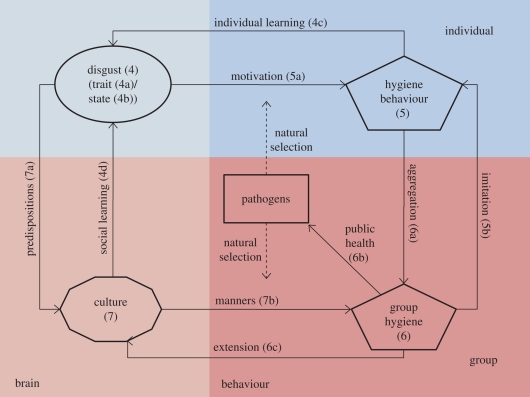
Disgust is an evolved psychological system for protecting organisms from infection through disease avoidant behaviour. This 'behavioural immune system', present in a diverse array of species, exhibits universal features that orchestrate hygienic behaviour in response to cues of risk of contact with pathogens. However, disgust is also a dynamic adaptive system. Individuals show variation in pathogen avoidance associated with psychological traits like having a neurotic personality, as well as a consequence of being in certain physiological states such as pregnancy or infancy. Three specialized learning mechanisms modify the disgust response: the Garcia effect, evaluative conditioning and the law of contagion. Hygiene behaviour is influenced at the group level through social learning heuristics such as 'copy the frequent'. Finally, group hygiene is extended symbolically to cultural rules about purity and pollution, which create social separations and are enforced as manners. Cooperative hygiene endeavours such as sanitation also reduce pathogen prevalence. Our model allows us to integrate perspectives from psychology, ecology and cultural evolution with those of epidemiology and anthropology. Understanding the nature of disease avoidance psychology at all levels of human organization can inform the design of programmes to improve public health.

摘要

厌恶是一种进化而来的心理系统,通过疾病回避行为来保护生物体免受感染。这种“行为免疫系统”存在于多种物种中,表现出普遍的特征,协调与病原体接触风险相关的卫生行为。然而,厌恶也是一个动态的自适应系统。个体在与神经质人格等心理特征相关的病原体回避方面表现出差异,也会因处于怀孕或婴儿期等特定生理状态而产生差异。三种专门的学习机制可以改变厌恶反应:加西亚效应、评价性条件作用和传染律。通过“模仿常见的行为”等社会学习启发式,在群体层面上影响卫生行为。最后,文化规则将群体卫生扩展到纯洁和污染上,这些规则造成社会隔离,并通过礼仪加以执行。合作卫生努力,如卫生设施,也可以降低病原体的流行率。我们的模型使我们能够将心理学、生态学和文化进化的观点与流行病学和人类学的观点结合起来。在人类组织的各个层面上理解疾病回避心理学的本质,可以为改善公共卫生的项目设计提供信息。
https://cdn.ncbi.nlm.nih.gov/pmc/blobs/a924/3013466/d7b3fcc6e00a/rstb20100117-g2.jpg
https://cdn.ncbi.nlm.nih.gov/pmc/blobs/a924/3013466/b81c4e2a1e38/rstb20100117-g1.jpg
https://cdn.ncbi.nlm.nih.gov/pmc/blobs/a924/3013466/d7b3fcc6e00a/rstb20100117-g2.jpg
https://cdn.ncbi.nlm.nih.gov/pmc/blobs/a924/3013466/b81c4e2a1e38/rstb20100117-g1.jpg
https://cdn.ncbi.nlm.nih.gov/pmc/blobs/a924/3013466/d7b3fcc6e00a/rstb20100117-g2.jpg

相似文献

1
Disgust as an adaptive system for disease avoidance behaviour.厌恶作为一种用于疾病回避行为的适应系统。
Philos Trans R Soc Lond B Biol Sci. 2011 Feb 12;366(1563):389-401. doi: 10.1098/rstb.2010.0117.
2
Extending the the behavioral immune system to political psychology: are political conservatism and disgust sensitivity really related?将行为免疫系统扩展到政治心理学:政治保守主义与厌恶敏感性真的相关吗?
Evol Psychol. 2010 Oct 26;8(4):599-616. doi: 10.1177/147470491000800406.
3
Dirt, disgust and disease: a natural history of hygiene.污垢、厌恶与疾病:一部卫生史
J Epidemiol Community Health. 2007 Aug;61(8):660-4. doi: 10.1136/jech.2007.062380.
4
Disgust as a disease-avoidance mechanism.厌恶作为一种疾病规避机制。
Psychol Bull. 2009 Mar;135(2):303-21. doi: 10.1037/a0014823.
5
Dirt, disgust, and disease. Is hygiene in our genes?污垢、厌恶与疾病。卫生观念存在于我们的基因中吗?
Perspect Biol Med. 2001 Winter;44(1):17-31. doi: 10.1353/pbm.2001.0001.
6
Evolution of pathogen and parasite avoidance behaviours.病原体和寄生虫回避行为的进化。
Philos Trans R Soc Lond B Biol Sci. 2018 Jul 19;373(1751). doi: 10.1098/rstb.2017.0256.
7
Contamination sensitivity and the development of disease-avoidant behaviour.污染敏感与疾病回避行为的发展。
Philos Trans R Soc Lond B Biol Sci. 2011 Dec 12;366(1583):3427-32. doi: 10.1098/rstb.2011.0036.
8
The behavioural immune system and the psychology of human sociality.行为免疫系统与人类社会性的心理学。
Philos Trans R Soc Lond B Biol Sci. 2011 Dec 12;366(1583):3418-26. doi: 10.1098/rstb.2011.0029.
9
Infection-avoidance behaviour in humans and other animals.人类和其他动物的感染预防行为。
Trends Immunol. 2014 Oct;35(10):457-64. doi: 10.1016/j.it.2014.08.006. Epub 2014 Sep 22.
10
Why disgust matters.厌恶为何重要。
Philos Trans R Soc Lond B Biol Sci. 2011 Dec 12;366(1583):3478-90. doi: 10.1098/rstb.2011.0165.

引用本文的文献

1
Emotional Responses to Bed Bug Encounters: Effects of Sex, Proximity, and Educational Intervention on Fear and Disgust Perceptions.对臭虫遭遇的情绪反应:性别、接近程度和教育干预对恐惧和厌恶认知的影响。
Insects. 2025 Jul 24;16(8):759. doi: 10.3390/insects16080759.
2
Negative Perception of Bats, Exacerbated by the SARS-CoV-2 Pandemic, May Hinder Bat Conservation in Northern Uganda.对蝙蝠的负面认知,因新冠疫情而加剧,可能会阻碍乌干达北部的蝙蝠保护工作。
Sustainability. 2022 Dec 2;14(24). doi: 10.3390/su142416924. Epub 2022 Dec 16.
3
Let's talk about "talking" dogs! Reviewing the science behind a bold idea.

本文引用的文献

1
Mere visual perception of other people's disease symptoms facilitates a more aggressive immune response.仅仅观察他人的疾病症状就能促进更强烈的免疫反应。
Psychol Sci. 2010 May;21(5):649-52. doi: 10.1177/0956797610368064. Epub 2010 Apr 2.
2
Experimental pretesting of hand-washing interventions in a natural setting.在自然环境中对手部清洗干预措施进行实验前测试。
Am J Public Health. 2009 Oct;99 Suppl 2(Suppl 2):S405-11. doi: 10.2105/AJPH.2009.164160.
3
Planned, motivated and habitual hygiene behaviour: an eleven country review.
让我们来谈谈会“说话”的狗!回顾一个大胆想法背后的科学依据。
Biol Futur. 2025 Jun;76(2):273-291. doi: 10.1007/s42977-025-00276-0. Epub 2025 Jul 29.
4
Surface neatness as an index of aesthetic value of everyday objects.作为日常用品美学价值指标的表面整洁度。
Front Psychol. 2025 Jul 10;16:1578785. doi: 10.3389/fpsyg.2025.1578785. eCollection 2025.
5
Bad Feelings, Best Explanations: In Defence of the Propitiousness Theory of the Low Mood System.负面情绪,最佳解释:为低落情绪系统的吉祥理论辩护。
Erkenntnis. 2025;90(5):1695-1720. doi: 10.1007/s10670-023-00773-5. Epub 2024 Jan 22.
6
Examining disgust learning through category conditioning: Evidence from trial-unique presentations and oculomotor avoidance.通过类别条件作用检验厌恶学习:来自独特试验呈现和眼球运动回避的证据。
Learn Behav. 2025 Mar 10. doi: 10.3758/s13420-025-00669-0.
7
Social distancing between personal belongings during the COVID-19 pandemic.在新冠疫情期间个人物品之间保持社交距离。
F1000Res. 2025 Feb 5;12:199. doi: 10.12688/f1000research.130662.3. eCollection 2023.
8
The Relationship Between Face-Based First Impressions and Perceptions of Purity and Compared to Other Moral Violations.基于面部的第一印象与纯洁感认知之间的关系以及与其他道德违规行为的比较。
Behav Sci (Basel). 2024 Dec 16;14(12):1205. doi: 10.3390/bs14121205.
9
Oral Sex May Serve as Low Mate Value Compensation Among Men: Evidence from a Pre-registered Study.口交可能是男性低配偶价值的一种补偿方式:来自一项预注册研究的证据。
Arch Sex Behav. 2025 Mar;54(3):893-903. doi: 10.1007/s10508-024-03064-4. Epub 2024 Dec 26.
10
The Role of Disgust Certainty in Intuitive Thought Processing: Electrophysiological Evidence.厌恶确定性在直觉思维加工中的作用:电生理学证据
Psychol Res Behav Manag. 2024 Oct 24;17:3709-3719. doi: 10.2147/PRBM.S471624. eCollection 2024.
计划性、主动性和习惯性卫生行为:一项十一个国家的综述。
Health Educ Res. 2009 Aug;24(4):655-73. doi: 10.1093/her/cyp002. Epub 2009 Mar 13.
4
Disgust as a disease-avoidance mechanism.厌恶作为一种疾病规避机制。
Psychol Bull. 2009 Mar;135(2):303-21. doi: 10.1037/a0014823.
5
When hunger finds no fault with moldy corn: food deprivation reduces food-related disgust.当饥饿对发霉的玉米也挑不出毛病时:食物匮乏会降低与食物相关的厌恶感。
Emotion. 2009 Feb;9(1):50-8. doi: 10.1037/a0014449.
6
Assortative sociality, limited dispersal, infectious disease and the genesis of the global pattern of religion diversity.选择性社交、有限扩散、传染病与全球宗教多样性模式的起源
Proc Biol Sci. 2008 Nov 22;275(1651):2587-94. doi: 10.1098/rspb.2008.0688.
7
Ecosystem energetic implications of parasite and free-living biomass in three estuaries.三个河口地区寄生虫和自由生活生物量对生态系统能量的影响
Nature. 2008 Jul 24;454(7203):515-8. doi: 10.1038/nature06970.
8
Pathogens, personality, and culture: disease prevalence predicts worldwide variability in sociosexuality, extraversion, and openness to experience.病原体、人格与文化:疾病流行率预示着社会性行为、外向性及经验开放性在全球范围内的变异性。
J Pers Soc Psychol. 2008 Jul;95(1):212-21. doi: 10.1037/0022-3514.95.1.212.
9
Morning sickness: adaptive cause or nonadaptive consequence of embryo viability?孕吐:胚胎活力的适应性原因还是非适应性结果?
Am Nat. 2008 Jul;172(1):54-62. doi: 10.1086/588081.
10
How emotion shapes behavior: feedback, anticipation, and reflection, rather than direct causation.情绪如何塑造行为:是反馈、预期和反思,而非直接因果关系。
Pers Soc Psychol Rev. 2007 May;11(2):167-203. doi: 10.1177/1088868307301033.