Department of Agroenvironmental Sciences and Technologies, University of Bologna, viale Fanin 44, 40127 Bologna, Italy.
BMC Plant Biol. 2011 Jan 6;11:4. doi: 10.1186/1471-2229-11-4.
Collections of nearly isogenic lines where each line carries a delimited portion of a donor source genome into a common recipient genetic background are known as introgression libraries and have already shown to be instrumental for the dissection of quantitative traits. By means of marker-assisted backcrossing, we have produced an introgression library using the extremely early-flowering maize (Zea mays L.) variety Gaspé Flint and the elite line B73 as donor and recipient genotypes, respectively, and utilized this collection to investigate the genetic basis of flowering time and related traits of adaptive and agronomic importance in maize.
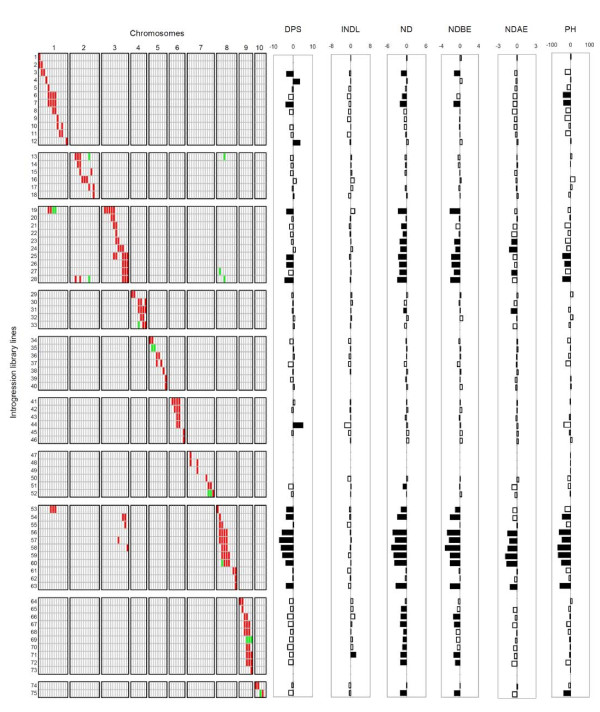
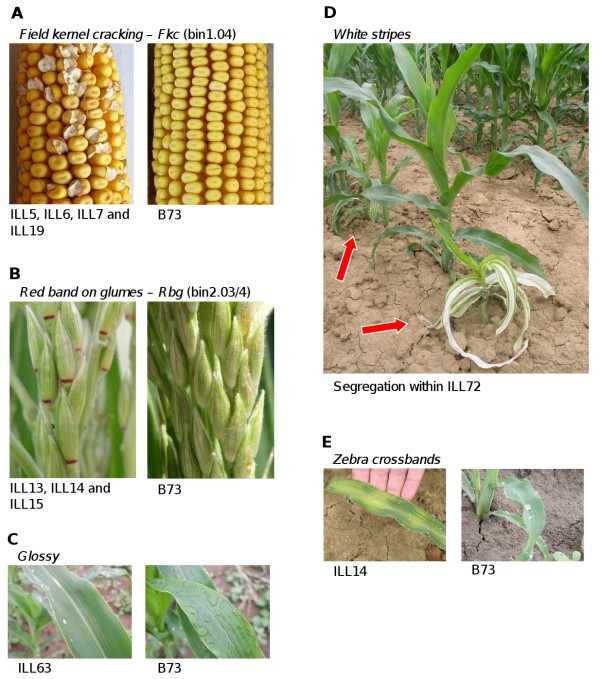
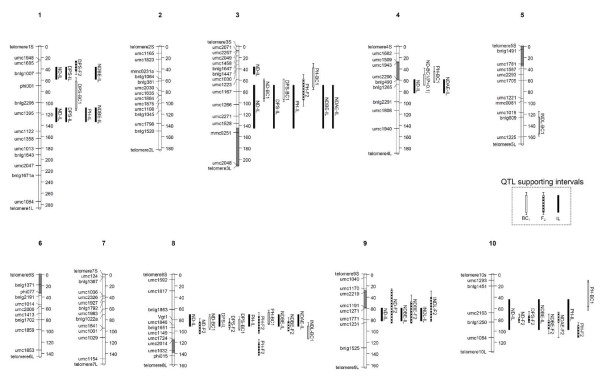
The collection includes 75 lines with an average Gaspé Flint introgression length of 43.1 cM. The collection was evaluated for flowering time, internode length, number of ears, number of nodes (phytomeres), number of nodes above the ear, number and proportion of nodes below the ear and plant height. Five QTLs for flowering time were mapped, all corresponding to major QTLs for number of nodes. Three additional QTLs for number of nodes were mapped. Besides flowering time, the QTLs for number of nodes drove phenotypic variation for plant height and number of nodes below and above the top ear, but not for internode length. A number of apparently Mendelian-inherited phenotypes were also observed.
While the inheritance of flowering time was dominated by the well-known QTL Vgt1, a number of other important flowering time QTLs were identified and, thanks to the type of plant material here utilized, immediately isogenized and made available for fine mapping. At each flowering time QTL, early flowering correlated with fewer vegetative phytomeres, indicating the latter as a key developmental strategy to adapt the maize crop from the original tropical environment to the northern border of the temperate zone (southern Canada), where Gaspé Flint was originally cultivated. Because of the trait differences between the two parental genotypes, this collection will serve as a permanent source of nearly isogenic materials for multiple studies of QTL analysis and cloning.
近等基因系集合,其中每条系携带供体基因组的限定部分进入共同的受体遗传背景,被称为基因渐渗系库,已被证明对解析数量性状至关重要。通过利用标记辅助回交,我们使用极早开花的玉米(Zea mays L.)品种 Gaspé Flint 和优秀的 B73 品系作为供体和受体基因型,制作了一个基因渐渗系库,并利用该系库研究了玉米开花时间和相关适应性及农艺性状的遗传基础。
该系库包含 75 条系,平均 Gaspé Flint 基因渐渗长度为 43.1cM。该系库对开花时间、节间长度、穗数、节数(分蘗节)、穗上节数、穗下节数和株高进行了评估。共定位到 5 个开花时间 QTL,均与主要的节点数 QTL 相对应。另外还定位到 3 个节点数 QTL。除了开花时间,节点数 QTL 还驱动了株高和穗上、穗下节点数的表型变异,但不影响节间长度。还观察到一些明显的孟德尔遗传表型。
虽然开花时间的遗传主要由著名的 Vgt1 QTL 主导,但也鉴定到了一些其他重要的开花时间 QTL,并且由于这里利用的植物材料类型,可以立即进行近等基因化并可用于精细作图。在每个开花时间 QTL 上,早开花与较少的营养分蘗节相关,表明后者是玉米作物从原始热带环境适应到温带北部边界(Gaspé Flint 最初种植的地方)的关键发育策略。由于两个亲本基因型之间的性状差异,该系库将成为多个 QTL 分析和克隆研究的近等基因材料的永久来源。