Department of Biomedical Engineering, The City College of New York, The City University of New York, New York, New York, United States of America.
PLoS One. 2011 Jan 5;6(1):e15956. doi: 10.1371/journal.pone.0015956.
Interstitial flow directly affects cells that reside in tissues and regulates tissue physiology and pathology by modulating important cellular processes including proliferation, differentiation, and migration. However, the structures that cells utilize to sense interstitial flow in a 3-dimensional (3D) environment have not yet been elucidated. Previously, we have shown that interstitial flow upregulates matrix metalloproteinase (MMP) expression in rat vascular smooth muscle cells (SMCs) and fibroblasts/myofibroblasts via activation of an ERK1/2-c-Jun pathway, which in turn promotes cell migration in collagen. Herein, we focused on uncovering the flow-induced mechanotransduction mechanism in 3D.
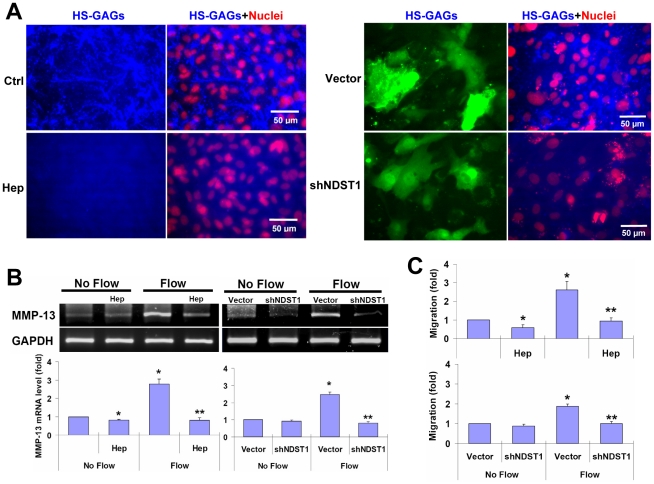
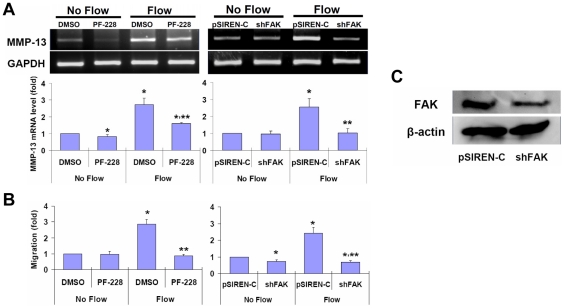
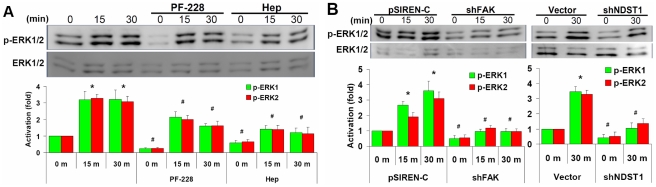
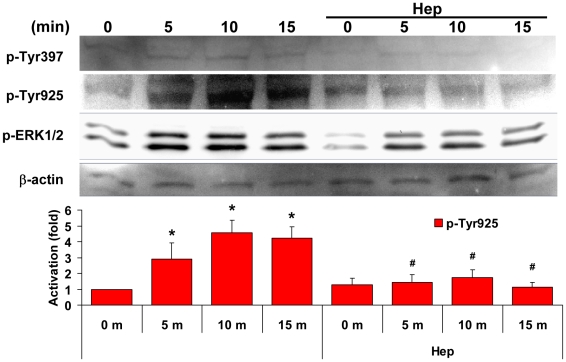
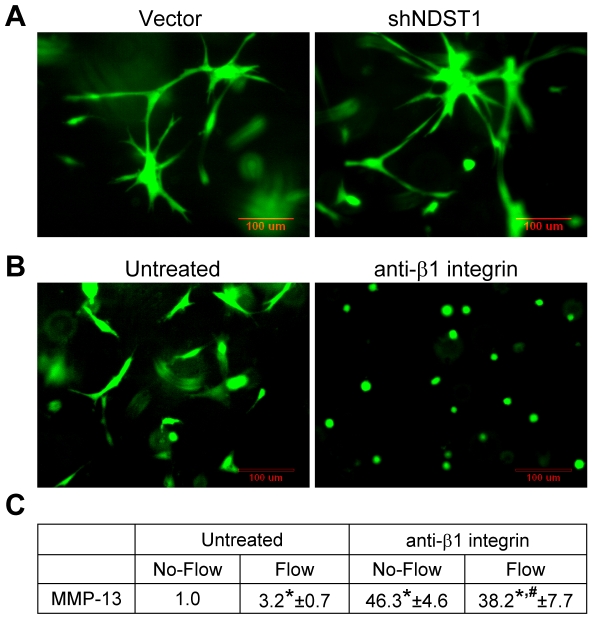
METHODOLOGY/PRINCIPAL FINDINGS: Cleavage of rat vascular SMC surface glycocalyx heparan sulfate (HS) chains from proteoglycan (PG) core proteins by heparinase or disruption of HS biosynthesis by silencing N-deacetylase/N-sulfotransferase 1 (NDST1) suppressed interstitial flow-induced ERK1/2 activation, interstitial collagenase (MMP-13) expression, and SMC motility in 3D collagen. Inhibition or knockdown of focal adhesion kinase (FAK) also attenuated or blocked flow-induced ERK1/2 activation, MMP-13 expression, and cell motility. Interstitial flow induced FAK phosphorylation at Tyr925, and this activation was blocked when heparan sulfate proteoglycans (HSPGs) were disrupted. These data suggest that HSPGs mediate interstitial flow-induced mechanotransduction through FAK-ERK. In addition, we show that integrins are crucial for mechanotransduction through HSPGs as they mediate cell spreading and maintain cytoskeletal rigidity.
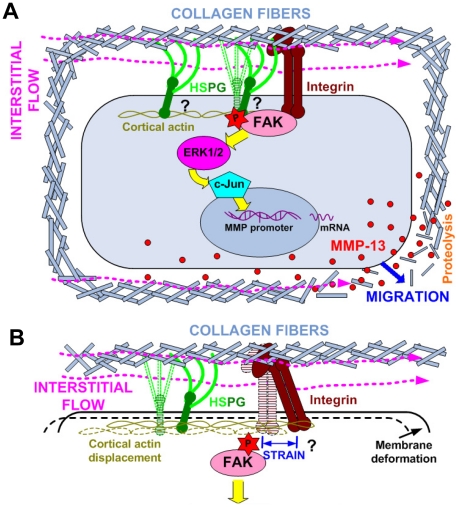
CONCLUSIONS/SIGNIFICANCE: We propose a conceptual mechanotransduction model wherein cell surface glycocalyx HSPGs, in the presence of integrin-mediated cell-matrix adhesions and cytoskeleton organization, sense interstitial flow and activate the FAK-ERK signaling axis, leading to upregulation of MMP expression and cell motility in 3D. This is the first study to describe a flow-induced mechanotransduction mechanism via HSPG-mediated FAK activation in 3D. This study will be of interest in understanding the flow-related mechanobiology in vascular lesion formation, tissue morphogenesis, cancer cell metastasis, and stem cell differentiation in 3D, and also has implications in tissue engineering.
间质流直接影响驻留在组织中的细胞,并通过调节包括增殖、分化和迁移在内的重要细胞过程来调节组织生理学和病理学。然而,细胞在三维(3D)环境中用于感知间质流的结构尚未阐明。先前,我们已经表明,间质流通过激活 ERK1/2-c-Jun 途径上调大鼠血管平滑肌细胞(SMC)和纤维母细胞/肌成纤维细胞中的基质金属蛋白酶(MMP)表达,这反过来又促进胶原中的细胞迁移。在此,我们专注于揭示 3D 中流动诱导的力学转导机制。
方法/主要发现:用肝素酶从蛋白聚糖(PG)核心蛋白中切割大鼠血管 SMC 表面糖萼硫酸乙酰肝素(HS)链,或通过沉默 N-脱乙酰基/N-磺基转移酶 1(NDST1)抑制 HS 生物合成,抑制间质流诱导的 ERK1/2 激活、间质胶原酶(MMP-13)表达和 3D 胶原中的 SMC 迁移。粘着斑激酶(FAK)的抑制或敲低也减弱或阻断了流动诱导的 ERK1/2 激活、MMP-13 表达和细胞迁移。间质流诱导 FAK 在 Tyr925 处磷酸化,当破坏硫酸乙酰肝素蛋白聚糖(HSPG)时,这种激活被阻断。这些数据表明 HSPG 通过 FAK-ERK 介导间质流诱导的力学转导。此外,我们还表明整合素对于通过 HSPG 的力学转导至关重要,因为它们介导细胞铺展并维持细胞骨架刚性。
结论/意义:我们提出了一个概念性的力学转导模型,其中细胞表面糖萼 HSPG,在整合素介导的细胞-基质附着和细胞骨架组织存在的情况下,感知间质流并激活 FAK-ERK 信号轴,导致 MMP 表达和 3D 中细胞迁移的上调。这是第一项描述 HSPG 介导的 FAK 激活在 3D 中诱导流动诱导的力学转导机制的研究。这项研究对于理解血管病变形成、组织形态发生、癌症细胞转移和 3D 中的干细胞分化中的与流动相关的力学生物学将很有兴趣,并且对组织工程也具有意义。