Department of Genetics, Biology and Biochemistry, University of Turin, Turin, Italy.
PLoS One. 2011 Jan 5;6(1):e15847. doi: 10.1371/journal.pone.0015847.
While G6PD deficiency is one of the major causes of acute hemolytic anemia, the membrane changes leading to red cell lysis have not been extensively studied. New findings concerning the mechanisms of G6PD deficient red cell destruction may facilitate our understanding of the large individual variations in susceptibility to pro-oxidant compounds and aid the prediction of the hemolytic activity of new drugs.
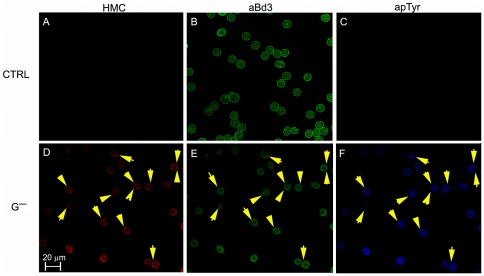
METHODOLOGY/PRINCIPAL FINDINGS: Our results show that treatment of G6PD deficient red cells with diamide (0.25 mM) or divicine (0.5 mM) causes: (1) an increase in the oxidation and tyrosine phosphorylation of AE1; (2) progressive recruitment of phosphorylated AE1 in large membrane complexes which also contain hemichromes; (3) parallel red cell lysis and a massive release of vesicles containing hemichromes. We have observed that inhibition of AE1 phosphorylation by Syk kinase inhibitors prevented its clustering and the membrane vesiculation while increases in AE1 phosphorylation by tyrosine phosphatase inhibitors increased both red cell lysis and vesiculation rates. In control RBCs we observed only transient AE1 phosphorylation.
CONCLUSIONS/SIGNIFICANCE: Collectively, our findings indicate that persistent tyrosine phosphorylation produces extensive membrane destabilization leading to the loss of vesicles which contain hemichromes. The proposed mechanism of hemolysis may be applied to other hemolytic diseases characterized by the accumulation of hemoglobin denaturation products.
虽然 G6PD 缺乏症是急性溶血性贫血的主要原因之一,但导致红细胞溶解的膜变化尚未得到广泛研究。关于 G6PD 缺乏红细胞破坏机制的新发现可能有助于我们理解对促氧化剂化合物的敏感性的个体差异,并有助于预测新药物的溶血活性。
方法/主要发现:我们的结果表明,用联脒(0.25mM)或双丁酰环磷腺苷(0.5mM)处理 G6PD 缺乏的红细胞会导致:(1)AE1 的氧化和酪氨酸磷酸化增加;(2)磷酸化的 AE1 逐渐募集到含有血影蛋白的大膜复合物中;(3)红细胞溶解和平行的大量含有血影蛋白的小泡释放。我们观察到,Syk 激酶抑制剂抑制 AE1 磷酸化可防止其聚集和膜小泡化,而酪氨酸磷酸酶抑制剂增加 AE1 磷酸化则同时增加红细胞溶解和小泡化速率。在对照 RBC 中,我们仅观察到短暂的 AE1 磷酸化。
结论/意义:总的来说,我们的发现表明持续的酪氨酸磷酸化会导致广泛的膜不稳定,从而导致含有血影蛋白的小泡丢失。所提出的溶血机制可应用于其他以血红蛋白变性产物积累为特征的溶血性疾病。