Laboratory of Reliability and Quality Control in Laboratory Hematology (HemQcR), Department of Biomedical Sciences, School of Health & Caring Sciences, University of West Attica (UniWA), 12243 Egaleo, Greece.
Department of Biology, Section of Cell Biology and Biophysics, National & Kapodistrian University of Athens (NKUA), 15784 Athens, Greece.
Biomolecules. 2022 Jun 8;12(6):803. doi: 10.3390/biom12060803.
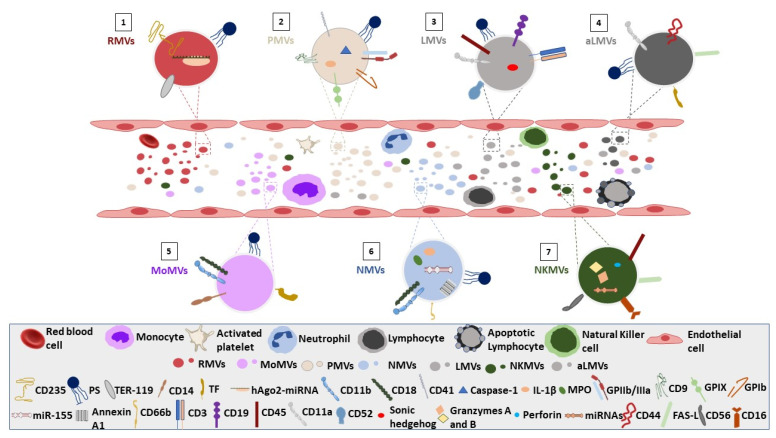
Microvesicles or ectosomes represent a major type of extracellular vesicles that are formed by outward budding of the plasma membrane. Typically, they are bigger than exosomes but smaller than apoptotic vesicles, although they may overlap with both in size and content. Their release by cells is a means to dispose redundant, damaged, or dangerous material; to repair membrane lesions; and, primarily, to mediate intercellular communication. By participating in these vital activities, microvesicles may impact a wide array of cell processes and, consequently, changes in their concentration or components have been associated with several pathologies. Of note, microvesicles released by leukocytes, red blood cells, and platelets, which constitute the vast majority of plasma microvesicles, change under a plethora of diseases affecting not only the hematological, but also the nervous, cardiovascular, and urinary systems, among others. In fact, there is evidence that microvesicles released by blood cells are significant contributors towards pathophysiological states, having inflammatory and/or coagulation and/or immunomodulatory arms, by either promoting or inhibiting the relative disease phenotypes. Consequently, even though microvesicles are typically considered to have adverse links with disease prognosis, progression, or outcomes, not infrequently, they exert protective roles in the affected cells. Based on these functional relations, microvesicles might represent promising disease biomarkers with diagnostic, monitoring, and therapeutic applications, equally to the more thoroughly studied exosomes. In the current review, we provide a summary of the features of microvesicles released by blood cells and their potential implication in hematological and non-hematological diseases.
微泡或外泌体是一种主要的细胞外囊泡,由质膜向外出芽形成。通常,它们比外泌体大,但比凋亡小体小,尽管它们在大小和内容上可能与两者重叠。细胞释放微泡是一种处理多余、受损或危险物质的方法;修复膜损伤;主要是介导细胞间通讯。通过参与这些重要的活动,微泡可能会影响广泛的细胞过程,因此,其浓度或成分的变化与几种病理学有关。值得注意的是,白细胞、红细胞和血小板释放的微泡(构成了绝大多数血浆微泡)在影响不仅是血液系统,还有神经系统、心血管系统和泌尿系统等多种疾病的情况下会发生变化。事实上,有证据表明,血细胞释放的微泡通过炎症和/或凝血和/或免疫调节作用,对病理生理状态有重要贡献,通过促进或抑制相对疾病表型。因此,尽管微泡通常被认为与疾病的预后、进展或结果有不良联系,但它们在受影响的细胞中经常发挥保护作用。基于这些功能关系,微泡可能代表具有诊断、监测和治疗应用潜力的有前途的疾病生物标志物,与更深入研究的外泌体一样。在当前的综述中,我们提供了血细胞释放的微泡的特征概述及其在血液学和非血液学疾病中的潜在作用。