Department of Cardiology, the Second hospital of Shandong University, Jinan, Shandong 250033, China.
Lipids Health Dis. 2011 Jan 19;10:13. doi: 10.1186/1476-511X-10-13.
Lipoprotein-associated phospholipase A₂ (Lp-PLA₂) is a recently identified and potentially useful plasma biomarker for cardiovascular and atherosclerotic diseases. However, the correlation between the Lp-PLA₂ activity and carotid atherosclerosis remains poorly investigated in patients with metabolic syndrome (MetS). The present study aimed to evaluate the potential role of Lp-PLA₂ as a comprehensive marker of metabolic syndrome in individuals with and without carotid atherosclerosis.
We documented 118 consecutive patients with MetS and 70 age- and sex-matched healthy subjects served as controls. The patients were further divided into two groups: 39 with carotid plaques and 79 without carotid plaques to elucidate the influence of Lp-PLA₂ on carotid atherosclerosis. The plasma Lp-PLA₂ activity was measured by using ELISA method and carotid intimal-media thickness (IMT) was performed by ultrasound in all participants.
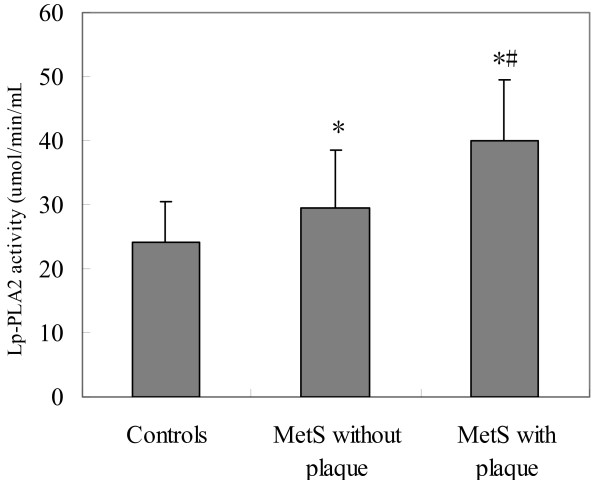
Lp-PLA₂ activity was significantly increased in MetS subgroups when compared with controls, and was higher in patients with carotid plaques than those without plaques (P < 0.05). Furthermore, we found that significant difference in Lp-PLA₂ was obtained between patients with three and four disorders of metabolic syndrome (P < 0.01). Age (β = 0.183, P = 0.029), LDL-cholesterol (β = 0.401, P = 0.000) and waist-hip ratio (β = 0.410, P = 0.000) emerged as significant and independent determinants of Lp-PLA₂ activity. Multiple stepwise regression analysis revealed that LDL-cholesterol (β = 0.309, P = 0.000), systolic blood pressure (β = 0.322, P = 0.002) and age (β = 0.235, P = 0.007) significantly correlated with max IMT, and Lp-PLA2 was not an independent predictor for carotid IMT.
Lp-PLA₂ may be a modulating factor for carotid IMT via age and LDL-cholesterol, not independent predictor in the pathophysiological process of carotid atherosclerosis in patients with MetS.
脂蛋白相关磷脂酶 A₂(Lp-PLA₂)是一种新近发现的、可能对心血管疾病和动脉粥样硬化疾病有用的血浆生物标志物。然而,代谢综合征(MetS)患者的 Lp-PLA₂活性与颈动脉粥样硬化之间的相关性仍研究甚少。本研究旨在评估 Lp-PLA₂作为代谢综合征个体的综合标志物的潜在作用,包括有颈动脉粥样硬化和无颈动脉粥样硬化的个体。
我们记录了 118 例连续的 MetS 患者和 70 例年龄和性别匹配的健康对照者。患者进一步分为两组:39 例有颈动脉斑块,79 例无颈动脉斑块,以阐明 Lp-PLA₂对颈动脉粥样硬化的影响。所有参与者均采用 ELISA 法测定血浆 Lp-PLA₂活性,采用超声测定颈动脉内膜中层厚度(IMT)。
与对照组相比,MetS 亚组的 Lp-PLA₂活性显著升高,且有颈动脉斑块的患者高于无斑块的患者(P < 0.05)。此外,我们发现代谢综合征有三种和四种疾病的患者之间的 Lp-PLA₂差异有统计学意义(P < 0.01)。年龄(β=0.183,P=0.029)、LDL-胆固醇(β=0.401,P=0.000)和腰臀比(β=0.410,P=0.000)是 Lp-PLA₂活性的显著独立决定因素。多元逐步回归分析显示,LDL-胆固醇(β=0.309,P=0.000)、收缩压(β=0.322,P=0.002)和年龄(β=0.235,P=0.007)与最大 IMT 显著相关,而 Lp-PLA2 不是颈动脉 IMT 的独立预测因子。
Lp-PLA₂可能通过年龄和 LDL-胆固醇调节颈动脉 IMT,但不是 MetS 患者颈动脉粥样硬化病理生理过程的独立预测因子。