• 文献检索
  • 文档翻译
  • 深度研究
  • 学术资讯
  • Suppr Zotero 插件Zotero 插件
  • 邀请有礼
  • 套餐&价格
  • 历史记录
应用&插件
Suppr Zotero 插件Zotero 插件浏览器插件Mac 客户端Windows 客户端微信小程序
定价
高级版会员购买积分包购买API积分包
服务
文献检索文档翻译深度研究API 文档MCP 服务
关于我们
关于 Suppr公司介绍联系我们用户协议隐私条款
关注我们

Suppr 超能文献

核心技术专利:CN118964589B侵权必究
粤ICP备2023148730 号-1Suppr @ 2026

文献检索

告别复杂PubMed语法,用中文像聊天一样搜索,搜遍4000万医学文献。AI智能推荐,让科研检索更轻松。

立即免费搜索

文件翻译

保留排版,准确专业,支持PDF/Word/PPT等文件格式,支持 12+语言互译。

免费翻译文档

深度研究

AI帮你快速写综述,25分钟生成高质量综述,智能提取关键信息,辅助科研写作。

立即免费体验

有经验的人工耳蜗植入患者对环境声音的感知。

Perception of environmental sounds by experienced cochlear implant patients.

机构信息

Rush University Medical Center, Communication Disorders and Sciences, Chicago, IL 60612, USA.

出版信息

Ear Hear. 2011 Jul-Aug;32(4):511-23. doi: 10.1097/AUD.0b013e3182064a87.

DOI:10.1097/AUD.0b013e3182064a87
PMID:21248643
原文链接:https://pmc.ncbi.nlm.nih.gov/articles/PMC3115425/
Abstract

OBJECTIVES

Environmental sound perception serves an important ecological function by providing listeners with information about objects and events in their immediate environment. Environmental sounds such as car horns, baby cries, or chirping birds can alert listeners to imminent dangers as well as contribute to one's sense of awareness and well being. Perception of environmental sounds as acoustically and semantically complex stimuli may also involve some factors common to the processing of speech. However, very limited research has investigated the abilities of cochlear implant (CI) patients to identify common environmental sounds, despite patients' general enthusiasm about them. This project (1) investigated the ability of patients with modern-day CIs to perceive environmental sounds, (2) explored associations among speech, environmental sounds, and basic auditory abilities, and (3) examined acoustic factors that might be involved in environmental sound perception.

DESIGN

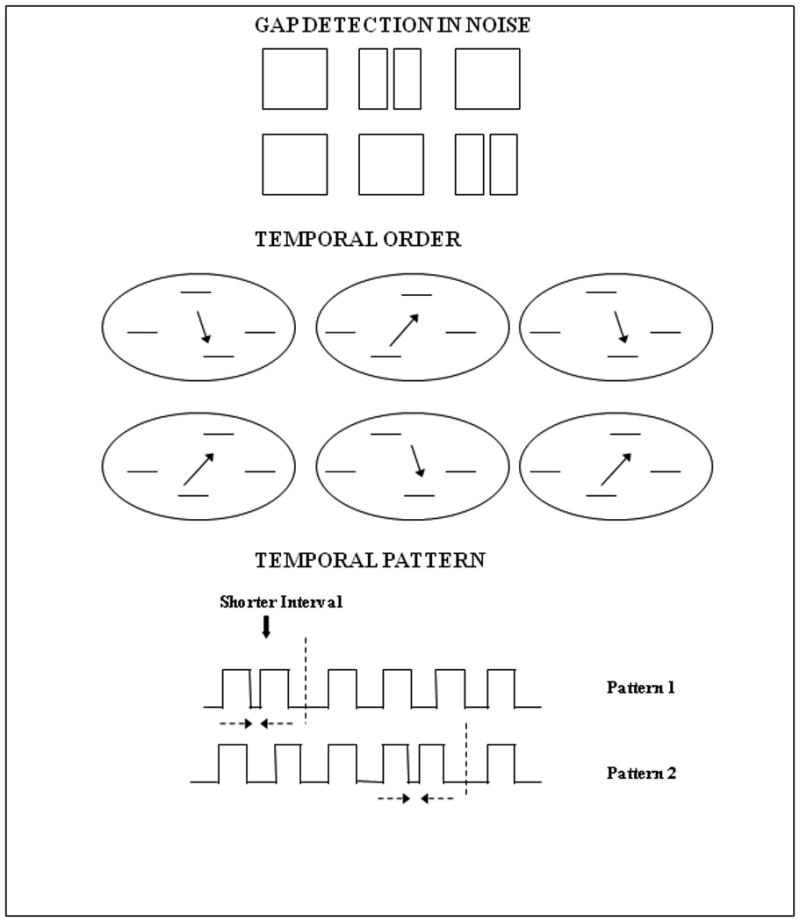
Seventeen experienced postlingually deafened CI patients participated in the study. Environmental sound perception was assessed with a large-item test composed of 40 sound sources, each represented by four different tokens. The relationship between speech and environmental sound perception and the role of working memory and some basic auditory abilities were examined based on patient performance on a battery of speech tests (HINT, CNC, and individual consonant and vowel tests), tests of basic auditory abilities (audiometric thresholds, gap detection, temporal pattern, and temporal order for tones tests), and a backward digit recall test.

RESULTS

The results indicated substantially reduced ability to identify common environmental sounds in CI patients (45.3%). Except for vowels, all speech test scores significantly correlated with the environmental sound test scores: r = 0.73 for HINT in quiet, r = 0.69 for HINT in noise, r = 0.70 for CNC, r = 0.64 for consonants, and r = 0.48 for vowels. HINT and CNC scores in quiet moderately correlated with the temporal order for tones. However, the correlation between speech and environmental sounds changed little after partialling out the variance due to other variables.

CONCLUSIONS

Present findings indicate that environmental sound identification is difficult for CI patients. They further suggest that speech and environmental sounds may overlap considerably in their perceptual processing. Certain spectrotemproral processing abilities are separately associated with speech and environmental sound performance. However, they do not appear to mediate the relationship between speech and environmental sounds in CI patients. Environmental sound rehabilitation may be beneficial to some patients. Environmental sound testing may have potential diagnostic applications, especially with difficult-to-test populations and might also be predictive of speech performance for prelingually deafened patients with cochlear implants.
https://cdn.ncbi.nlm.nih.gov/pmc/blobs/12a0/3115425/820bf09f5ab3/nihms270127f3.jpg
https://cdn.ncbi.nlm.nih.gov/pmc/blobs/12a0/3115425/a97c96f736b9/nihms270127f1.jpg
https://cdn.ncbi.nlm.nih.gov/pmc/blobs/12a0/3115425/20ddff896067/nihms270127f2.jpg
https://cdn.ncbi.nlm.nih.gov/pmc/blobs/12a0/3115425/820bf09f5ab3/nihms270127f3.jpg
https://cdn.ncbi.nlm.nih.gov/pmc/blobs/12a0/3115425/a97c96f736b9/nihms270127f1.jpg
https://cdn.ncbi.nlm.nih.gov/pmc/blobs/12a0/3115425/20ddff896067/nihms270127f2.jpg
https://cdn.ncbi.nlm.nih.gov/pmc/blobs/12a0/3115425/820bf09f5ab3/nihms270127f3.jpg
摘要

目的

环境声音感知通过向听众提供其周围环境中物体和事件的信息,从而发挥重要的生态功能。汽车喇叭声、婴儿哭声或鸟鸣声等环境声音可以提醒听众注意即将到来的危险,同时也有助于增强他们的意识和幸福感。对环境声音的感知作为复杂的听觉刺激,可能涉及到一些与言语处理共同的因素。然而,尽管患者普遍对其感兴趣,但针对使用现代人工耳蜗(CI)的患者识别常见环境声音的能力,相关研究非常有限。本项目(1)研究了具有现代 CI 的患者感知环境声音的能力,(2)探讨了言语、环境声音和基本听觉能力之间的关联,(3)检验了可能涉及环境声音感知的声学因素。

设计

17 名成年后失聪的 CI 患者参与了这项研究。使用由 40 个声源组成的大项目测试来评估环境声音感知,每个声源都有四个不同的样本。根据患者在一系列言语测试(HINT、CNC 以及个人辅音和元音测试)、基本听觉能力测试(听阈、间隙检测、音调和音序测试)和数字倒背测试中的表现,考察了言语和环境声音感知之间的关系以及工作记忆和一些基本听觉能力的作用。

结果

结果表明,CI 患者识别常见环境声音的能力明显下降(45.3%)。除了元音,所有言语测试得分均与环境声音测试得分显著相关:安静时 HINT 为 r = 0.73,噪声中 HINT 为 r = 0.69,CNC 为 r = 0.70,辅音为 r = 0.64,元音为 r = 0.48。安静时 HINT 和 CNC 与音调顺序的相关性较强。然而,在将其他变量的方差部分排除后,言语和环境声音之间的相关性变化不大。

结论

目前的研究结果表明,环境声音识别对 CI 患者来说很困难。进一步表明,言语和环境声音在感知处理上可能有很大的重叠。某些特定的频谱时间处理能力与言语和环境声音表现分别相关。然而,它们似乎并没有介导 CI 患者言语和环境声音之间的关系。环境声音康复可能对某些患者有益。环境声音测试可能具有潜在的诊断应用价值,特别是对于难以测试的人群,也可能对使用人工耳蜗的成年后失聪患者的言语表现具有预测作用。

相似文献

1
Perception of environmental sounds by experienced cochlear implant patients.有经验的人工耳蜗植入患者对环境声音的感知。
Ear Hear. 2011 Jul-Aug;32(4):511-23. doi: 10.1097/AUD.0b013e3182064a87.
2
Cochlear implant-mediated perception of nonlinguistic sounds.人工耳蜗介导的非语言声音感知。
Ear Hear. 2010 Aug;31(4):505-14. doi: 10.1097/AUD.0b013e3181d99a52.
3
Identification of vowel length, word stress, and compound words and phrases by postlingually deafened cochlear implant listeners.语后聋人工耳蜗植入者对元音长度、单词重音以及复合词和短语的识别
J Am Acad Audiol. 2013 Oct;24(9):879-90. doi: 10.3766/jaaa.24.9.11.
4
Behavioral Measures of Temporal Processing and Speech Perception in Cochlear Implant Users.人工耳蜗使用者时间处理与言语感知的行为测量
J Am Acad Audiol. 2016 Oct;27(9):701-713. doi: 10.3766/jaaa.15026.
5
Peripheral Neural Synchrony in Postlingually Deafened Adult Cochlear Implant Users.后天耳聋成年人工耳蜗使用者的外周神经同步性。
Ear Hear. 2024;45(5):1125-1137. doi: 10.1097/AUD.0000000000001502. Epub 2024 Mar 20.
6
Optimization of programming parameters in children with the advanced bionics cochlear implant.先进仿生人工耳蜗植入儿童编程参数的优化
J Am Acad Audiol. 2012 May;23(5):302-12. doi: 10.3766/jaaa.23.5.2.
7
Age-Related Changes in Temporal Resolution Revisited: Electrophysiological and Behavioral Findings From Cochlear Implant Users.重新探讨年龄相关的时间分辨率变化:来自人工耳蜗使用者的电生理和行为学发现。
Ear Hear. 2019 Nov/Dec;40(6):1328-1344. doi: 10.1097/AUD.0000000000000732.
8
Amplitude Modulation Detection and Speech Recognition in Late-Implanted Prelingually and Postlingually Deafened Cochlear Implant Users.晚期植入的语前聋和语后聋人工耳蜗使用者的调幅检测与语音识别
Ear Hear. 2015 Sep-Oct;36(5):557-66. doi: 10.1097/AUD.0000000000000162.
9
Electric and acoustic harmonic integration predicts speech-in-noise performance in hybrid cochlear implant users.电声谐波整合可预测混合式人工耳蜗使用者在噪声环境中的言语表现。
Hear Res. 2018 Sep;367:223-230. doi: 10.1016/j.heares.2018.06.016. Epub 2018 Jun 28.
10
The influence of environmental sound training on the perception of spectrally degraded speech and environmental sounds.环境声音训练对频谱退化语音和环境声音感知的影响。
Trends Amplif. 2012 Jun;16(2):83-101. doi: 10.1177/1084713812454225. Epub 2012 Aug 12.

引用本文的文献

1
Auditory sequence learning with degraded input: children with cochlear implants ('nature effect') compared to children from low and high socio-economic backgrounds ('nurture effect').输入退化时的听觉序列学习:与来自低社会经济背景和高社会经济背景的儿童(“后天培养效应”)相比,接受人工耳蜗植入的儿童(“先天效应”)。
Sci Rep. 2025 Mar 6;15(1):7872. doi: 10.1038/s41598-025-92454-2.
2
Cochlear-implant simulated spectral degradation attenuates emotional responses to environmental sounds.人工耳蜗模拟的频谱退化会减弱对环境声音的情绪反应。
Int J Audiol. 2025 May;64(5):518-524. doi: 10.1080/14992027.2024.2385552. Epub 2024 Aug 15.
3
Augmented-Reality Presentation of Household Sounds for Deaf and Hard-of-Hearing People.

本文引用的文献

1
Cochlear implant-mediated perception of nonlinguistic sounds.人工耳蜗介导的非语言声音感知。
Ear Hear. 2010 Aug;31(4):505-14. doi: 10.1097/AUD.0b013e3181d99a52.
2
Development of a large-item environmental sound test and the effects of short-term training with spectrally-degraded stimuli.大项目环境声音测试的开发以及频谱退化刺激的短期训练效果
Ear Hear. 2008 Oct;29(5):775-90. doi: 10.1097/AUD.0b013e31817e08ea.
3
Identification of environmental sounds with varying spectral resolution.具有不同频谱分辨率的环境声音识别。
增强现实呈现家居声音,帮助聋人和重听人士
Sensors (Basel). 2023 Sep 2;23(17):7616. doi: 10.3390/s23177616.
4
A convolutional neural network-based framework for analysis and assessment of non-linguistic sound classification and enhancement for normal hearing and cochlear implant listeners.一种基于卷积神经网络的框架,用于分析和评估正常听力和人工耳蜗听者的非语言声音分类及增强。
J Acoust Soc Am. 2022 Nov;152(5):2720. doi: 10.1121/10.0014955.
5
Identification of Everyday Sounds Affects Their Pleasantness.对日常声音的识别会影响其愉悦感。
Front Psychol. 2022 Jul 8;13:894034. doi: 10.3389/fpsyg.2022.894034. eCollection 2022.
6
Perception of Environmental Sounds in Cochlear Implant Users: A Systematic Review.人工耳蜗使用者对环境声音的感知:一项系统综述。
Front Neurosci. 2022 Jan 10;15:788899. doi: 10.3389/fnins.2021.788899. eCollection 2021.
7
A Longitudinal Comparison of Environmental Sound Recognition in Adults With Hearing Aids Before and After Cochlear Implantation.成人在植入人工耳蜗前后使用助听器的环境声音识别的纵向比较。
J Speech Lang Hear Res. 2021 Mar 17;64(3):1040-1052. doi: 10.1044/2020_JSLHR-20-00400. Epub 2021 Mar 2.
8
Development of the Basic Auditory Skills Evaluation Battery for Online Testing of Cochlear Implant Listeners.基本听觉技能评估电池的开发,用于在线测试人工耳蜗植入者的听力。
Am J Audiol. 2020 Sep 18;29(3S):577-590. doi: 10.1044/2020_AJA-19-00083.
9
Are There Real-world Benefits to Bimodal Listening?双模式听力是否有实际获益?
Otol Neurotol. 2020 Oct;41(9):e1111-e1117. doi: 10.1097/MAO.0000000000002767.
10
Categorization of everyday sounds by cochlear implanted children.人工耳蜗植入儿童对日常声音的分类。
Sci Rep. 2019 Mar 5;9(1):3532. doi: 10.1038/s41598-019-39991-9.
Ear Hear. 2008 Jun;29(3):401-20. doi: 10.1097/AUD.0b013e31816a0cf1.
4
Perceptual learning of spectrally degraded speech and environmental sounds.频谱退化语音和环境声音的感知学习。
J Acoust Soc Am. 2008 Feb;123(2):1126-39. doi: 10.1121/1.2823453.
5
Discrimination of Schroeder-phase harmonic complexes by normal-hearing and cochlear-implant listeners.正常听力者和人工耳蜗使用者对施罗德相位谐波复合体的辨别
J Assoc Res Otolaryngol. 2008 Mar;9(1):138-49. doi: 10.1007/s10162-007-0107-6. Epub 2007 Dec 8.
6
Similarity and categorization of environmental sounds.环境声音的相似性与分类
Percept Psychophys. 2007 Aug;69(6):839-55. doi: 10.3758/bf03193921.
7
Individual differences in source identification from synthesized impact sounds.从合成撞击声中进行声源识别的个体差异。
J Acoust Soc Am. 2007 Aug;122(2):1017-28. doi: 10.1121/1.2751269.
8
Individual differences in auditory abilities.听觉能力的个体差异。
J Acoust Soc Am. 2007 Jul;122(1):418-35. doi: 10.1121/1.2743154.
9
Spectral-ripple resolution correlates with speech reception in noise in cochlear implant users.频谱纹波分辨率与人工耳蜗使用者在噪声中的言语接受度相关。
J Assoc Res Otolaryngol. 2007 Sep;8(3):384-92. doi: 10.1007/s10162-007-0085-8. Epub 2007 Jun 21.
10
Psychophysical performance and Mandarin tone recognition in noise by cochlear implant users.人工耳蜗使用者在噪声环境中的心理物理学表现及普通话声调识别
Ear Hear. 2007 Apr;28(2 Suppl):62S-65S. doi: 10.1097/AUD.0b013e318031512c.