Heller Laurie M, Smith Jessica M
Auditory Lab, Department of Psychology, Carnegie Mellon University, Pittsburgh, PA, United States.
Front Psychol. 2022 Jul 8;13:894034. doi: 10.3389/fpsyg.2022.894034. eCollection 2022.
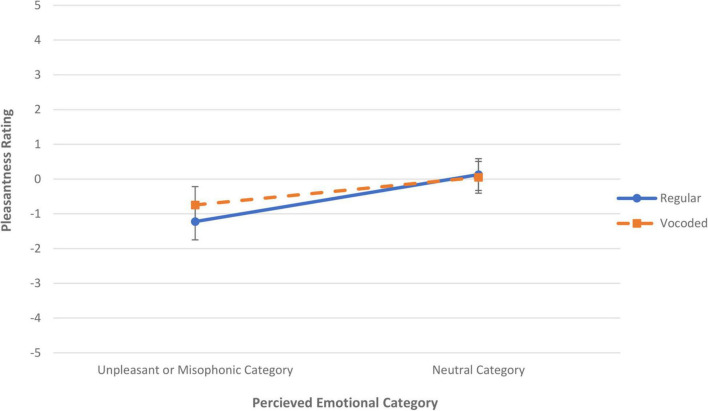
This study examines the role of source identification in the emotional response to everyday sounds. Although it is widely acknowledged that sound identification modulates the unpleasantness of sounds, this assumption is based on sparse evidence on a select few sounds. We gathered more robust evidence by having listeners judge the causal properties of sounds, such as actions, materials, and causal agents. Participants also identified and rated the pleasantness of the sounds. We included sounds from a variety of emotional categories, such as Neutral, Misophonic, Unpleasant, and Pleasant. The Misophonic category consists of everyday sounds that are uniquely distressing to a subset of listeners who suffer from Misophonia. Sounds from different emotional categories were paired together based on similar causal properties. This enabled us to test the prediction that a sound's pleasantness should increase or decrease if it is misheard as being in a more or less pleasant emotional category, respectively. Furthermore, we were able to induce more misidentifications by imposing spectral degradation in the form of envelope vocoding. Several instances of misidentification were obtained, all of which showed pleasantness changes that agreed with our predictions.
本研究考察了声源识别在对日常声音的情绪反应中的作用。尽管人们普遍认为声音识别会调节声音的不愉快程度,但这一假设基于对少数几种声音的稀少证据。我们通过让听众判断声音的因果属性,如动作、材料和因果主体,收集了更有力的证据。参与者还识别并评价了声音的愉悦程度。我们纳入了来自各种情绪类别的声音,如中性、恐音症、不愉快和愉悦。恐音症类别包括日常声音,这些声音对患有恐音症的一部分听众来说具有独特的困扰性。基于相似的因果属性,将来自不同情绪类别的声音配对在一起。这使我们能够检验这样的预测:如果一个声音被误听为处于更愉悦或更不愉悦的情绪类别中,其愉悦程度应该分别增加或降低。此外,我们通过以包络声码器的形式施加频谱退化来诱导更多的误识别。获得了几个误识别的实例,所有这些实例都显示出与我们的预测相符的愉悦程度变化。