Virginia Institute for Psychiatric and Behavioral Genetics, Department of Psychiatry, Medical College of Virginia of Virginia Commonwealth University, Richmond, VA, USA.
Psychol Med. 2011 Sep;41(9):1907-16. doi: 10.1017/S003329171000259X. Epub 2011 Jan 20.
Genetic and environmental factors are important in the etiology of substance use. However, little is known about the stability of these factors across development. We aimed to answer three crucial questions about this etiology that have never been addressed in a single study: (1) Is there a general vulnerability to substance consumption from early adolescence to young adulthood? (2) If so, do the genetic and environmental influences on this vulnerability change across development? (3) Do these developmental processes differ in males and females?
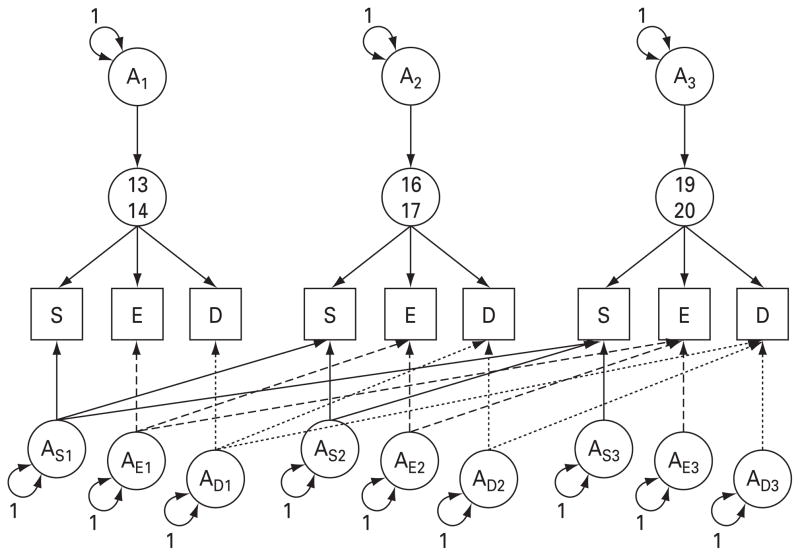
Subjects included 1480 twin pairs from the Swedish Twin Study of Child and Adolescent Development who have been followed since 1994. Prospective, self-reported regular smoking, alcohol intoxication and illicit drug use were assessed at ages 13-14, 16-17 and 19-20 years. Structural modeling was performed with the program Mx.
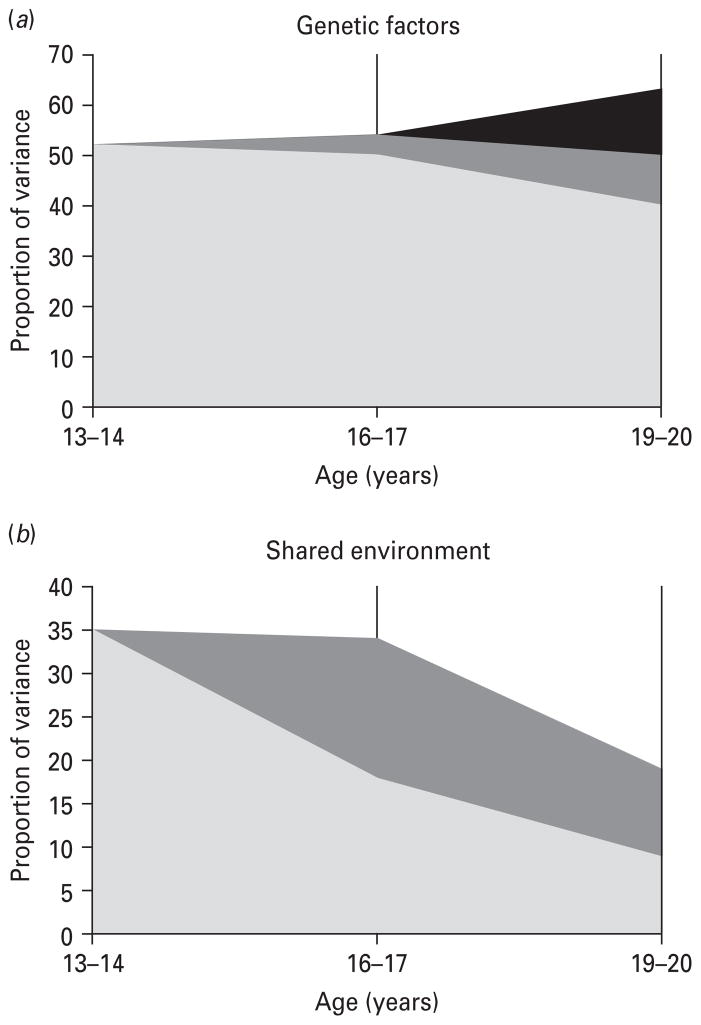
An underlying common factor accounted for the association between smoking, alcohol and illicit drug consumption for the three age groups. Common genetic and shared environmental effects showed substantial continuity. In general, as participants aged, the influence of the shared environment decreased, and genetic effects became more substance specific in their effect.
The current report answers three important questions in the etiology of substance use. The genetic and environmental risk for substance consumption is partly mediated through a common factor and is partly substance specific. Developmentally, evidence was strongest for stability of common genetic effects, with less evidence for genetic innovation. These processes seem to be the same in males and females.
遗传和环境因素在物质使用的病因学中很重要。然而,关于这些因素在整个发展过程中的稳定性知之甚少。我们旨在回答关于该病因学的三个关键问题,这些问题在单个研究中从未得到过解答:(1)从青少年早期到成年早期,是否存在对物质消费的普遍易感性?(2)如果是这样,这种易感性的遗传和环境影响是否会随时间变化?(3)这些发展过程在男性和女性之间是否存在差异?
受试者包括来自瑞典儿童和青少年发展双胞胎研究的 1480 对双胞胎,自 1994 年以来一直被跟踪。前瞻性、自我报告的定期吸烟、酒精中毒和非法药物使用在 13-14 岁、16-17 岁和 19-20 岁时进行评估。使用 Mx 程序进行结构建模。
一个潜在的共同因素解释了三个年龄组中吸烟、酒精和非法药物使用之间的关联。共同遗传和共享环境影响具有很大的连续性。一般来说,随着参与者年龄的增长,共享环境的影响减少,遗传效应在其效应上变得更加物质特异性。
本报告回答了物质使用病因学中的三个重要问题。物质消费的遗传和环境风险部分是通过共同因素介导的,部分是物质特异性的。从发展的角度来看,共同遗传效应稳定性的证据最强,遗传创新的证据较少。这些过程在男性和女性中似乎是相同的。