Department of Biochemistry and Biophysics, University of North Carolina at Chapel Hill, Chapel Hill, North Carolina, United States of America.
PLoS Comput Biol. 2011 Jan 6;7(1):e1001042. doi: 10.1371/journal.pcbi.1001042.
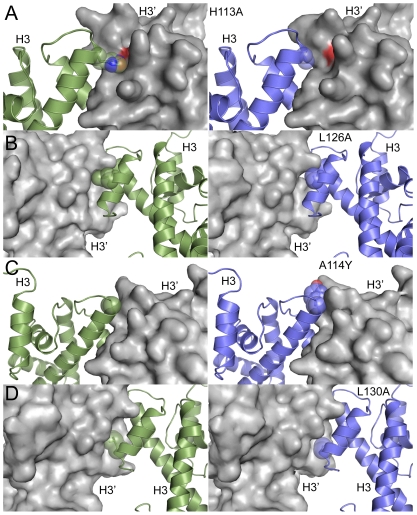
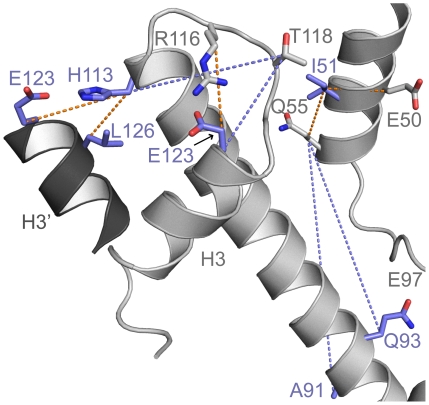
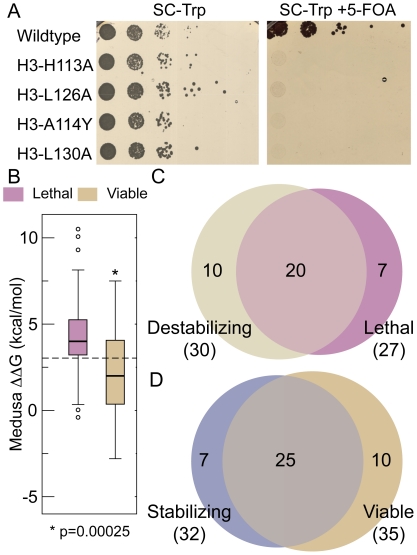
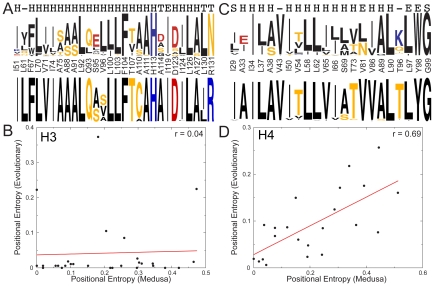
Determining the forces that conserve amino acid positions in proteins across species is a fundamental pursuit of molecular evolution. Evolutionary conservation is driven by either a protein's function or its thermodynamic stability. Highly conserved histone proteins offer a platform to evaluate these driving forces. While the conservation of histone H3 and H4 "tail" domains and surface residues are driven by functional importance, the driving force behind the conservation of buried histone residues has not been examined. Using a computational approach, we determined the thermodynamically preferred amino acids at each buried position in H3 and H4. In agreement with what is normally observed in proteins, we find a significant correlation between thermodynamic stability and evolutionary conservation in the buried residues in H4. In striking contrast, we find that thermodynamic stability of buried H3 residues does not correlate with evolutionary conservation. Given that these H3 residues are not post-translationally modified and only regulate H3-H3 and H3-H4 stabilizing interactions, our data imply an unknown function responsible for driving conservation of these buried H3 residues.
确定在不同物种的蛋白质中保守氨基酸位置的作用力是分子进化的基本追求。进化保守性是由蛋白质的功能或热力学稳定性驱动的。高度保守的组蛋白提供了一个评估这些驱动力的平台。虽然组蛋白 H3 和 H4“尾部”结构域和表面残基的保守性是由功能重要性驱动的,但尚未研究埋藏组蛋白残基保守性的驱动力。我们使用计算方法确定了 H3 和 H4 中每个埋藏位置的热力学优选氨基酸。与通常在蛋白质中观察到的情况一致,我们发现 H4 中埋藏残基的热力学稳定性与进化保守性之间存在显著相关性。相比之下,我们发现埋藏的 H3 残基的热力学稳定性与进化保守性无关。鉴于这些 H3 残基没有经过翻译后修饰,并且仅调节 H3-H3 和 H3-H4 稳定相互作用,我们的数据表明,负责驱动这些埋藏的 H3 残基保守性的未知功能。