Department of Dermatology and Venereology, Innsbruck Medical University, Anichstrasse 35, 6020 Innsbruck, Austria.
Curr Top Microbiol Immunol. 2012;351:113-38. doi: 10.1007/82_2010_118.
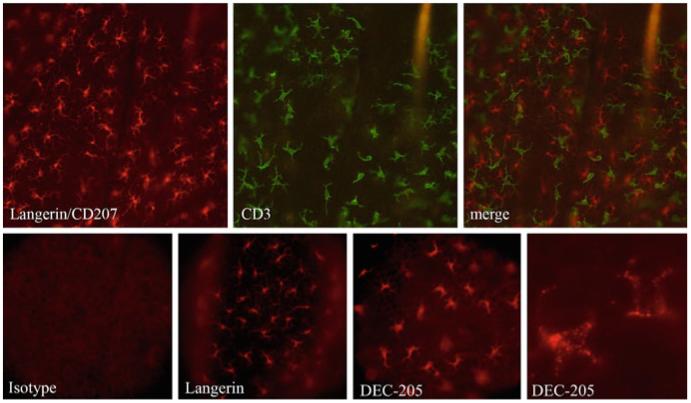
Vaccinations in medicine are typically administered into the muscle beneath the skin or into the subcutaneous fat. As a consequence, the vaccine is immunologically processed by antigen-presenting cells of the skin or the muscle. Recent evidence suggests that the clinically seldom used intradermal route is effective and possibly even superior to the conventional subcutaneous or intramuscular route. Several types of professional antigen-presenting cells inhabit the healthy skin. Epidermal Langerhans cells (CD207/langerin(+)), dermal langerin(neg), and dermal langerin(+) dendritic cells (DC) have been described, the latter subset so far only in mouse skin. In human skin langerin(neg) dermal DC can be further classified based on their reciprocal expression of CD1a and CD14. The relative contributions of these subsets to the generation of immunity or tolerance are still unclear. Yet, specializations of these different populations have become apparent. Langerhans cells in human skin appear to be specialized for induction of cytotoxic T lymphocytes; human CD14(+) dermal DC can promote antibody production by B cells. It is currently attempted to rationally devise and improve vaccines by harnessing such specific properties of skin DC. This could be achieved by specifically targeting functionally diverse skin DC subsets. We discuss here advances in our knowledge on the immunological properties of skin DC and strategies to significantly improve the outcome of vaccinations by applying this knowledge.
医学中的疫苗接种通常注入皮肤下的肌肉或皮下脂肪中。因此,疫苗被皮肤或肌肉中的抗原呈递细胞进行免疫处理。最近的证据表明,临床上很少使用的皮内途径是有效的,甚至可能优于传统的皮下或肌肉内途径。几种类型的专业抗原呈递细胞栖息在健康的皮肤中。已经描述了表皮朗格汉斯细胞(CD207/朗格汉斯蛋白(+))、真皮朗格汉斯蛋白(-)和真皮朗格汉斯蛋白(+)树突状细胞(DC),后一个亚群迄今为止仅在小鼠皮肤中发现。在人类皮肤中,根据其对 CD1a 和 CD14 的相互表达,可进一步对真皮 DC 中的朗格汉斯蛋白(-)进行分类。这些亚群对免疫或耐受的相对贡献仍不清楚。然而,这些不同群体的专业化已经变得明显。人类皮肤中的朗格汉斯细胞似乎专门用于诱导细胞毒性 T 淋巴细胞;人类 CD14(+)真皮 DC 可以促进 B 细胞产生抗体。目前,人们试图通过利用皮肤 DC 的这些特定特性来合理设计和改进疫苗。这可以通过专门针对功能多样化的皮肤 DC 亚群来实现。我们在这里讨论了关于皮肤 DC 免疫特性的知识进展,以及通过应用这些知识来显著提高疫苗接种效果的策略。