Forsea Ana-Maria, Carstea Elfrieda Mihaela, Ghervase Luminita, Giurcaneanu Calin, Pavelescu Gabriela
Dermatology Department, Elias University Hospital, Bucharest, Romania.
J Med Life. 2010 Oct-Dec;3(4):381-9.
Optical coherence tomography (OCT) is an emergent imaging technique, based on the interference of infrared radiation and living tissues, that allows the in vivo visualization of the skin structures, at high resolution and up to 1.6 mm depth. As such, there is mounting evidence that OCT may be an interesting technique for the diagnosis of skin diseases, including the noninvasive early detection of cutaneous tumors.
We aimed to investigate the utility of OCT for the diagnosis of non-melanocytic, non-pigmented cutaneous tumors.
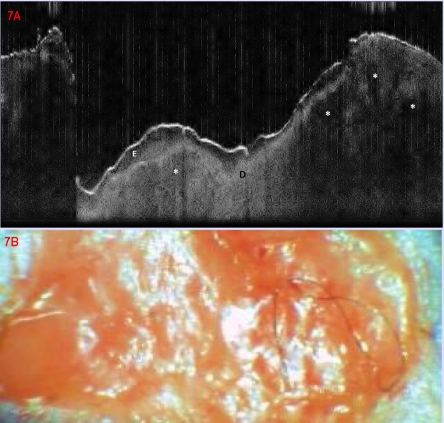
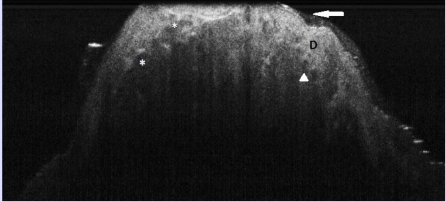
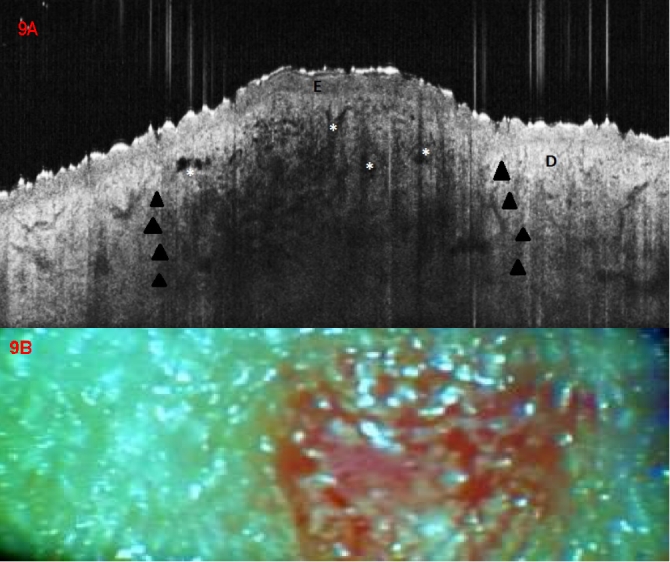
Preliminary results are presented from an initiated study. Fifteen consecutive patients with clinical suspicion of epithelial cancers and precancers registered over one week in a university dermatologic department were included. As control were selected 7 patients with inflammatory skin diseases (psoriasis, lichen planus, cutaneous lupus erythematosus). In all study and control patients, the lesions and samples of normal, perilesional skin were documented by clinical digital photography, contact dermoscopy with digital image capture and OCT with central wavelength of 930 nm. Final diagnosis was certified by histopathological analysis.
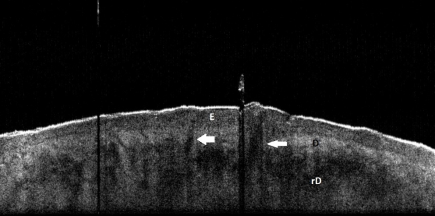
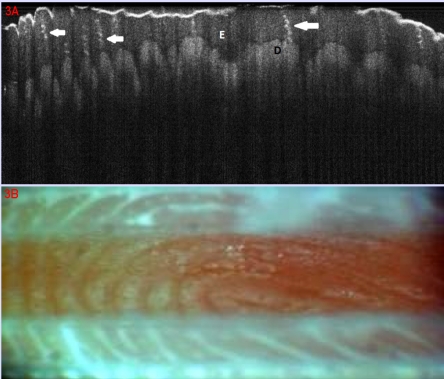
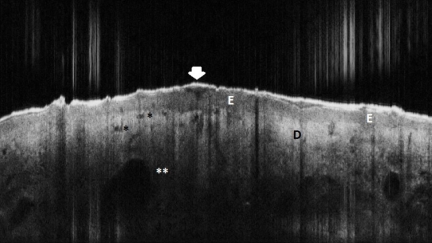
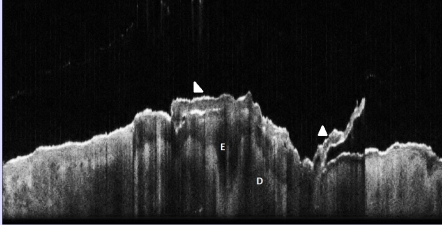
We could identify morphological features in OCT examination that distinguished between normal and lesional skin, and between neoplastic vs. inflammatory lesions. In the same time, combining OCT and dermatoscopical evaluation of a lesion improved the performance of diagnosis when compared to clinical diagnosis alone and with either OCT or dermoscopy imaging used alone.
OCT appears as a promising method of in vivo diagnosis of early neoplastic cutaneous lesions with equivocal clinical and/or dermoscopic aspect. Continuation of our study as well as other larger investigation will be able to contribute with new insights in the role of OCT in the non-invasive diagnosis of skin disease.
光学相干断层扫描(OCT)是一种新兴的成像技术,基于红外辐射与活体组织的干涉原理,能够在体内以高分辨率对皮肤结构进行可视化成像,深度可达1.6毫米。因此,越来越多的证据表明,OCT可能是一种用于诊断皮肤疾病的有趣技术,包括皮肤肿瘤的无创早期检测。
我们旨在研究OCT在诊断非黑素细胞性、无色素性皮肤肿瘤中的应用价值。
本文呈现了一项已启动研究的初步结果。纳入了在一所大学皮肤科连续登记的15例临床怀疑为上皮癌和癌前病变的患者,这些患者在一周内就诊。选择7例患有炎症性皮肤病(银屑病、扁平苔藓、皮肤红斑狼疮)的患者作为对照。对所有研究对象和对照患者的病变以及正常、病变周围皮肤样本,通过临床数码摄影、带数字图像采集的接触式皮肤镜检查以及中心波长为930纳米的OCT进行记录。最终诊断通过组织病理学分析得以证实。
我们能够在OCT检查中识别出区分正常皮肤与病变皮肤、肿瘤性病变与炎症性病变的形态学特征。同时,与单独的临床诊断以及单独使用OCT或皮肤镜成像相比,联合使用OCT和皮肤镜对病变进行评估可提高诊断性能。
对于临床和/或皮肤镜表现不明确的早期皮肤肿瘤性病变,OCT似乎是一种有前景的体内诊断方法。继续开展我们的研究以及其他更大规模的调查,将能够为OCT在皮肤疾病无创诊断中的作用提供新的见解。