Mongan Institute for Health Policy, and Tobacco Research and Treatment Center, Massachusetts General Hospital, Harvard Medical School, Boston, MA 02114, USA.
J Consult Clin Psychol. 2011 Feb;79(1):34-42. doi: 10.1037/a0022154.
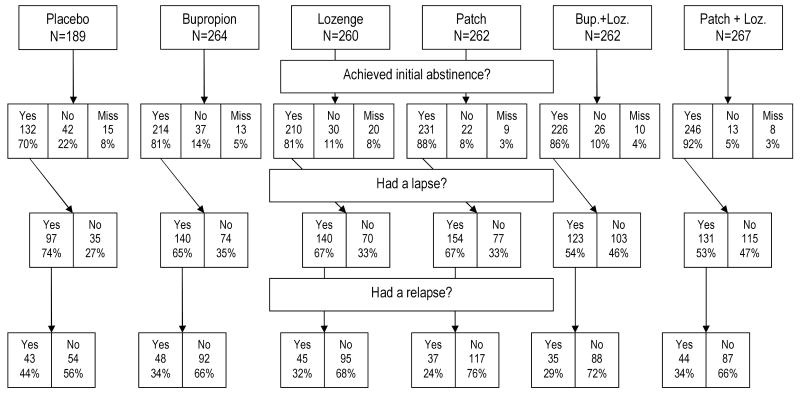
Most smoking cessation studies have used long-term abstinence as their primary outcome measure. Recent research has suggested that long-term abstinence may be an insensitive index of important smoking cessation mechanisms. The goal of the current study was to examine the effects of 5 smoking cessation pharmacotherapies using Shiffman et al.'s (2006) approach of examining the effect of smoking cessation medications on 3 process markers of cessation or smoking cessation milestones: initial abstinence, lapse, and the lapse-relapse transition.
The current study (N = 1,504; 58.2% female and 41.8% male; 83.9% Caucasian, 13.6% African American, 2.5% other races) examined the effect of 5 smoking cessation pharmacotherapy treatments versus placebo (bupropion, nicotine lozenge, nicotine patch, bupropion + lozenge, patch + lozenge) on Shiffman et al.'s smoking cessation milestones over 8 weeks following a quit attempt.
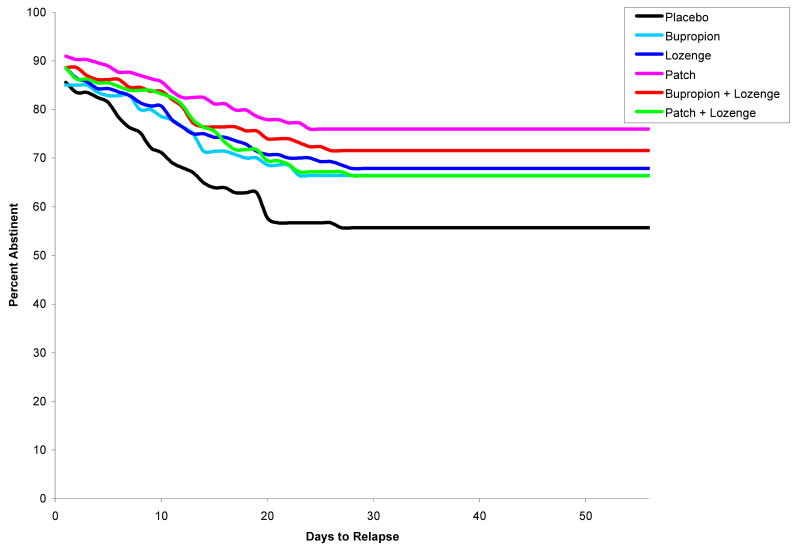
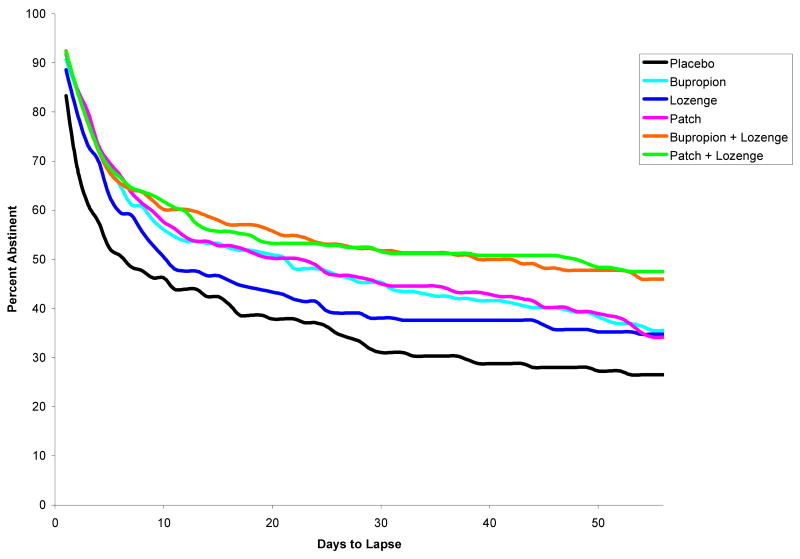
Results show that all 5 medication conditions decreased rates of failure to achieve initial abstinence and most (with the exception of the nicotine lozenge) decreased lapse risk; however, only the nicotine patch and bupropion + lozenge conditions affected the lapse-relapse transition.
These findings demonstrate that medications are effective at aiding initial abstinence and decreasing lapse risk but that they generally do not decrease relapse risk following a lapse. The analysis of cessation milestones sheds light on important impediments to long-term smoking abstinence, suggests potential mechanisms of action of smoking cessation pharmacotherapies, and identifies targets for future treatment development.
大多数戒烟研究都将长期戒烟作为主要的结果衡量标准。最近的研究表明,长期戒烟可能是一个不敏感的重要戒烟机制的指标。本研究的目的是使用 Shiffman 等人(2006 年)的方法,通过检查戒烟药物对戒烟或戒烟里程碑的 3 个过程标记物的影响,来检验 5 种戒烟药物治疗的效果:初始戒烟、复发和复发-复发过渡。
本研究(N=1504;58.2%女性和 41.8%男性;83.9%白种人,13.6%非裔美国人,2.5%其他种族)检验了 5 种戒烟药物治疗(安非他酮、尼古丁含片、尼古丁贴片、安非他酮+含片、贴片+含片)与安慰剂相比,对戒烟尝试后 8 周内 Shiffman 等人的戒烟里程碑的影响。
结果表明,所有 5 种药物治疗都降低了未能实现初始戒烟的比率,大多数(尼古丁含片除外)降低了复发风险;然而,只有尼古丁贴片和安非他酮+含片治疗条件影响了复发-复发过渡。
这些发现表明,药物在帮助初始戒烟和降低复发风险方面是有效的,但它们通常不能降低复发后的复发风险。对戒烟里程碑的分析揭示了长期戒烟的重要障碍,表明了戒烟药物治疗的潜在作用机制,并确定了未来治疗发展的目标。