Key Laboratory of Forest Tree Genetic Improvement and Biotechnology (Northeast Forestry University), Ministry of Education, Harbin 150040, China.
J Insect Sci. 2010;10:200. doi: 10.1673/031.010.20001.
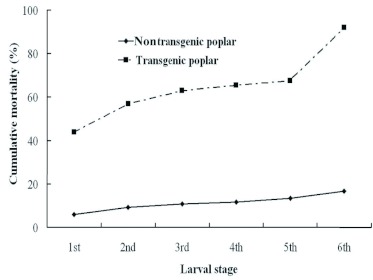
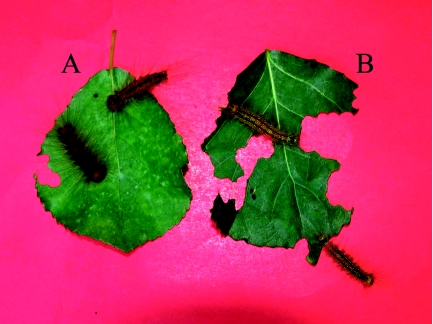
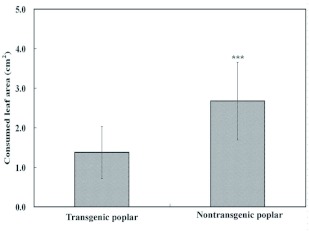
The response of the Asian gypsy moth Lymantria dispar (L.) (Lepidoptera: Lymantriidae) to a fusion gene consisting of the spider, Atrax robustus Simon (Araneae: Hexanthelidae) ω-ACTX-Ar1 sequence coding for an ω-atracotoxin and a sequence coding for the Bt-toxin C-peptide, expressed in transgenic poplar Populus simonii x P. nigra L. (Malphigiales: Salicaceae) was investigated. Individual performance, feeding selection, midgut proteinase activity and nutrition utilization were monitored. The growth and development of L. dispar were significantly affected by continually feeding on the transgenic poplar, with the larval instars displaying significantly shorter developmental times than those fed on nontransgenic poplar, but pupation was delayed. Mortality was higher in populations fed transgenic poplar leaves, than for larvae fed nontransgenic poplar leaves. The cumulative mortality during all stages of larvae fed transgenic leaves was 92% compared to 16.7% of larvae on nontransgenic leaves. The highest mortality observed was 71.7% in the last larval instar stage. A two-choice test showed that fifth-instar larvae preferred to feed on nontransgenic leaves at a ratio of 1:1.4. Feeding on transgenic leaves had highly significant negative effects on relative growth of larvae, and the efficiency of conversion of ingested and digested food. Activity of major midgut proteinases was measured using substrates TAME and BTEE showed significant increases in tryptase and chymotrypsinlike activity (9.2- and 9.0-fold, respectively) in fifth-instar larvae fed on transgenic leaves over control. These results suggest transgenic poplar is resistant to L. dispar, and the mature L. dispar may be weakened by the transgenic plants due to Bt protoxins activated by elevated major midgut proteinase activity. The new transgenic poplar expressing fusion protein genes of Bt and a new spider insecticidal peptide are good candidates for managing gypsy moth.
研究了由蜘蛛,Atrax robustus Simon(Araneae:Hexanthelidae)ω-ACTX-Ar1 序列编码的 ω-蜘蛛毒素和编码 Bt 毒素 C-肽的序列组成的融合基因对亚洲舞毒蛾 Lymantria dispar(鳞翅目:Lymantriidae)的反应,该基因在转基因杨树 Populus simonii x P. nigra L.(Malphigiales:Salicaceae)中表达。监测了个体表现,取食选择,中肠蛋白酶活性和营养利用。 L. dispar 的生长和发育受到持续取食转基因杨树的显著影响,幼虫各龄期的发育时间明显短于取食非转基因杨树的幼虫,但化蛹延迟。取食转基因杨树叶片的种群死亡率高于取食非转基因杨树叶片的幼虫。取食转基因叶片的幼虫在所有发育阶段的累积死亡率为 92%,而取食非转基因叶片的幼虫为 16.7%。最后一龄幼虫的死亡率最高,为 71.7%。二选一测试表明,五龄幼虫更喜欢以 1:1.4 的比例取食非转基因叶片。取食转基因叶片对幼虫的相对生长和摄入及消化食物的转化效率有很高的负面影响。使用 TAME 和 BTEE 作为底物测量主要中肠蛋白酶的活性表明,取食转基因叶片的五龄幼虫的胰蛋白酶和糜蛋白酶样活性分别显著增加了 9.2-和 9.0 倍。这些结果表明,转基因杨树对舞毒蛾具有抗性,成熟的舞毒蛾可能由于中肠蛋白酶活性升高而被转基因植物激活的 Bt 原毒素而减弱。表达 Bt 和新型蜘蛛杀虫肽融合蛋白基因的新型转基因杨树是防治舞毒蛾的良好候选材料。