Institute for Molecular Bioscience, University of Queensland, St Lucia, Australia.
PLoS One. 2013 Sep 11;8(9):e73136. doi: 10.1371/journal.pone.0073136. eCollection 2013.
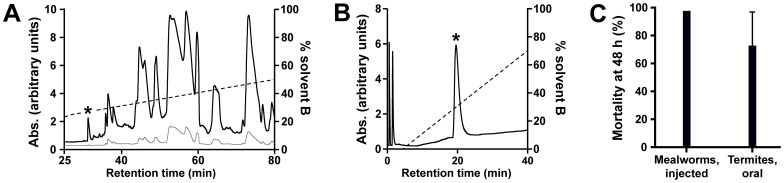
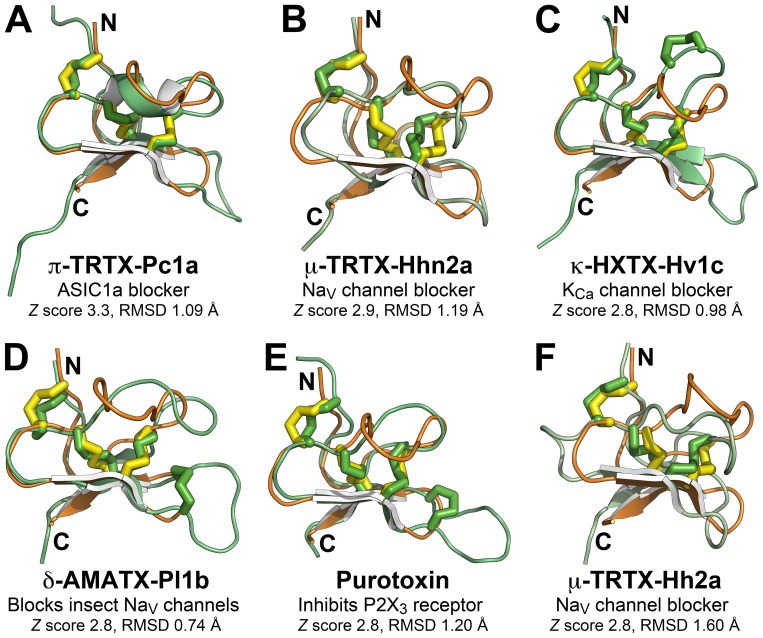
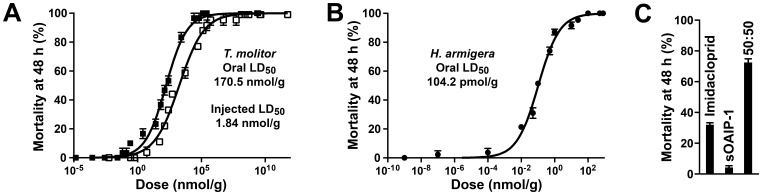
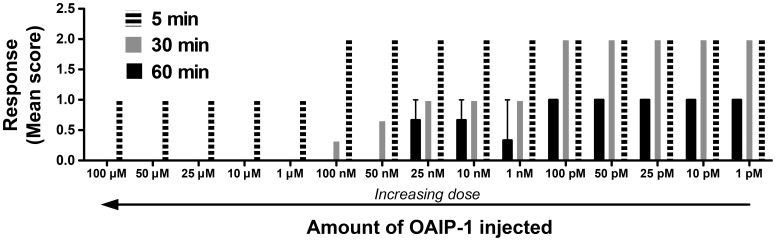
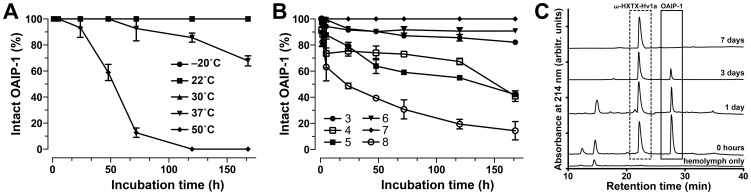
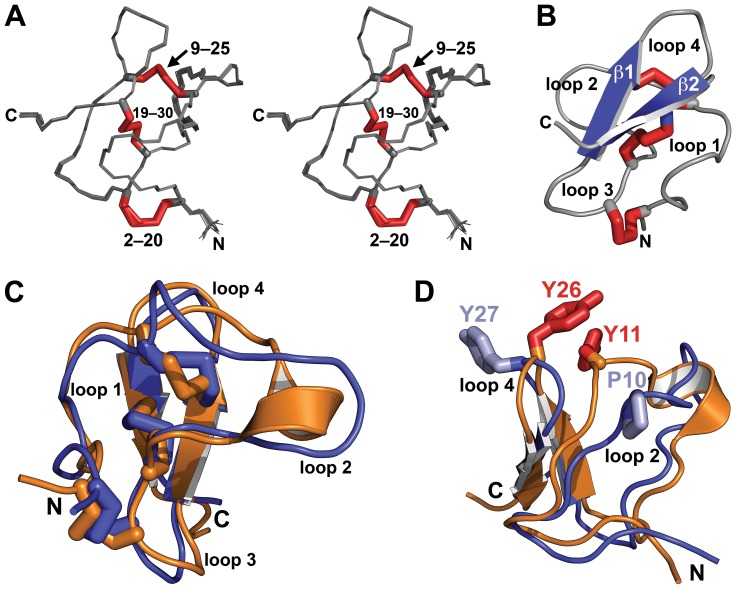
Many insect pests have developed resistance to existing chemical insecticides and consequently there is much interest in the development of new insecticidal compounds with novel modes of action. Although spiders have deployed insecticidal toxins in their venoms for over 250 million years, there is no evolutionary selection pressure on these toxins to possess oral activity since they are injected into prey and predators via a hypodermic needle-like fang. Thus, it has been assumed that spider-venom peptides are not orally active and are therefore unlikely to be useful insecticides. Contrary to this dogma, we show that it is possible to isolate spider-venom peptides with high levels of oral insecticidal activity by directly screening for per os toxicity. Using this approach, we isolated a 34-residue orally active insecticidal peptide (OAIP-1) from venom of the Australian tarantula Selenotypus plumipes. The oral LD50 for OAIP-1 in the agronomically important cotton bollworm Helicoverpa armigera was 104.2±0.6 pmol/g, which is the highest per os activity reported to date for an insecticidal venom peptide. OAIP-1 is equipotent with synthetic pyrethroids and it acts synergistically with neonicotinoid insecticides. The three-dimensional structure of OAIP-1 determined using NMR spectroscopy revealed that the three disulfide bonds form an inhibitor cystine knot motif; this structural motif provides the peptide with a high level of biological stability that probably contributes to its oral activity. OAIP-1 is likely to be synergized by the gut-lytic activity of the Bacillus thuringiensis Cry toxin (Bt) expressed in insect-resistant transgenic crops, and consequently it might be a good candidate for trait stacking with Bt.
许多昆虫害虫已经对现有的化学杀虫剂产生了抗性,因此人们非常关注开发具有新作用模式的新杀虫剂化合物。尽管蜘蛛在其毒液中已经部署了杀虫毒素超过 2.5 亿年,但由于这些毒素是通过类似皮下注射的毒牙注射到猎物和捕食者体内,因此它们没有进化选择压力来具有口服活性。因此,人们一直认为蜘蛛毒液肽没有口服活性,因此不太可能成为有用的杀虫剂。与这一教条相反,我们通过直接筛选口服毒性,证明有可能分离出具有高口服杀虫活性的蜘蛛毒液肽。使用这种方法,我们从澳大利亚狼蛛 Selenotypus plumipes 的毒液中分离出一种 34 个残基的具有口服活性的杀虫肽 (OAIP-1)。OAIP-1 在农业上重要的棉铃虫 Helicoverpa armigera 中的口服 LD50 为 104.2±0.6 pmol/g,这是迄今为止报道的杀虫毒液肽的最高口服活性。OAIP-1 与合成拟除虫菊酯等效,并且与新烟碱类杀虫剂协同作用。使用 NMR 光谱确定的 OAIP-1 的三维结构表明,三个二硫键形成了一个抑制剂半胱氨酸结基序;这种结构基序赋予肽高水平的生物稳定性,这可能有助于其口服活性。OAIP-1 可能与在抗虫转基因作物中表达的苏云金芽孢杆菌 Cry 毒素(Bt)的肠溶活性协同增效,因此它可能是与 Bt 进行性状叠加的良好候选物。