Trejaut Jean, Lee Chien-Liang, Yen Ju-Chen, Loo Jun-Hun, Lin Marie
Mackay Memorial Hospital, #45 Min-Sheng Road, Tamsui 25115, Taiwan.
Chin J Cancer. 2011 Feb;30(2):96-105. doi: 10.5732/cjc.010.10589.
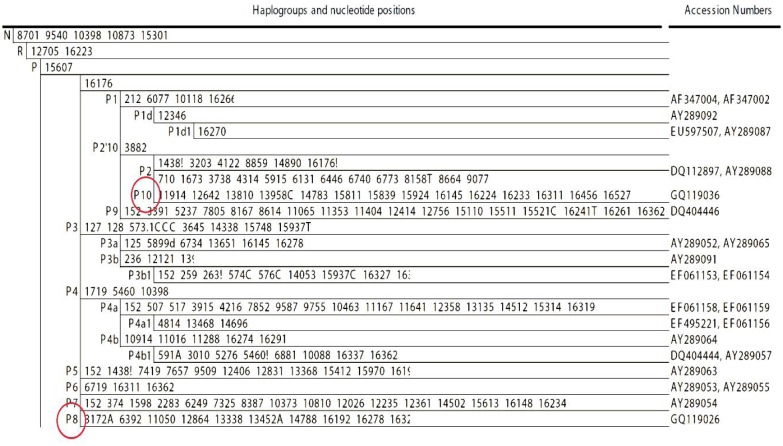
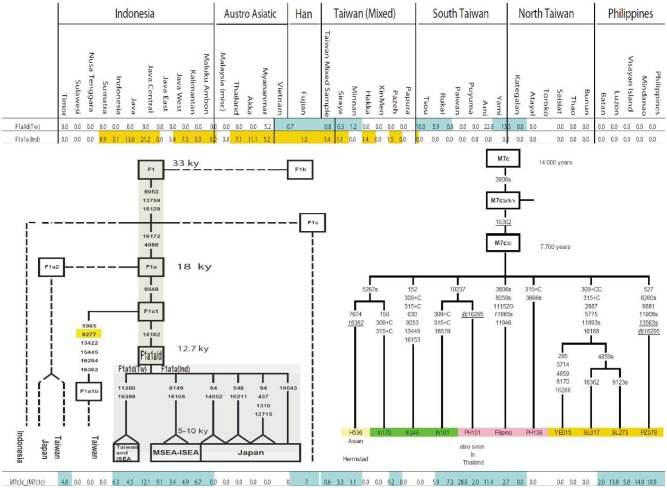
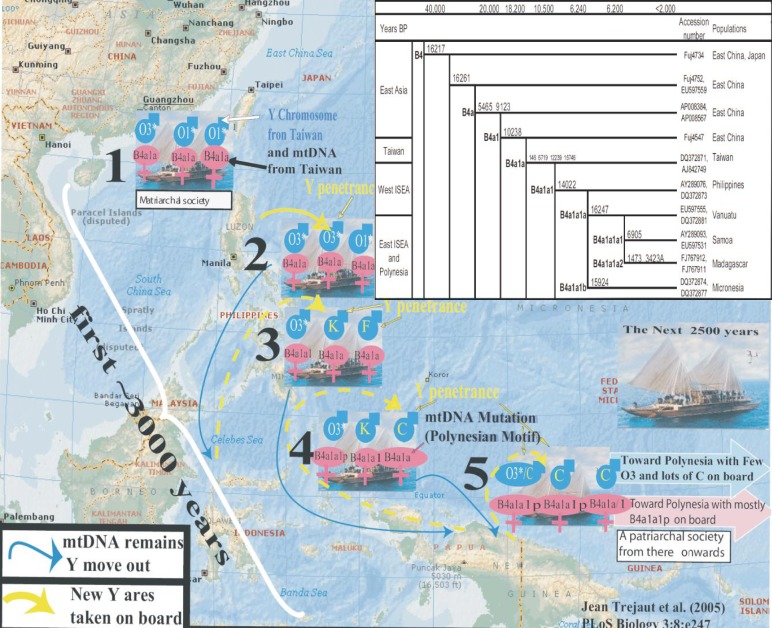
Mitochondrial DNA (mtDNA) and non-recombining Y chromosome (NRY) are inherited uni-parentally from mother to daughter or from father to son respectively. Their polymorphism has initially been studied throughout populations of the world to demonstrate the "Out of Africa" hypothesis. Here, to correlate the distribution of nasopharyngeal carcinoma (NPC) in different populations of insular Asia, we analyze the mtDNA information (lineages) obtained from genotyping of the hyper variable region (HVS I & II) among 1400 individuals from island Southeast Asia (ISEA), Taiwan and Fujian and supplemented with the analysis of relevant coding region polymorphisms. Lineages that best represented a clade (a branch of the genetic tree) in the phylogeny were further analyzed using complete genomic mtDNA sequencing. Finally, these complete mtDNA sequences were used to construct a most parsimonious tree which now constitutes the most up-to-date mtDNA dataset available on ISEA and Taiwan. This analysis has exposed new insights of the evolutionary history of insular Asia and has strong implications in assessing possible correlations with linguistic, archaeology, demography and the NPC distribution in populations within these regions. To obtain a more objective and balanced genetic point of view, slowly evolving biallelic Y single nucleotide polymorphism (Y-SNP) was also analyzed. As in the first step above, the technique was first applied to determine affinities (macro analysis) between populations of insular Asia. Secondly, sixteen Y short tandem repeats (Y-STR) were used as they allow deeper insight (micro analysis) into the relationship between individuals of a same region. Together, mtDNA and NRY allowed a better definition of the relational, demographic, cultural and genetic components that constitute the make up of the present day peoples of ISEA. Outstanding findings were obtained on the routes of migration that occurred along with the spread of NPC during the settlement of insular Asia. The results of this analysis will be discussed using a conceptual approach.
线粒体DNA(mtDNA)和非重组Y染色体(NRY)分别从母亲到女儿或从父亲到儿子进行单亲遗传。最初,人们在全世界人群中研究了它们的多态性,以证明“走出非洲”假说。在此,为了关联亚洲岛屿不同人群中鼻咽癌(NPC)的分布情况,我们分析了从东南亚岛屿(ISEA)、台湾和福建的1400名个体的高变区(HVS I和II)基因分型中获得的mtDNA信息(谱系),并辅以相关编码区多态性分析。在系统发育中最能代表一个进化枝(遗传树的一个分支)的谱系,通过完整基因组mtDNA测序进一步分析。最后,这些完整的mtDNA序列被用于构建一棵最简约树,这棵树现在构成了ISEA和台湾现有的最新mtDNA数据集。该分析揭示了亚洲岛屿进化历史的新见解,并对评估这些地区人群中语言、考古、人口统计学与NPC分布之间的可能关联具有重要意义。为了获得更客观和平衡的遗传观点,还分析了进化缓慢的双等位基因Y单核苷酸多态性(Y-SNP)。与上述第一步一样,该技术首先用于确定亚洲岛屿人群之间的亲缘关系(宏观分析)。其次,使用了16个Y短串联重复序列(Y-STR),因为它们能更深入地洞察同一地区个体之间的关系(微观分析)。mtDNA和NRY共同使得对构成ISEA当今人群组成的关系、人口统计学、文化和遗传成分有了更好的定义。在亚洲岛屿定居期间,随着NPC传播而发生的迁徙路线上获得了显著发现。将使用概念性方法讨论该分析结果。