Department of Molecular Cardiovascular Biology and Pharmacology, Graduate School of Medicine, Ehime University, Tohon, Ehime 791-0295, Japan.
Cardiol Res Pract. 2011 Jan 9;2011:306189. doi: 10.4061/2011/306189.
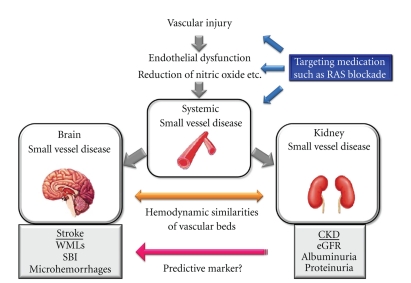
Patients with chronic kidney disease (CKD) are well known to have a higher prevalence of cardiovascular disease from epidemiological studies. Recently, CKD has also been shown to be related to neurological disorders, not only ischemic brain injury but also cognitive impairment. This cerebrorenal connection is considered to involve small vessel disease in both the kidney and brain, based on their hemodynamic similarities. Clinical studies suggest that markers for CKD such as estimated glomerular filtration rate (eGFR), proteinuria, and albuminuria may be helpful to predict brain small vessel disease, white matter lesions (WMLs), silent brain ischemia (SBI), and microhemorrhages. Recently, changes in the vascular system of the brain have been shown to contribute to the onset and progression of cognitive impairment, not only vascular dementia but also Alzheimer's disease. Patients with CKD are also reported to have higher risk of impaired cognitive function in the future compared with non-CKD subjects. These results indicate that CKD markers may be helpful to predict the future risk of neuronal disease.
慢性肾脏病(CKD)患者的流行病学研究表明,其心血管疾病的患病率更高。最近,CKD 也与神经系统疾病有关,不仅与缺血性脑损伤有关,而且与认知障碍有关。这种肾脑关联被认为涉及肾脏和大脑的小血管疾病,这基于它们的血流动力学相似性。临床研究表明,CKD 的标志物,如估计肾小球滤过率(eGFR)、蛋白尿和白蛋白尿,可能有助于预测脑小血管疾病、白质病变(WML)、无症状性脑缺血(SBI)和微出血。最近,研究表明,大脑血管系统的变化可能导致认知障碍的发生和进展,不仅与血管性痴呆有关,而且与阿尔茨海默病有关。与非 CKD 患者相比,CKD 患者的认知功能受损风险也更高。这些结果表明,CKD 标志物可能有助于预测未来的神经疾病风险。