CSIRO Mathematics Informatics and Statistics, The Leeuwin Centre, 65 Brockway Road, Floreat, Western Australia.
BMC Bioinformatics. 2011 Feb 1;12:42. doi: 10.1186/1471-2105-12-42.
Typical analysis of microarray data ignores the correlation between gene expression values. In this paper we present a model for microarray data which specifically allows for correlation between genes. As a result we combine gene network ideas with linear models and differential expression.
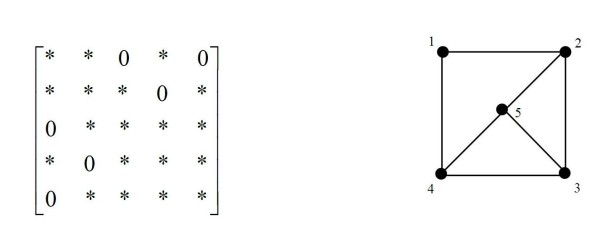
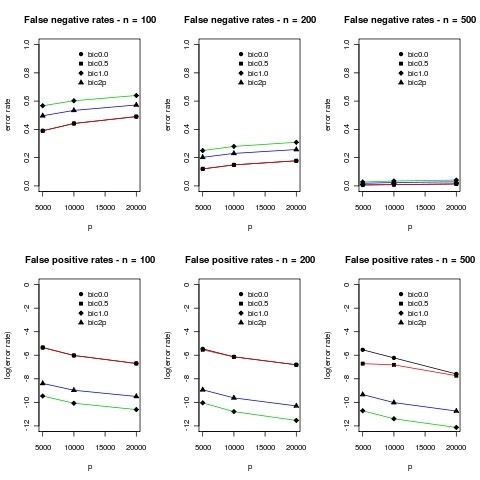
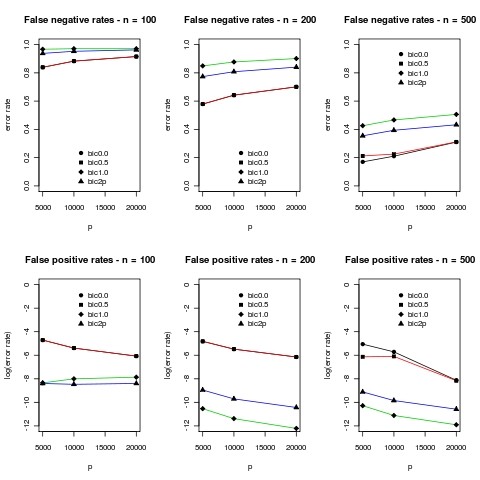
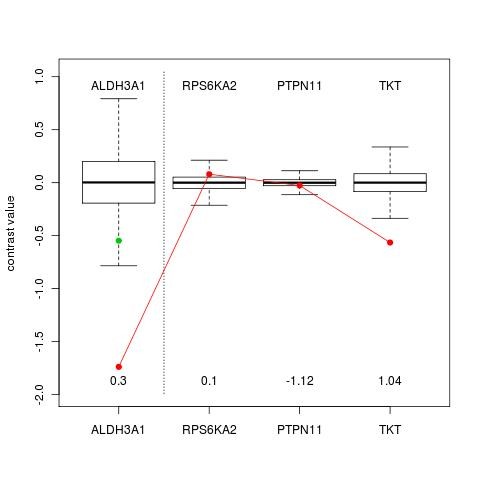
We use sparse inverse covariance matrices and their associated graphical representation to capture the notion of gene networks. An important issue in using these models is the identification of the pattern of zeroes in the inverse covariance matrix. The limitations of existing methods for doing this are discussed and we provide a workable solution for determining the zero pattern. We then consider a method for estimating the parameters in the inverse covariance matrix which is suitable for very high dimensional matrices. We also show how to construct multivariate tests of hypotheses. These overall multivariate tests can be broken down into two components, the first one being similar to tests for differential expression and the second involving the connections between genes.
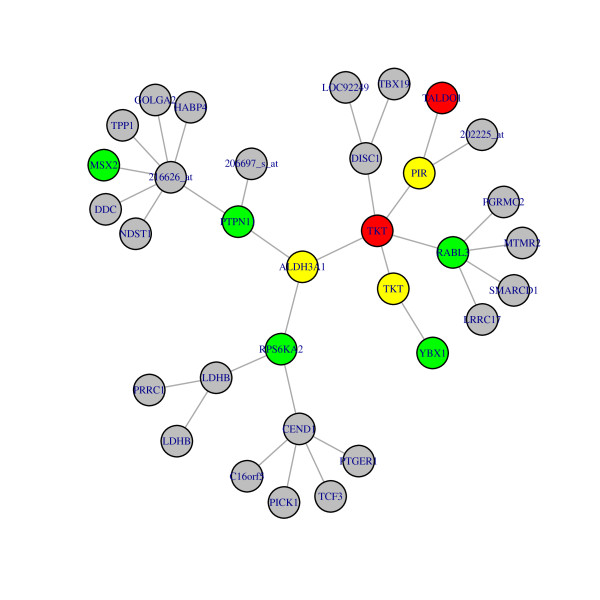
The methods in this paper enable the extraction of a wealth of information concerning the relationships between genes which can be conveniently represented in graphical form. Differentially expressed genes can be placed in the context of the gene network and places in the gene network where unusual or interesting patterns have emerged can be identified, leading to the formulation of hypotheses for future experimentation.
典型的微阵列数据分析忽略了基因表达值之间的相关性。在本文中,我们提出了一个特别允许基因之间相关的微阵列数据模型。因此,我们将基因网络的思想与线性模型和差异表达相结合。
我们使用稀疏逆协方差矩阵及其相关的图形表示来捕捉基因网络的概念。在使用这些模型时,一个重要的问题是确定逆协方差矩阵中零的模式。讨论了现有方法在这方面的局限性,并提供了一种确定零模式的可行解决方案。然后,我们考虑了一种适合于非常高维矩阵的逆协方差矩阵参数估计方法。我们还展示了如何构建假设的多元检验。这些总体多元检验可以分解为两个组成部分,第一个类似于差异表达的检验,第二个涉及基因之间的连接。
本文中的方法能够提取大量关于基因之间关系的信息,这些信息可以方便地以图形形式表示。差异表达的基因可以放在基因网络的背景下,并且可以识别出基因网络中出现异常或有趣模式的位置,从而形成未来实验的假设。