Center for Clinical Laboratory, Zhujiang Hospital, Southern Medical University, Guangzhou, PR China.
Virol J. 2011 Feb 2;8:47. doi: 10.1186/1743-422X-8-47.
Early and accurate diagnosis of dengue infection is essential for control of disease outbreaks. Recently, the dengue virus non-structural antigen 1 (NS1), a conserved and secreted glycoprotein, has been used as a marker for early diagnosis of dengue with convenience and cost-effectiveness. Serological tests of dengue IgM and IgG antibodies are still the most widely used for diagnosis of dengue. In order to assess combined diagnostic value of these tests, we study the kinetic profiles of circulating NS1, dengue IgM and IgG antibodies over the course of the disease by using an in-house dengue type 1 (DENV1) specific NS1 capture ELISA and the commercial Panbio Dengue IgM and IgG capture ELISAs.
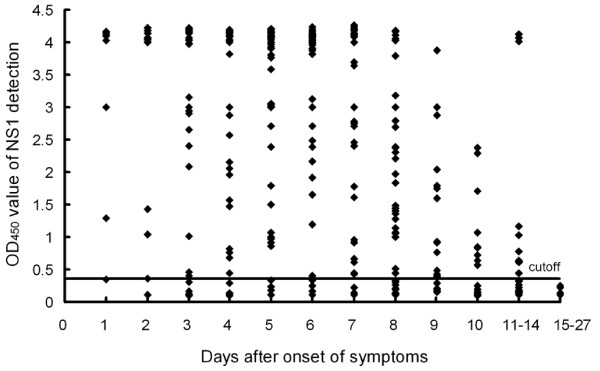
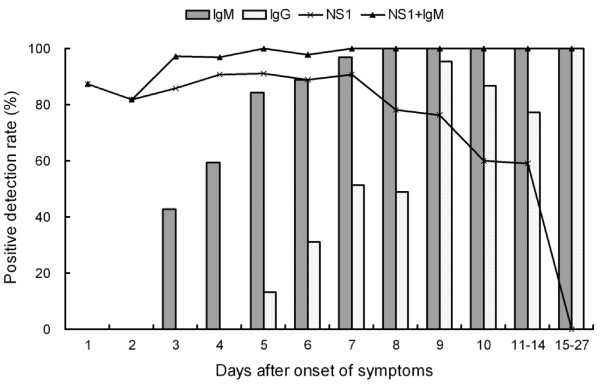
A panel of 313 acute-and early convalescent-phase serum specimens from 140 DENV1 primary infected patients during an outbreak of dengue in Guangzhou, China, in 2006 were studied. Dengue NS1 presented high levels in acute-phase serum samples. It was detectable as early as day 1 of illness, and up to 14 day after onset. The sensitivity of NS1 detection was ranged from 81.8% to 91.1% with samples taken during the first 7 days. Anti-dengue IgM antibody was detectable on the third day of onset with the positive rate of 42.9%, and rapidly increasing to 100% by day 8 of illness. Anti-dengue IgG antibody was detectable on the fifth day of onset with low level at the first week of onset, and slowly increasing to 100% by day 15 of illness. Combining the results of NS1 and IgM antibody detection allowed positive diagnosis in 96.9%-100% for samples taken after day 3 of onset.
Dengue NS1 detection might shorten the window period by first few days of illness. A combination of dengue NS1 antigen and IgM antibody testing facilitates enhanced diagnosis rates. The procedures should be suitable for developing countries where dengue is endemic.
早期、准确的登革热感染诊断对疾病爆发的控制至关重要。最近,登革热病毒非结构蛋白 1(NS1)作为一种保守的分泌型糖蛋白,因其方便、经济而被用于登革热的早期诊断。检测登革热 IgM 和 IgG 抗体仍然是诊断登革热最广泛使用的方法。为了评估这些检测方法的联合诊断价值,我们使用内部建立的登革热 1 型(DENV1)特异性 NS1 捕获 ELISA 以及商业 Panbio Dengue IgM 和 IgG 捕获 ELISA 检测试剂盒,研究了疾病过程中循环 NS1、登革热 IgM 和 IgG 抗体的动力学特征。
本研究纳入了 2006 年中国广州登革热爆发期间 140 例初次感染 DENV1 的患者在急性期和早期恢复期的 313 份血清样本。登革热 NS1 在急性期血清样本中呈现高表达水平。在发病的第 1 天即可检测到,持续至发病后第 14 天。在发病的前 7 天内采集的样本中,NS1 检测的灵敏度范围为 81.8%至 91.1%。发病第 3 天即可检测到抗登革热 IgM 抗体,阳性率为 42.9%,第 8 天迅速增加至 100%。抗登革热 IgG 抗体在发病第 5 天即可检测到,发病第一周水平较低,第 15 天缓慢增加至 100%。将 NS1 和 IgM 抗体检测结果结合,可在发病后第 3 天起采集的样本中实现 96.9%至 100%的阳性诊断。
登革热 NS1 检测可将疾病的窗口期缩短数天。登革热 NS1 抗原和 IgM 抗体联合检测有助于提高诊断率。该方法适合于登革热流行的发展中国家。