School of Social and Community Medicine, University of Bristol, Bristol, United Kingdom.
PLoS One. 2011 Jan 27;6(1):e14607. doi: 10.1371/journal.pone.0014607.
It is suggested that maternal adiposity has a stronger association with offspring adiposity than does paternal adiposity. Furthermore, a recent small study reported gender assortment in parental-offspring adiposity associations. We aimed to examine these associations in one of the largest studies to date using data from a low-middle income country that has recently undergone a major political and economic transition.
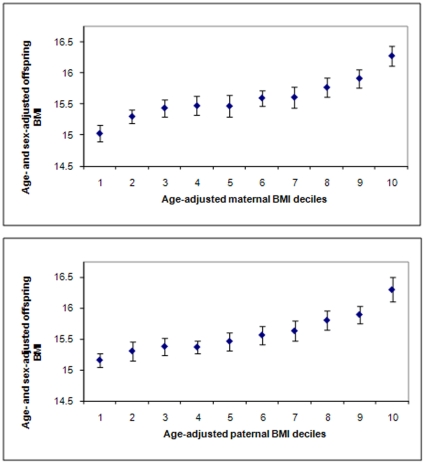
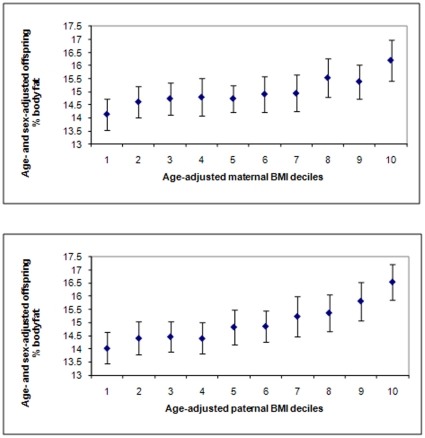
In a cross-sectional study of 12,181 parental-offspring trios from Belarus (mean age (SD) of mothers 31.7 (4.9), fathers 34.1 (5.1) and children 6.6 (0.3) at time of assessment), we found positive graded associations of mother's and father's BMI with offspring adiposity. There was no evidence that these associations differed between mothers and fathers. For example, the odds ratio of offspring overweight or obesity (based on BMI) comparing obese and overweight mothers to normal weight mothers was 2.03 (95%CI 1.77, 2.31) in fully adjusted models; the equivalent result for father's overweight/obesity was 1.81 (1.58, 2.07). Equivalent results for offspring being in the top 10% waist circumference were 1.91 (1.67, 2.18) comparing obese/overweight to normal weight mothers and 1.72 (1.53, 1.95) comparing obese/overweight to normal weight fathers. Similarly, results for offspring being in the top 10% of percent fat mass were 1.58 (1.36, 1.84) and 1.76 (1.49, 2.07), for mother's and father's obese/overweight exposures respectively. There was no strong or consistent evidence of gender assortment--i.e. associations of maternal adiposity exposures with offspring outcomes were similar in magnitude for their daughters compared to equivalent associations in their sons and paternal associations were also similar in sons and daughters.
CONCLUSIONS/SIGNIFICANCE: These findings suggest that genetic and/or shared familial environment explain family clustering of adiposity. Interventions aimed at changing overall family lifestyle are likely to be important for population level obesity prevention.
与父亲肥胖相比,母亲肥胖与后代肥胖的关联性更强。此外,最近一项小型研究报告了父母与子女肥胖关联中的性别选择。我们旨在使用来自一个低中等收入国家的数据,对迄今为止最大的研究之一进行这些关联的检验,该国家最近经历了重大的政治和经济转型。
在白俄罗斯的 12181 对父母-子女三胞胎的横断面研究中(母亲的平均年龄(SD)为 31.7(4.9)岁,父亲为 34.1(5.1)岁,孩子为 6.6(0.3)岁),我们发现母亲和父亲的 BMI 与后代肥胖呈正相关梯度关联。没有证据表明这些关联在母亲和父亲之间存在差异。例如,在完全调整的模型中,与正常体重母亲相比,肥胖和超重母亲的子女超重或肥胖(基于 BMI)的比值比为 2.03(95%CI 1.77,2.31);父亲超重/肥胖的相应结果为 1.81(1.58,2.07)。对于子女腰围处于前 10%的情况,与正常体重母亲相比,肥胖/超重母亲的比值比为 1.91(1.67,2.18),与正常体重父亲相比,肥胖/超重母亲的比值比为 1.72(1.53,1.95)。同样,对于子女脂肪量处于前 10%的情况,母亲肥胖/超重暴露的结果为 1.58(1.36,1.84),父亲肥胖/超重暴露的结果为 1.76(1.49,2.07)。没有强有力或一致的证据表明性别选择——即母亲肥胖暴露与后代结果之间的关联,对于女儿而言与儿子的同等关联相似,而父亲的关联在儿子和女儿中也相似。
结论/意义:这些发现表明,遗传和/或共享家庭环境解释了肥胖的家族聚集性。旨在改变整体家庭生活方式的干预措施可能对人群肥胖预防很重要。