Devakumar Delan, Grijalva-Eternod Carlos, Cortina-Borja Mario, Williams Jane, Fewtrell Mary, Wells Jonathan
UCL Institute for Global Health, London, WC1N 1EH, United Kingdom.
Clinical Epidemiology, Nutrition and Biostatistics Section, UCL Institute of Child Health, London, WC1N 1EH, United Kingdom.
Am J Hum Biol. 2016 Jul;28(4):524-33. doi: 10.1002/ajhb.22825. Epub 2016 Feb 5.
This study sets out to investigate the intergenerational associations between the body mass index (BMI) of parents and the body composition of their offspring.
The cross-sectional data were analyzed for 511 parent-offspring trios from London and south-east England. The offspring were aged 5-21 years. Parental BMI was obtained by recall and offspring fat mass and lean mass were obtained using the four-component model. Multivariable regression analysis, with multiple imputation for missing paternal values was used. Sensitivity analyses for levels of non-paternity were conducted.
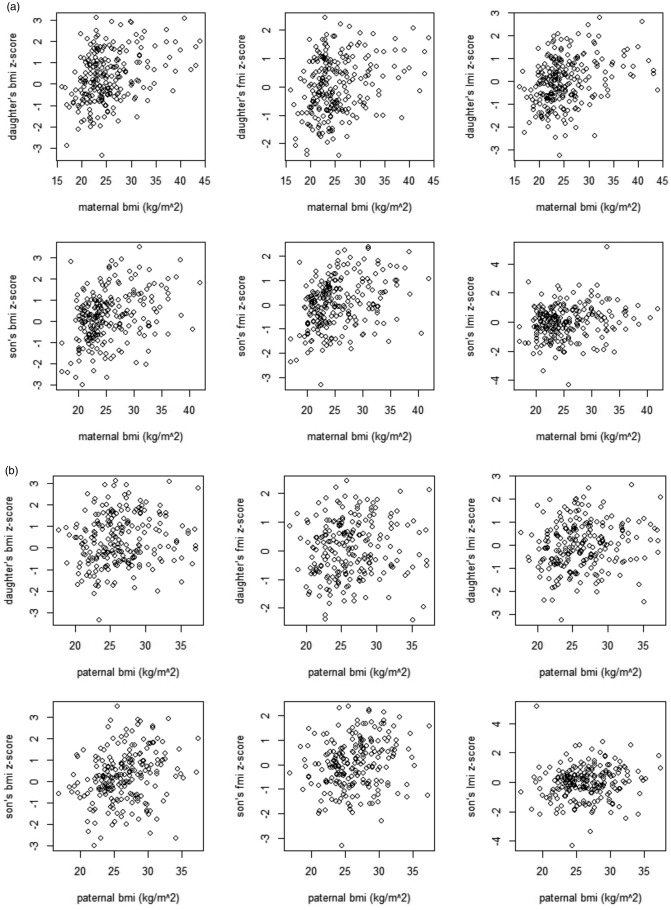
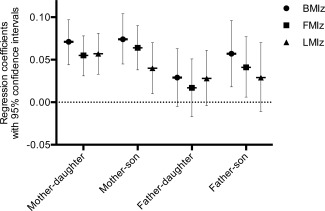
A positive association was seen between parental BMI and offspring BMI, fat mass index (FMI), and lean mass index (LMI). The mother's BMI was positively associated with the BMI, FMI, and LMI z-scores of both daughters and sons and of a similar magnitude for both sexes. The father's BMI showed similar associations to the mother's BMI, with his son's BMI, FMI, and LMI z-scores, but no association with his daughter. Sensitivity tests for non-paternity showed that maternal coefficients remained greater than paternal coefficients throughout but there was no statistical difference at greater levels of non-paternity.
We found variable associations between parental BMI and offspring body composition. Associations were generally stronger for maternal than paternal BMI, and paternal associations appeared to differ between sons and daughters. In this cohort, the mother's BMI was statistically significantly associated with her child's body composition but the father's BMI was only associated with the body composition of his sons. Am. J. Hum. Biol. 28:524-533, 2016. © 2016 The Authors American Journal of Human Biology Published by Wiley Periodicals, Inc.
本研究旨在调查父母的体重指数(BMI)与后代身体成分之间的代际关联。
对来自伦敦和英格兰东南部的511个亲子三人组的横断面数据进行分析。后代年龄在5至21岁之间。通过回忆获取父母的BMI,使用四成分模型获取后代的脂肪量和瘦体重。采用多变量回归分析,并对缺失的父亲数据进行多重填补。对非亲生率水平进行敏感性分析。
父母BMI与后代BMI、脂肪量指数(FMI)和瘦体重指数(LMI)之间存在正相关。母亲的BMI与女儿和儿子的BMI、FMI和LMI z评分均呈正相关,且两性的相关程度相似。父亲的BMI与母亲的BMI表现出相似的相关性,与儿子的BMI、FMI和LMI z评分相关,但与女儿无关。非亲生率的敏感性测试表明,整个过程中母亲的系数始终大于父亲的系数,但在较高非亲生率水平下无统计学差异。
我们发现父母BMI与后代身体成分之间存在不同的关联。母亲BMI的关联通常比父亲BMI更强,而且父亲的关联在儿子和女儿之间似乎有所不同。在这个队列中,母亲的BMI与孩子的身体成分在统计学上有显著关联,但父亲的BMI仅与儿子的身体成分相关。《美国人类生物学杂志》2016年第28卷:524 - 533页。© 2016作者 美国人类生物学杂志 由威利期刊公司出版