Zhou Zhifeng, Zhu Guanshan, Hariri Ahmad R, Enoch Mary-Anne, Scott David, Sinha Rajita, Virkkunen Matti, Mash Deborah C, Lipsky Robert H, Hu Xian-Zhang, Hodgkinson Colin A, Xu Ke, Buzas Beata, Yuan Qiaoping, Shen Pei-Hong, Ferrell Robert E, Manuck Stephen B, Brown Sarah M, Hauger Richard L, Stohler Christian S, Zubieta Jon-Kar, Goldman David
Laboratory of Neurogenetics, NIAAA, NIH, Bethesda, Maryland 20892, USA.
Nature. 2008 Apr 24;452(7190):997-1001. doi: 10.1038/nature06858. Epub 2008 Apr 2.
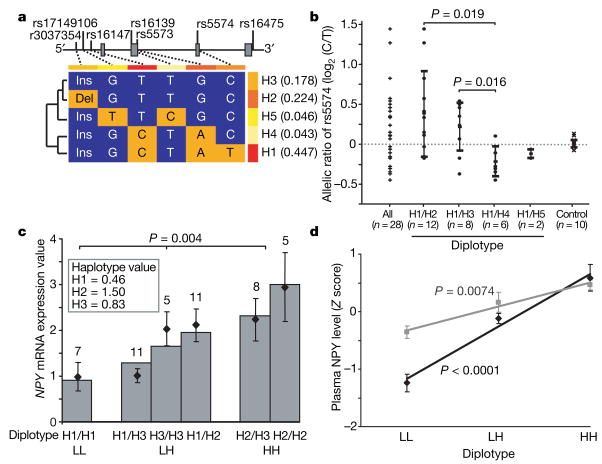
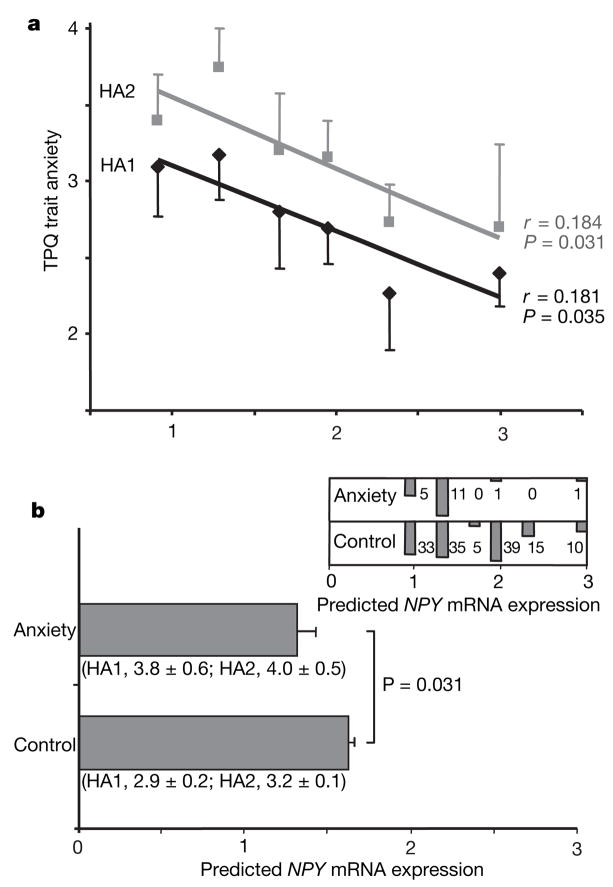
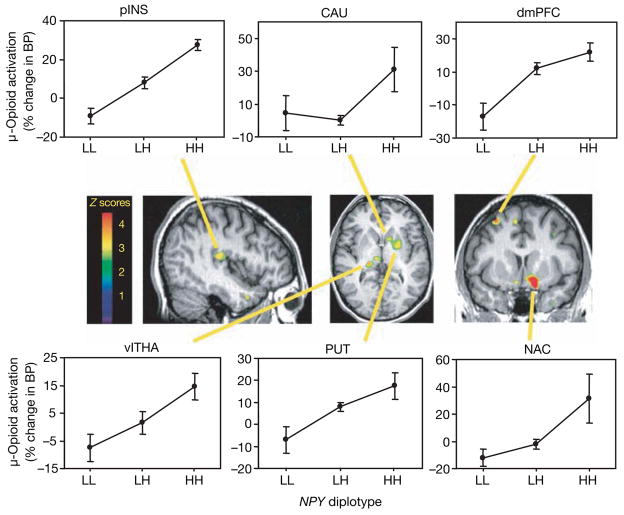
Understanding inter-individual differences in stress response requires the explanation of genetic influences at multiple phenotypic levels, including complex behaviours and the metabolic responses of brain regions to emotional stimuli. Neuropeptide Y (NPY) is anxiolytic and its release is induced by stress. NPY is abundantly expressed in regions of the limbic system that are implicated in arousal and in the assignment of emotional valences to stimuli and memories. Here we show that haplotype-driven NPY expression predicts brain responses to emotional and stress challenges and also inversely correlates with trait anxiety. NPY haplotypes predicted levels of NPY messenger RNA in post-mortem brain and lymphoblasts, and levels of plasma NPY. Lower haplotype-driven NPY expression predicted higher emotion-induced activation of the amygdala, as well as diminished resiliency as assessed by pain/stress-induced activations of endogenous opioid neurotransmission in various brain regions. A single nucleotide polymorphism (SNP rs16147) located in the promoter region alters NPY expression in vitro and seems to account for more than half of the variation in expression in vivo. These convergent findings are consistent with the function of NPY as an anxiolytic peptide and help to explain inter-individual variation in resiliency to stress, a risk factor for many diseases.
了解个体间应激反应的差异需要在多个表型水平上解释基因影响,包括复杂行为以及脑区对情绪刺激的代谢反应。神经肽Y(NPY)具有抗焦虑作用,其释放由应激诱导。NPY在边缘系统中大量表达,这些区域与唤醒以及对刺激和记忆赋予情绪效价有关。我们在此表明,单倍型驱动的NPY表达可预测大脑对情绪和应激挑战的反应,并且与特质焦虑呈负相关。NPY单倍型可预测死后大脑和淋巴母细胞中NPY信使RNA的水平以及血浆NPY的水平。较低的单倍型驱动的NPY表达预测杏仁核在情绪诱导下的激活程度更高,并且通过疼痛/应激诱导的各种脑区内源性阿片类神经传递激活评估,其恢复力也更低。位于启动子区域的一个单核苷酸多态性(SNP rs16147)在体外会改变NPY的表达,并且似乎占体内表达变化的一半以上。这些一致的发现与NPY作为抗焦虑肽的功能相符,并有助于解释个体间对应激恢复力的差异,而应激恢复力是许多疾病的一个风险因素。