Division of Mental Health and Addiction Medicine, Institutes of Population Health Sciences, National Health Research Institutes, Miaoli County, Taiwan.
BMC Public Health. 2011 Feb 8;11:87. doi: 10.1186/1471-2458-11-87.
Positive alcohol outcome expectancy has consistently been linked with problematic drinking, but there is little population-based evidence on its role on early stages of drinking in childhood. The present study seeks to understand the extent to which drinking of family members is differentially associated with the endorsement of alcohol expectancy in late childhood.
A representative sample of 4th and 6th graders (N = 2455) drawn from 28 public schools in an urban region of Taiwan completed a self-administered paper-and-pencil questionnaire. Each student provided information on alcohol expectancy, drinking experiences, and individual and family attributes. Complex survey analyses were performed to evaluate the relationship, with stratification by children's alcohol drinking history.
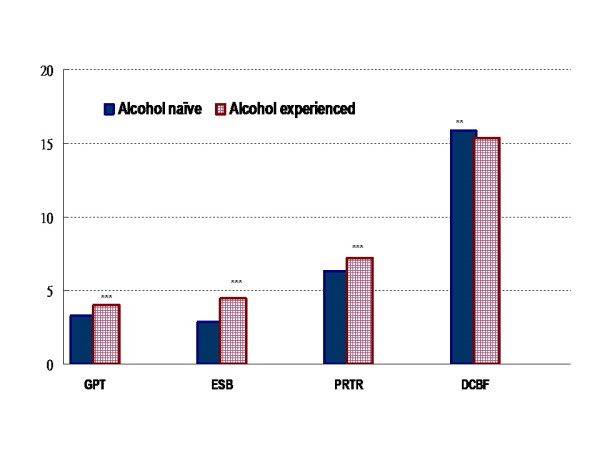
An estimated 29% of the 4th graders and 43% of the 6th graders had initiated alcohol consumption (over 40% of them had drank on three or more occasions). Alcohol drinking-related differences appear in both the endorsement and the correlates of alcohol expectancy. Positive alcohol expectancy was strongly associated with family drinking, particularly the dimension of "enhanced social behaviors"; negative alcohol expectancy was inversely associated with drinking frequency. Among alcohol naïve children, significant connections appear between paternal drinking and three dimensions of positive alcohol expectancy (i.e., enhanced social behaviors:βwt = 0.15, promoting relaxation or tension reduction:βwt = 0.18, and global positive transformation:βwt = 0.22).
Individual tailored strategies that address family influences on alcohol expectancy may be needed in prevention programs targeting drinking behaviors in children.
积极的酒精预期结果与问题性饮酒一直存在关联,但关于其在儿童饮酒早期阶段的作用,基于人群的证据较少。本研究旨在了解家庭成员的饮酒情况与儿童晚期对酒精期望的认可程度之间存在何种差异。
从台湾一个城市地区的 28 所公立学校中抽取的 4 年级和 6 年级的代表性样本(N=2455)完成了一份自我管理的纸质问卷。每个学生都提供了有关酒精期望、饮酒经历以及个人和家庭属性的信息。采用复杂的调查分析来评估这种关系,并按儿童的饮酒史进行分层。
估计有 29%的 4 年级学生和 43%的 6 年级学生已经开始饮酒(其中超过 40%的人已经喝了三次或更多次)。在酒精相关的差异出现在酒精期望的认可和相关方面。积极的酒精期望与家庭饮酒密切相关,特别是“增强社交行为”维度;消极的酒精期望与饮酒频率呈负相关。在酒精无知的儿童中,父亲饮酒与积极酒精期望的三个维度之间存在显著关联(即,增强社交行为:βwt=0.15,促进放松或减轻紧张:βwt=0.18,以及整体积极转变:βwt=0.22)。
针对儿童饮酒行为的预防计划可能需要针对家庭对酒精期望的影响采取个性化的策略。