Department of Biotechnology, All India Institute of Medical Sciences, New Delhi, Indian.
PLoS One. 2011 Jan 27;6(1):e16500. doi: 10.1371/journal.pone.0016500.
DevR (also called as DosR) is a two-domain response regulator of the NarL subfamily that controls dormancy adaptation of Mycobacterium tuberculosis (M. tb). In response to inducing signals such as hypoxia and ascorbic acid, the N-terminal receiver domain of DevR (DevR(N)) is phosphorylated at Asp54. This results in DevR binding to DNA via its C-terminal domain (DevR(C)) and subsequent induction of the DevR regulon. The mechanism of phosphorylation-mediated activation is not known. The present study was designed to understand the role of the N- and C-terminal domains of DevR in DevR regulon genes activation.
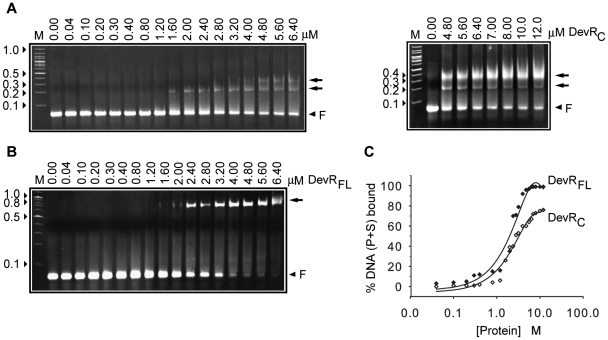
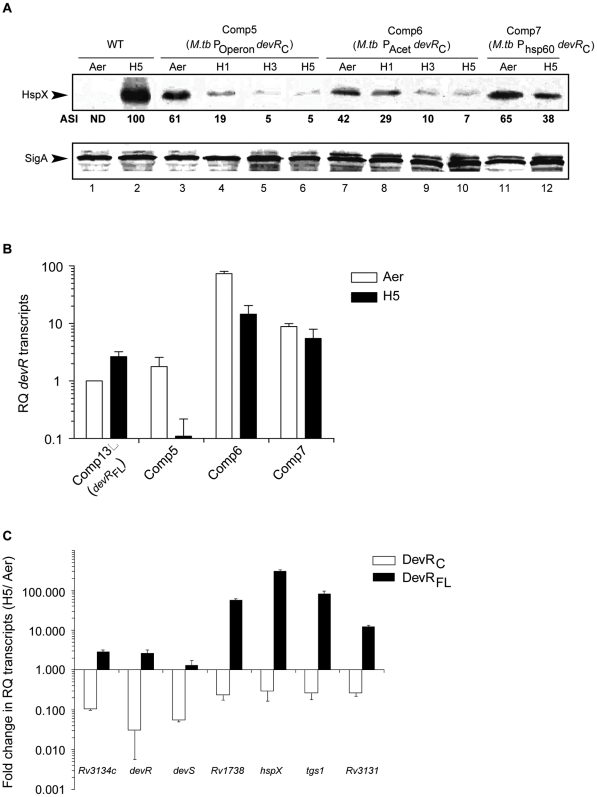
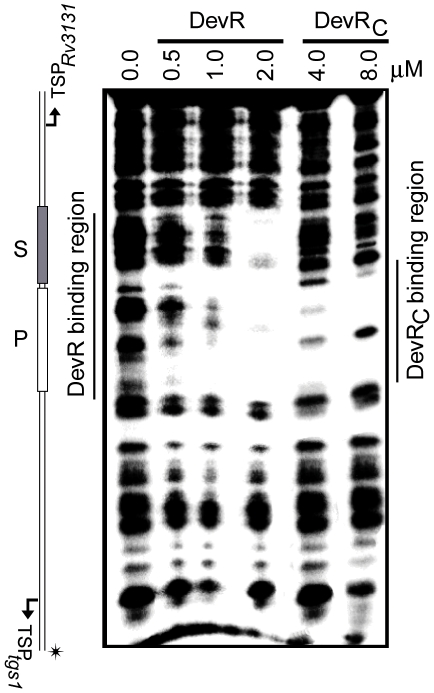
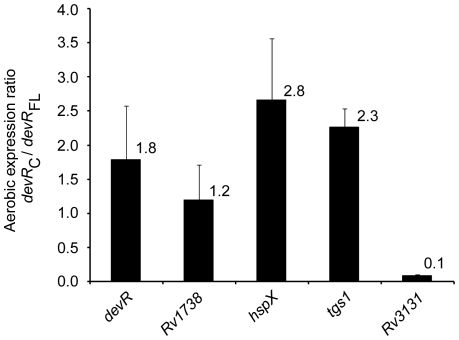
METHODOLOGY/PRINCIPAL FINDINGS: Towards deciphering the activation mechanism of DevR, we compared the DNA binding properties of DevR(C) and DevR and correlated the findings with their ability to activate gene expression. We show that isolated DevR(C) can interact with DNA, but only with the high affinity site of a representative target promoter. Therefore, one role of DevR(N) is to mask the intrinsic DNA binding function of DevR(C). However, unlike phosphorylated DevR, isolated DevR(C) does not interact with the adjacent low affinity binding site suggesting that a second role of DevR(N) is in cooperative binding to the secondary site. Transcriptional analysis shows that consistent with unmasking of its DNA binding property, DevR(C) supports the aerobic induction, albeit feebly, of DevR regulon genes but is unable to sustain gene activation during hypoxia.
CONCLUSIONS/SIGNIFICANCE: DevR is a unique response regulator that employs a dual activation mechanism including relief of inhibition and cooperative interaction with binding sites. Importantly, both these functions reside outside the C-terminal domain. DevR(N) is also essential for stabilizing DevR and sustaining autoregulation under hypoxia. Hence, both domains of DevR are required for robust transcription activation.
DevR(也称为 DosR)是 NarL 亚家族的双结构域响应调节剂,控制结核分枝杆菌(M. tb)的休眠适应。在缺氧和抗坏血酸等诱导信号的作用下,DevR 的 N 端受体结构域(DevR(N))在天冬氨酸 54 位发生磷酸化。这导致 DevR 通过其 C 端结构域(DevR(C))与 DNA 结合,随后诱导 DevR 调节子。磷酸化介导的激活机制尚不清楚。本研究旨在了解 DevR 的 N 和 C 端结构域在 DevR 调节子基因激活中的作用。
方法/主要发现:为了解析 DevR 的激活机制,我们比较了 DevR(C)和 DevR 的 DNA 结合特性,并将这些发现与它们激活基因表达的能力相关联。我们表明,分离的 DevR(C)可以与 DNA 相互作用,但仅与代表性靶启动子的高亲和力位点相互作用。因此,DevR(N)的一个作用是掩盖 DevR(C)的固有 DNA 结合功能。然而,与磷酸化的 DevR 不同,分离的 DevR(C)不与相邻的低亲和力结合位点相互作用,这表明 DevR(N)的第二个作用是与二级位点协同结合。转录分析表明,与解除其 DNA 结合特性一致,DevR(C)支持 DevR 调节子基因的需氧诱导,尽管微弱,但不能在缺氧期间维持基因激活。
结论/意义:DevR 是一种独特的响应调节剂,采用包括解除抑制和与结合位点协同相互作用的双重激活机制。重要的是,这两个功能都位于 C 端结构域之外。DevR(N)对于在缺氧下稳定 DevR 和维持自调节也是必不可少的。因此,DevR 的两个结构域都需要进行稳健的转录激活。