Division of Epidemiology, Vanderbilt University, Nashville, Tennessee, USA.
Diabetes Care. 2011 Apr;34(4):1000-5. doi: 10.2337/dc10-1791. Epub 2011 Feb 9.
To determine whether skin intrinsic fluorescence (SIF) was associated with autonomic neuropathy and confirmed distal symmetrical polyneuropathy (CDSP) in 111 individuals with type 1 diabetes (mean age 49 years, mean diabetes duration 40 years).
SIF was measured using the SCOUT DM device. Autonomic neuropathy was defined as an electrocardiographic abnormal heart rate response to deep breathing (expiration-to-inspiration ratio <1.1). CDSP was defined using the Diabetes Control and Complications Trial clinical exam protocol (the presence of two or more of the following: symptoms, sensory and/or motor signs, and/or reduced/absent tendon reflexes consistent with DSP) confirmed by the presence of an abnormal age-specific vibratory threshold (using a Vibratron II tester).
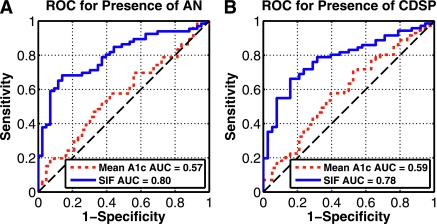
The prevalence of autonomic neuropathy and CDSP were 61 and 66%, respectively. SIF was higher in those with autonomic neuropathy (P < 0.0001). In multivariable analyses controlling for age and updated mean (18-year average) HbA(1c), and allowing for other univariately and clinically significant correlates of autonomic neuropathy, each SD change in SIF was associated with a 2.6-greater likelihood of autonomic neuropathy (P = 0.006). Receiver operating characteristic (ROC) analyses revealed that SIF and updated mean HbA(1c) accounted for 80 and 57%, respectively, of the area under the curve (AUC) for autonomic neuropathy. SIF also was higher in those with CDSP (P < 0.0001) and remained so in multivariable analyses (odds ratio 2.70; P = 0.005). ROC analyses revealed that SIF and updated mean HbA(1c) accounted for 78 and 59%, respectively, of the AUC for CDSP.
SIF, a marker of dermal advanced glycation end products, appears to be more strongly associated with the presence of both CDSP and autonomic neuropathy than mean HbA(1c).
在 111 名 1 型糖尿病患者(平均年龄 49 岁,平均糖尿病病程 40 年)中,确定皮肤固有荧光(SIF)是否与自主神经病变相关,并证实其存在远端对称性多发性神经病(CDSP)。
使用 SCOUT DM 设备测量 SIF。自主神经病变定义为心电图异常心率对深呼吸的反应(呼气与吸气比值<1.1)。CDSP 采用糖尿病控制与并发症试验临床检查方案(存在两种或两种以上以下症状、感觉和/或运动体征、以及/或降低/缺失与 DSP 一致的跟腱反射)定义,并通过存在异常年龄特异性振动阈值(使用 Vibratron II 测试仪)确认。
自主神经病变和 CDSP 的患病率分别为 61%和 66%。自主神经病变患者的 SIF 更高(P<0.0001)。在多变量分析中,控制年龄和最新平均(18 年平均)HbA1c,并允许其他与自主神经病变有显著关联的单变量因素,SIF 的每个标准差变化与自主神经病变的可能性增加 2.6 倍相关(P=0.006)。接受者操作特征(ROC)分析显示,SIF 和最新平均 HbA1c 分别占自主神经病变曲线下面积(AUC)的 80%和 57%。SIF 在 CDSP 患者中也更高(P<0.0001),且在多变量分析中仍如此(优势比 2.70;P=0.005)。ROC 分析显示,SIF 和最新平均 HbA1c 分别占 CDSP AUC 的 78%和 59%。
SIF,一种皮肤晚期糖基化终产物的标志物,似乎与 CDSP 和自主神经病变的存在比平均 HbA1c 更密切相关。