London School of Hygiene and Tropical Medicine, London, UK.
United Kingdom Public Health Rapid Support Team, London, UK.
BMC Public Health. 2021 Sep 25;21(1):1741. doi: 10.1186/s12889-021-11790-w.
Use of electronic data collection, management and analysis tools to support outbreak response is limited, especially in low income countries. This can hamper timely decision-making during outbreak response. Identifying available tools and assessing their functions in the context of outbreak response would support appropriate selection and use, and likely more timely data-driven decision-making during outbreaks.
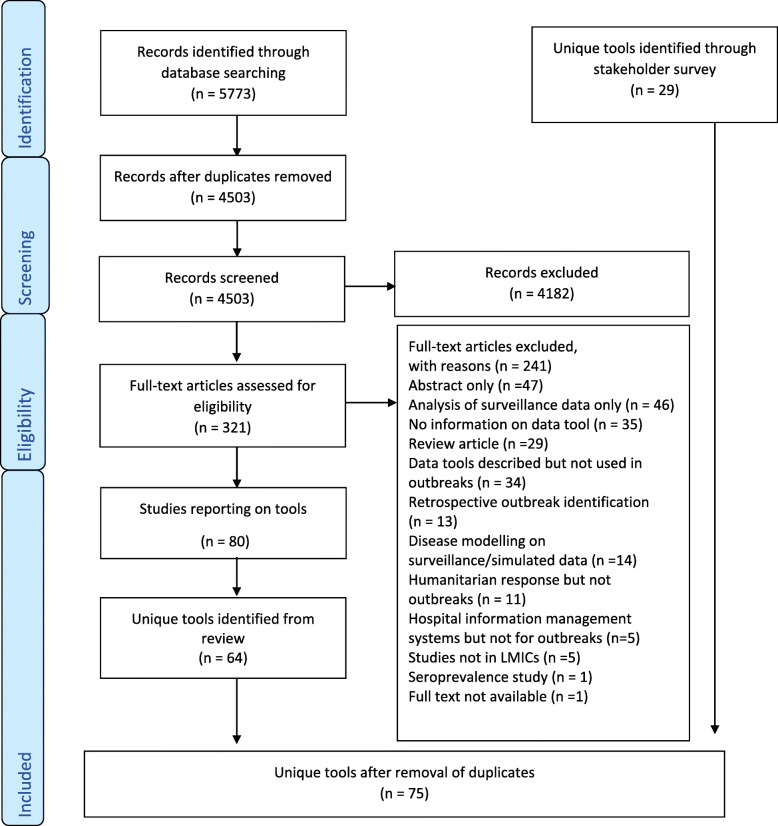
We conducted a systematic review and a stakeholder survey of the Global Outbreak Alert and Response Network and other partners to identify and describe the use of, and technical characteristics of, electronic data tools used for outbreak response in low- and middle-income countries. Databases included were MEDLINE, EMBASE, Global Health, Web of Science and CINAHL with publications related to tools for outbreak response included from January 2010-May 2020. Software tool websites of identified tools were also reviewed. Inclusion and exclusion criteria were applied and counts, and proportions of data obtained from the review or stakeholder survey were calculated.
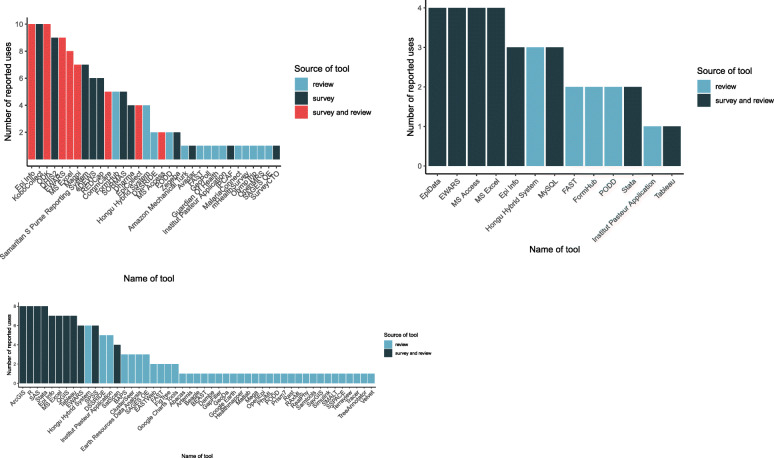
We identified 75 electronic tools including for data collection (33/75), management (13/75) and analysis (49/75) based on data from the review and survey. Twenty-eight tools integrated all three functionalities upon collection of additional information from the tool developer websites. The majority were open source, capable of offline data collection and data visualisation. EpiInfo, KoBoCollect and Open Data Kit had the broadest use, including for health promotion, infection prevention and control, and surveillance data capture. Survey participants highlighted harmonisation of data tools as a key challenge in outbreaks and the need for preparedness through training front-line responders on data tools. In partnership with the Global Health Network, we created an online interactive decision-making tool using data derived from the survey and review.
Many electronic tools are available for data -collection, -management and -analysis in outbreak response, but appropriate tool selection depends on knowledge of tools' functionalities and capabilities. The online decision-making tool created to assist selection of the most appropriate tool(s) for outbreak response helps by matching requirements with functionality. Applying the tool together with harmonisation of data formats, and training of front-line responders outside of epidemic periods can support more timely data-driven decision making in outbreaks.
电子数据收集、管理和分析工具在支持疫情应对方面的应用有限,尤其是在低收入国家。这可能会阻碍疫情应对期间的及时决策。确定现有工具并评估其在疫情应对背景下的功能,将有助于适当选择和使用工具,并可能在疫情期间更及时地做出数据驱动的决策。
我们对全球疫情警报和反应网络以及其他合作伙伴进行了系统评价和利益攸关方调查,以确定和描述在中低收入国家用于疫情应对的电子数据工具的使用情况和技术特点。纳入的数据库包括 MEDLINE、EMBASE、全球卫生、Web of Science 和 CINAHL,从 2010 年 1 月至 2020 年 5 月,纳入了与疫情应对工具相关的出版物。还审查了确定工具的软件工具网站。应用了纳入和排除标准,并计算了从审查或利益攸关方调查中获得的数据的计数和比例。
我们根据审查和调查的数据确定了 75 种电子工具,包括数据收集(33/75)、管理(13/75)和分析(49/75)。在从工具开发人员网站收集其他信息后,有 28 种工具集成了所有三种功能。大多数是开源的,能够离线收集数据和数据可视化。EpiInfo、KoboCollect 和 Open Data Kit 的使用最广泛,包括用于健康促进、感染预防和控制以及监测数据采集。调查参与者强调了数据工具的协调一致是疫情应对中的一个关键挑战,需要通过培训一线应对人员使用数据工具来做好准备。我们与全球卫生网络合作,使用调查和审查中获得的数据创建了一个在线交互式决策工具。
有许多电子工具可用于疫情应对中的数据收集、管理和分析,但适当的工具选择取决于对工具功能和能力的了解。为协助选择最适合疫情应对的工具而创建的在线决策工具通过将需求与功能相匹配来提供帮助。在疫情期间,应用该工具并协调数据格式以及对一线应对人员进行培训,可以支持更及时地做出数据驱动的决策。