Center for Biomedical Research, Population Council, 1230 York Avenue, New York, NY 10065, USA.
Trends Pharmacol Sci. 2011 May;32(5):290-9. doi: 10.1016/j.tips.2011.01.001. Epub 2011 Feb 15.
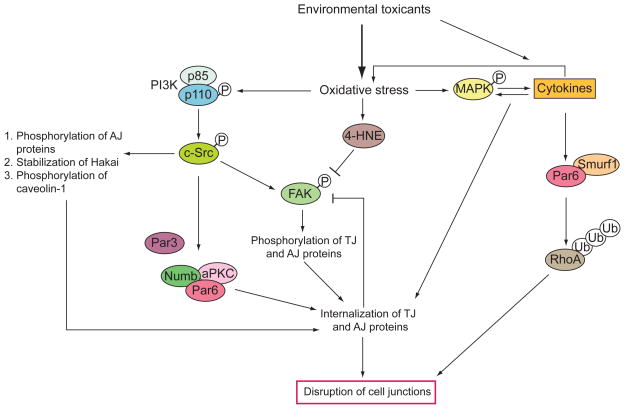
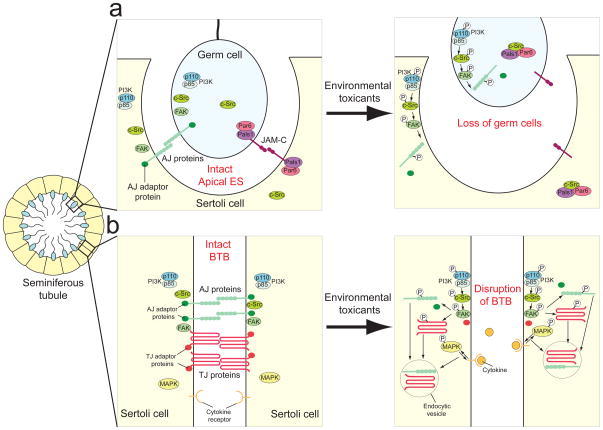
Male infertility caused by exposure to environmental toxicants such as cadmium, mercury, bisphenol A (BPA) and dioxin is a global problem, particularly in industrialized countries. Studies in the testis and other organs have illustrated the importance of environmental toxicant-induced oxidative stress in mediating disruption to cell junctions. This, in turn, is regulated by the activation of PI3K/c-Src/FAK and MAPK signaling pathways, with the involvement of polarity proteins. This leads to reproductive dysfunction such as reduced sperm count and reduced quality of semen. In this review, we discuss how these findings can improve understanding of the modes of action of environmental toxicants in testicular dysfunction. Thus, specific inhibitors and/or antagonists against signaling molecules in these pathways may be able to 'reverse' and/or 'block' the disruptive effects of toxicant-induced damage. Additional studies comparing high-level acute exposure versus low-level chronic exposure to environmental toxicants are also needed to fully elucidate the underlying molecular mechanism(s) by which these toxicants disrupt male reproductive function.
环境毒物(如镉、汞、双酚 A(BPA)和二恶英)导致的男性不育是一个全球性问题,特别是在工业化国家。睾丸和其他器官的研究表明,环境毒物诱导的氧化应激在介导细胞连接中断方面具有重要意义。这反过来又受到 PI3K/c-Src/FAK 和 MAPK 信号通路的激活以及极性蛋白的调控。这导致生殖功能障碍,如精子数量减少和精液质量下降。在这篇综述中,我们讨论了这些发现如何有助于提高对环境毒物在睾丸功能障碍中的作用模式的理解。因此,针对这些途径中的信号分子的特定抑制剂和/或拮抗剂可能能够“逆转”和/或“阻断”毒物诱导损伤的破坏作用。还需要进行比较高水平的急性暴露与低水平的慢性暴露于环境毒物的研究,以充分阐明这些毒物破坏男性生殖功能的潜在分子机制。