World Health Organization, Global Malaria Programme, 20 Avenue Appia 1211 Geneva 27, Switzerland.
Malar J. 2011 Feb 18;10:46. doi: 10.1186/1475-2875-10-46.
In Zanzibar, the Ministry of Health and partners accelerated malaria control from September 2003 onwards. The impact of the scale-up of insecticide-treated nets (ITN), indoor-residual spraying (IRS) and artemisinin-combination therapy (ACT) combined on malaria burden was assessed at six out of seven in-patient health facilities.
Numbers of outpatient and inpatient cases and deaths were compared between 2008 and the pre-intervention period 1999-2003. Reductions were estimated by segmented log-linear regression, adjusting the effect size for time trends during the pre-intervention period.
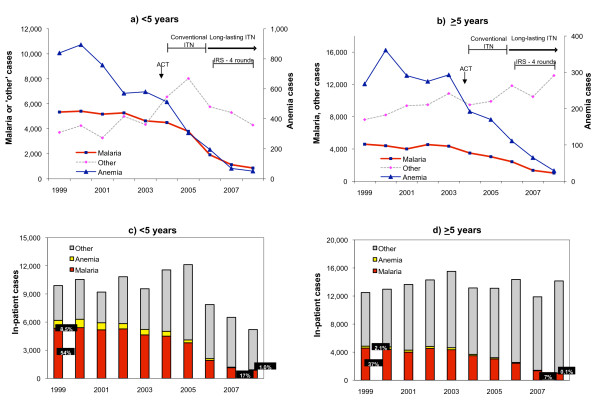
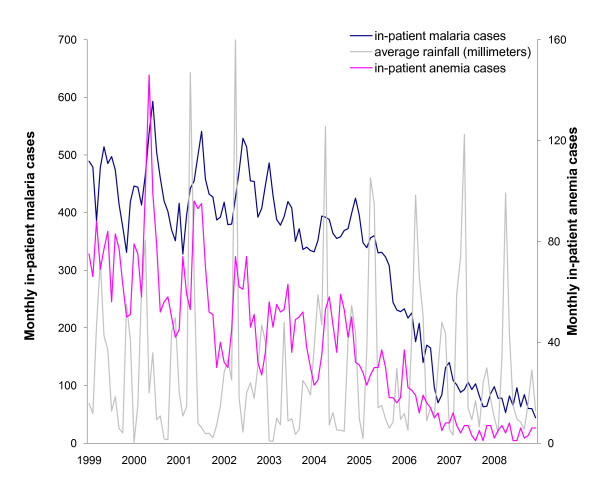
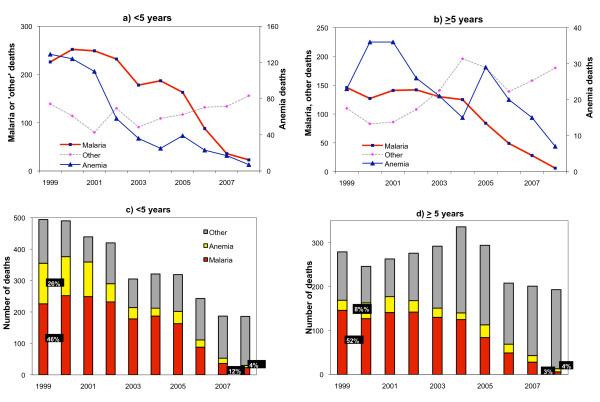
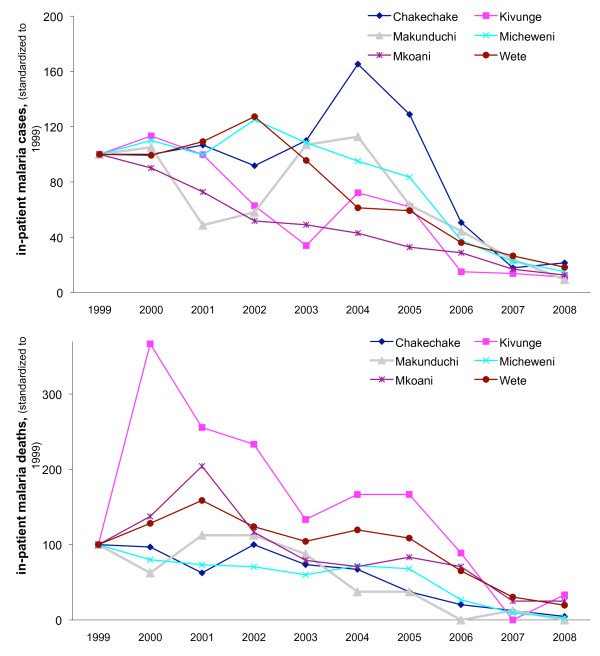
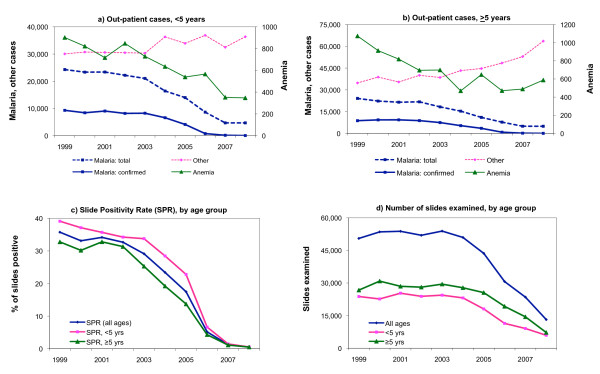
In 2008, for all age groups combined, malaria deaths had fallen by an estimated 90% (95% confidence interval 55-98%)(p < 0.025), malaria in-patient cases by 78% (48-90%), and parasitologically-confirmed malaria out-patient cases by 99.5% (92-99.9%). Anaemia in-patient cases decreased by 87% (57-96%); anaemia deaths and out-patient cases declined without reaching statistical significance due to small numbers. Reductions were similar for children under-five and older ages. Among under-fives, the proportion of all-cause deaths due to malaria fell from 46% in 1999-2003 to 12% in 2008 (p < 0.01) and that for anaemia from 26% to 4% (p < 0.01). Cases and deaths due to other causes fluctuated or increased over 1999-2008, without consistent difference in the trend before and after 2003.
Scaling-up effective malaria interventions reduced malaria-related burden at health facilities by over 75% within 5 years. In high-malaria settings, intensified malaria control can substantially contribute to reaching the Millennium Development Goal 4 target of reducing under-five mortality by two-thirds between 1990 and 2015.
在桑给巴尔,卫生部和合作伙伴自 2003 年 9 月起加速疟疾控制。在七个住院医疗机构中的六个评估了扩大使用经杀虫剂处理的蚊帐(ITN)、室内滞留喷洒(IRS)和青蒿素联合疗法(ACT)对疟疾负担的综合影响。
比较了 2008 年与 1999-2003 年干预前期间的门诊和住院病例数和死亡人数。通过分段对数线性回归估计减少量,调整干预前期间时间趋势的效应大小。
2008 年,所有年龄组的疟疾死亡人数估计下降了 90%(95%置信区间 55-98%)(p<0.025),疟疾住院病例下降了 78%(48-90%),寄生虫学证实的疟疾门诊病例下降了 99.5%(92-99.9%)。贫血住院病例减少了 87%(57-96%);由于病例数较少,贫血死亡和门诊病例减少未达到统计学意义。五岁以下儿童和年龄较大的儿童减少情况相似。五岁以下儿童中,所有原因死亡中疟疾的比例从 1999-2003 年的 46%降至 2008 年的 12%(p<0.01),贫血的比例从 26%降至 4%(p<0.01)。1999-2008 年间,其他原因导致的病例和死亡人数波动或增加,2003 年前后趋势没有一致差异。
扩大有效疟疾干预措施在 5 年内使医疗机构内与疟疾相关的负担减少了 75%以上。在疟疾高发地区,加强疟疾控制可以大大有助于实现到 2015 年将 1990 年至 2015 年期间五岁以下儿童死亡率减少三分之二的千年发展目标 4 目标。