Centre National de la Recherche Scientifique, URMITE, Université de la Méditerranée, Unité Mixte de Recherche 6236, Marseille, France.
Cell Death Dis. 2010 Apr 8;1(4):e34. doi: 10.1038/cddis.2010.11.
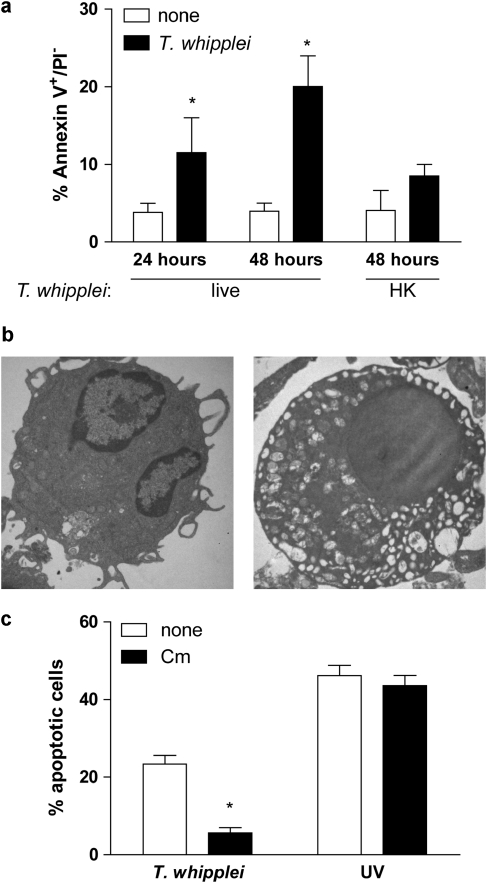
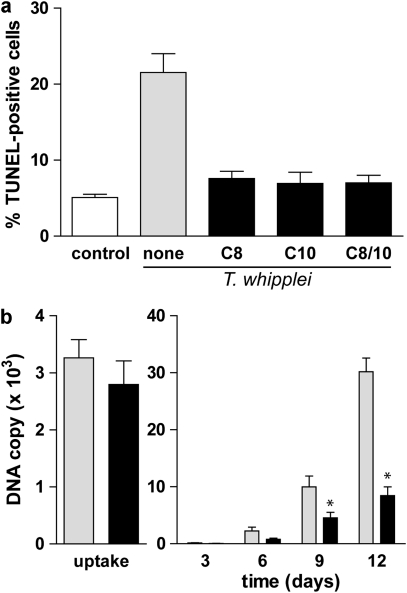
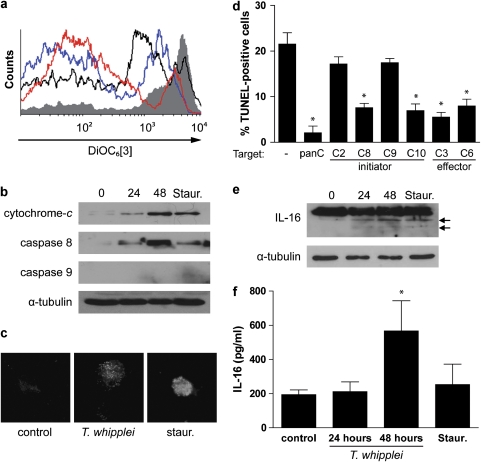
Tropheryma whipplei, the etiological agent of Whipple's disease, is an intracellular bacterium that infects macrophages. We previously showed that infection of macrophages results in M2 polarization associated with induction of apoptosis and interleukin (IL)-16 secretion. In patients with Whipple's disease, circulating levels of apoptotic markers and IL-16 are increased and correlate with the activity of the disease. To gain insight into the understanding of the pathophysiology of this rare disease, we examined the molecular pathways involved in T. whipplei-induced apoptosis of human macrophages. Our data showed that apoptosis induction depended on bacterial viability and inhibition of bacterial protein synthesis reduced the apoptotic program elicited by T. whipplei. Induction of apoptosis was also associated with a massive degradation of both pro- and anti-apoptotic mediators. Caspase-specific inhibition experiments revealed that initiator caspases 8 and 10 were required for apoptosis, in contrast to caspases 2 and 9, in spite of cytochrome-c release from mitochondria. Finally, the effector caspases 3 and 6 were mandatory for apoptosis induction. Collectively, these data suggest that T. whipplei induces apoptosis through the extrinsic pathway and that, beside M2 polarization of macrophages, apoptosis induction contributes to bacterial replication and represents a virulence trait of this intracellular pathogen.
特罗斐姆菌,即导致惠普尔病的病原体,是一种感染巨噬细胞的胞内细菌。我们先前表明,巨噬细胞感染会导致与细胞凋亡和白细胞介素 (IL)-16 分泌相关的 M2 极化。在惠普尔病患者中,循环中凋亡标志物和 IL-16 的水平增加,并与疾病的活动度相关。为了深入了解这种罕见疾病的病理生理学,我们研究了特罗斐姆菌诱导人巨噬细胞凋亡所涉及的分子途径。我们的数据表明,凋亡诱导取决于细菌的生存能力,并且抑制细菌蛋白合成可减少特罗斐姆菌引发的凋亡程序。凋亡的诱导还与前凋亡和抗凋亡介质的大量降解有关。半胱天冬酶特异性抑制实验表明,起始半胱天冬酶 8 和 10 对于凋亡是必需的,而半胱天冬酶 2 和 9 则不需要,尽管线粒体释放细胞色素 c。最后,效应半胱天冬酶 3 和 6 对于凋亡诱导是必需的。总之,这些数据表明,特罗斐姆菌通过外在途径诱导细胞凋亡,除了巨噬细胞的 M2 极化外,凋亡诱导有助于细菌复制,并代表这种胞内病原体的毒力特征。