Cervenka Mackenzie C, Boatman-Reich Dana F, Ward Julianna, Franaszczuk Piotr J, Crone Nathan E
Department of Neurology, Johns Hopkins University School of Medicine Baltimore, MD, USA.
Front Hum Neurosci. 2011 Feb 22;5:13. doi: 10.3389/fnhum.2011.00013. eCollection 2011.
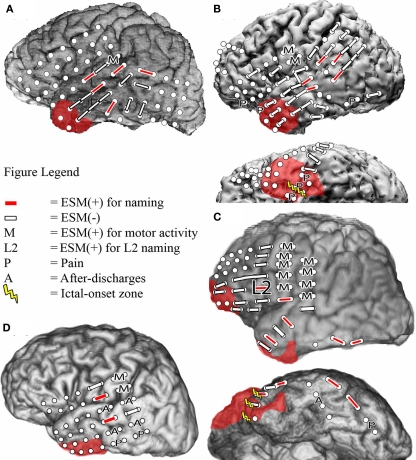
Multilingual patients pose a unique challenge when planning epilepsy surgery near language cortex because the cortical representations of each language may be distinct. These distinctions may not be evident with routine electrocortical stimulation mapping (ESM). Electrocorticography (ECoG) has recently been used to detect task-related spectral perturbations associated with functional brain activation. We hypothesized that using broadband high gamma augmentation (HGA, 60-150 Hz) as an index of cortical activation, ECoG would complement ESM in discriminating the cortical representations of first (L1) and second (L2) languages. We studied four adult patients for whom English was a second language, in whom subdural electrodes (a total of 358) were implanted to guide epilepsy surgery. Patients underwent ECoG recordings and ESM while performing the same visual object naming task in L1 and L2. In three of four patients, ECoG found sites activated during naming in one language but not the other. These language-specific sites were not identified using ESM. In addition, ECoG HGA was observed at more sites during L2 versus L1 naming in two patients, suggesting that L2 processing required additional cortical resources compared to L1 processing in these individuals. Post-operative language deficits were identified in three patients (one in L2 only). These deficits were predicted by ECoG spectral mapping but not by ESM. These results suggest that pre-surgical mapping should include evaluation of all utilized languages to avoid post-operative functional deficits. Finally, this study suggests that ECoG spectral mapping may potentially complement the results of ESM of language.
对于在语言皮层附近计划癫痫手术的多语言患者而言,由于每种语言的皮层表征可能不同,因此带来了独特的挑战。这些差异在常规皮层电刺激图谱(ESM)中可能并不明显。皮层脑电图(ECoG)最近已被用于检测与功能性脑激活相关的任务相关频谱扰动。我们假设,以宽带高伽马增强(HGA,60 - 150Hz)作为皮层激活指标,ECoG将在区分第一语言(L1)和第二语言(L2)的皮层表征方面补充ESM。我们研究了四名成年患者,他们均以英语作为第二语言,为指导癫痫手术而植入了硬膜下电极(总共358个)。患者在使用L1和L2执行相同的视觉物体命名任务时接受了ECoG记录和ESM。在四名患者中的三名中,ECoG发现了在一种语言命名期间激活而在另一种语言命名期间未激活的部位。使用ESM未识别出这些特定语言的部位。此外,在两名患者中,与L1命名相比,L2命名期间在更多部位观察到了ECoG HGA,这表明与这些个体的L1处理相比,L2处理需要额外的皮层资源。三名患者出现了术后语言缺陷(一名仅在L2中出现)。这些缺陷可通过ECoG频谱图谱预测,但不能通过ESM预测。这些结果表明,术前图谱应包括对所有使用语言的评估,以避免术后功能缺陷。最后,本研究表明ECoG频谱图谱可能潜在地补充语言ESM的结果。